GMAT Quant Fundamentals Map: Recognize the Structure Before You Calculate
Last updated August 24, 2026
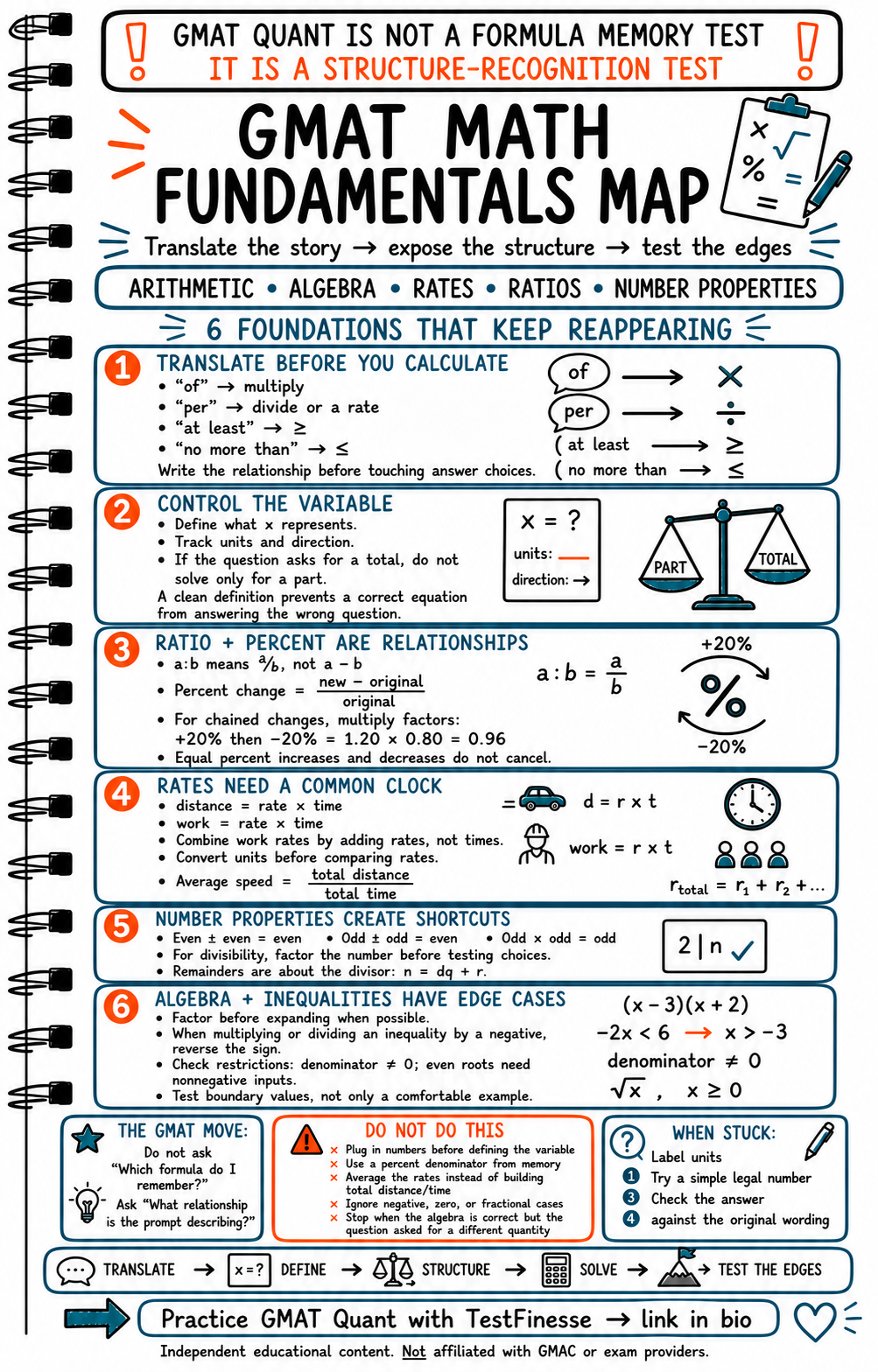
GMAT Quant is not simply a test of how many formulas you can remember.
It is a test of whether you can recognize the mathematical structure hidden inside a story.
A problem may talk about workers, products, discounts, travel, integers, or a changing quantity. The surface details change, but the underlying relationship may remain familiar:
A ratio
A percent change
A rate
A number-property rule
An inequality
A total-and-part relationship
A restriction or edge case
That is why the most useful GMAT Quant question is not:
“Which formula do I remember?”
It is:
“What relationship is this problem describing?”
The core GMAT move is:
Translate → Define → Expose the structure → Solve → Test the edges
1. Translate Before You Calculate
Words often hide the mathematical operation.
Common translations include:
“Of” often indicates multiplication
“Per” often indicates a rate or division relationship
“At least” means greater than or equal to
“No more than” means less than or equal to
“Difference” means subtraction
“Total” means the quantities must be combined
These are useful starting clues, but they are not mechanical substitutions that work in every sentence. Read the full relationship.
For example:
“20% of x” means
0.20x“x dollars per item” describes a unit rate
“At least 12” means
x >= 12“No more than 12” means
x <= 12
Before looking at the answer choices, write the mathematical relationship in your own notation.
Key rule: Translate the sentence before solving the equation.
Many errors happen because students begin manipulating numbers before deciding what the words mean.
2. Define the Variable
A variable is not just an empty box. It represents a specific quantity with a specific unit and direction.
Before writing an equation, define:
What does
xrepresent?What unit does it use?
Is it a part, total, rate, time, distance, or change?
Is it increasing or decreasing?
Does the question ask for
x, or for a quantity built fromx?
This prevents a common GMAT mistake: solving a correct equation for the wrong quantity.
Example
Suppose x represents the number of adult tickets. If child tickets are twice the adult tickets, then the number of child tickets is 2x. The total is not x; it is:
x + 2x = 3xIf the question asks for the total number of tickets, solving only for x is incomplete.
Key rule: Define the variable before using it.
3. Treat Ratios and Percentages as Relationships
A ratio is a comparison:
a:b = a/bIf the ratio of red to blue objects is 2:3, that does not necessarily mean there are exactly 2 red and 3 blue objects. It may mean:
red = 2k
blue = 3k
for some common multiplier k.
Percent change
Percent change is:
(new - original) / original x 100The denominator is the original amount because the change is being measured relative to where you started.
Chained percentage changes
Equal percentage increases and decreases do not cancel.
For example:
1.20 x 0.80 = 0.96A 20% increase followed by a 20% decrease produces 96% of the original value, which is a net decrease of 4%.
The reason is that the second percentage applies to a different base.
Key rule: For sequential changes, multiply the factors instead of adding or subtracting the percentages.
4. Give Rates a Common Clock
Rates describe how much happens per unit of time.
Core relationships include:
distance = rate x time
work = rate x time
average speed = total distance / total time
The phrase total time matters. Average speed is not automatically the average of two speeds. If a trip has multiple segments, calculate total distance divided by total elapsed time.
Combined work rates
When people or machines work independently toward the same task, their rates can often be added:
combined rate = rate 1 + rate 2 + ...Then:
work completed = combined rate x timeDo not add times when the question is asking for simultaneous work. Do not average rates without considering how long each rate applies.
Unit check
Before comparing rates, convert them to a common time unit. Comparing miles per hour with miles per minute without conversion can reverse your conclusion.
Key rule: Put every rate on the same clock before combining or comparing it.
5. Use Number Properties as Shortcuts
Number properties can reduce unnecessary calculation.
Useful patterns include:
Even plus even is even
Odd plus odd is even
Even plus odd is odd
Odd times odd is odd
Any integer multiplied by an even number is even
A remainder must be smaller than the positive divisor
The remainder relationship is:
n = dq + rwhere d is the divisor and r satisfies:
0 <= r < dFor divisibility questions, factoring may be faster than testing every answer choice. For example, prime factorization can reveal whether a number is divisible by a particular product without full long division.
Important limitation
These shortcuts depend on the type of number and operation involved. Negative values, fractions, and zero can change how an intuitive rule behaves.
Key rule: Use number properties to reduce work, then check whether the problem’s conditions fit the shortcut.
6. Respect Algebraic and Inequality Edge Cases
Algebra questions often become difficult at the boundaries.
Factoring
When possible, factoring may expose the structure faster than expanding. A factored expression can reveal roots, signs, or restrictions immediately.
Inequalities
When multiplying or dividing an inequality by a negative number, reverse the inequality sign.
For example:
-2x < 6
x > -3
The sign changes because the inequality is being reflected across zero.
Restrictions
Always check:
A denominator cannot equal zero.
An even root requires a nonnegative input in the real-number setting.
Boundary values may or may not be included.
A factored expression may have excluded values.
A square or absolute-value expression can introduce multiple cases.
Do not test only a comfortable example. Test the boundary and, when necessary, one value on each side.
Key rule: Correct algebra can still produce an invalid answer if you ignore restrictions.
What Not to Do
Avoid these common GMAT Quant habits:
Plugging in numbers before defining the variable
Memorizing “of” and “per” without reading the sentence
Averaging rates instead of calculating total distance over total time
Assuming equal percentage increases and decreases cancel
Ignoring negative, zero, fractional, or boundary cases
Solving for a part when the question asks for a total
Stopping when the algebra is correct but the quantity does not match the question
If you get stuck, use a controlled sequence:
Label the units.
Try a simple legal number if the problem permits substitution.
Check the answer choices.
Compare the result with the original wording.
Test whether restrictions or edge cases change the result.
Use the TestFinesse Practice Loop
Turn each GMAT Quant miss into a structure-recognition lesson:
Answer: Commit to a route before checking the explanation.
Explain: Name the relationship: ratio, rate, percent, number property, or inequality.
Reveal: Find the first step where your setup diverged.
Fix the gap: Write one trigger rule and solve a near-twin problem.
Example:
Miss: Averaged two speeds directly.
Label: Rate setup.
Trigger: Multiple travel segments require total distance divided by total time.
Repair: Solve a new two-segment travel question without using the original numbers.
The goal is not to memorize one solution. It is to recognize the same structure when the story changes.
Final Takeaway
GMAT Quant rewards structure recognition more than formula collecting.
Translate the words. Define the variable. Expose the relationship. Solve efficiently. Test the edges.
When a problem looks unfamiliar, do not ask which formula you hope to remember. Ask:
“What relationship is this prompt describing?”
That question is often the fastest path to the right setup.
Independent educational content. Not affiliated with GMAC or any exam provider. Always verify current exam rules, timing, calculator policies, and content details through the official GMAT source.
Keep studying
Practice Exam Skills
Turn this into a better score
Reading about a skill only gets you so far. TestFinesse's AI coach walks you through exam questions, explains exactly where your reasoning breaks down, and adapts to what you actually need to practice next.
Explore All Exams