What Your GMAT Score Report Actually Tells You: Measure Ability, Not Just Practice Scores
Last updated August 15, 2026
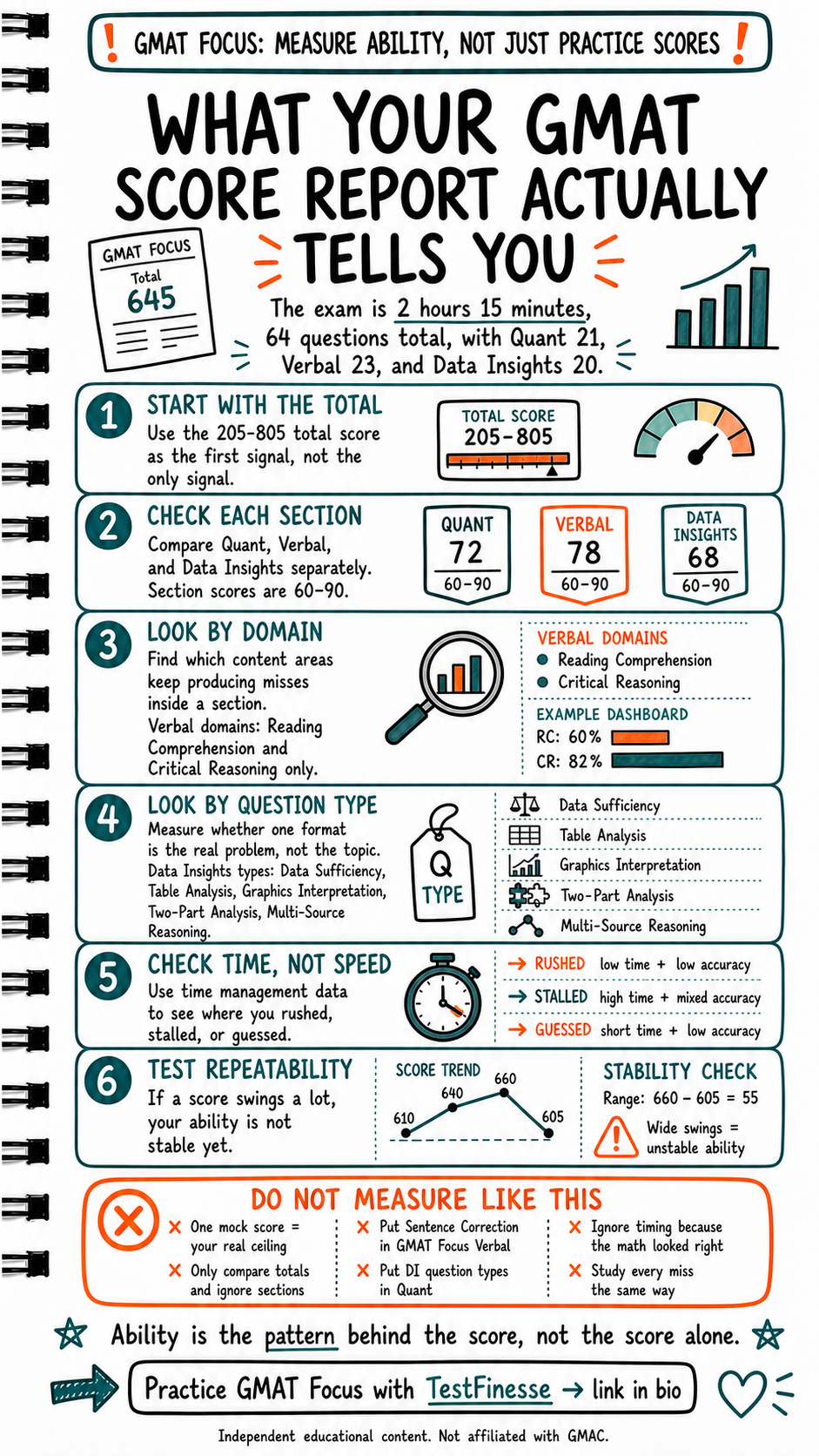
A GMAT score report is more useful than a single practice score.
That is the point most students miss.
They look at one total number, feel good or bad, and stop there. But the GMAT Focus score report is designed to show much more than a headline score. GMAC gives you a total score, section scores, question-type and content-domain insights, and time-management information. That means your report is not just a result. It is a map.
The best use of that map is not to ask, “Did I score high enough?” It is to ask:
What ability pattern is this score showing me?
Why The Score Report Matters
The GMAT Focus Edition is a 2 hour 15 minute exam with 64 questions total:
Quantitative Reasoning: 21 questions
Verbal Reasoning: 23 questions
Data Insights: 20 questions
GMAC also reports that the total score ranges from 205 to 805, and the section scores range from 60 to 90. That matters because the score report is built to show how the three sections contribute to your result, not just whether one practice test went up or down.
The TestFinesse rule here is simple:
Measure ability, not just practice scores.
A single mock score can be noisy. A score report trend is more useful.
1. Start With The Total
Use the total score as the first signal, not the only signal.
The total score tells you the broad direction of your performance. It tells you whether your preparation is generally moving upward, flat, or unstable.
But it does not tell you everything.
A strong total can hide a weak section.
A lower total can hide a section that is improving.
A score that bounces up and down can mean your ability is not stable yet.
That is why the total score should be your first read, not your final conclusion.
Score move: Use the total to ask whether the overall pattern is improving, then move into the sections.
2. Check Each Section
Compare Quant, Verbal, and Data Insights separately.
GMAC states that the GMAT Focus total score is based on all three sections, with each section weighted equally. The score report also shows section scores, which range from 60 to 90.
That means you should not treat one section as “close enough” if it is lagging hard behind the others.
Ask:
Is Quant pulling the total down?
Is Verbal the stable section?
Is Data Insights the main leak?
Are two sections strong and one section weak?
Are all three sections moving together?
This matters because the fix is different depending on the pattern.
If Quant is the leak, you may need setup, route selection, or arithmetic cleanup.
If Verbal is the leak, you may need reading-proof discipline or argument structure work.
If Data Insights is the leak, you may need question-type recognition and data interpretation practice.
Do not study the total. Study the imbalance.
3. Look By Domain
Find which content areas keep producing misses inside a section.
GMAC’s score report includes performance insights by content domain and question type. That makes the report more useful than a simple percentile alone.
For example, inside Verbal, your report may point you toward patterns in:
Reading Comprehension
Critical Reasoning
A domain-level view tells you whether the problem is broad or narrow.
If you keep missing one type of RC passage or one type of CR move, the issue is not “Verbal in general.” It is a smaller skill leak inside Verbal.
Score move: Drill the domain, not the label.
A report that says “Verbal is weaker” is not enough.
A report that says “Critical Reasoning is the recurring leak” gives you something to fix.
4. Look By Question Type
Measure whether one format is the real problem, not the topic.
Data Insights is the clearest place to use this lens because the section includes five question types:
Data Sufficiency
Multi-Source Reasoning
Table Analysis
Graphics Interpretation
Two-Part Analysis
If you are missing one type repeatedly, that is not random. It means your decision pattern for that format is not stable yet.
For example:
Data Sufficiency may be a setup and sufficiency problem.
Graphics Interpretation may be a reading and data-trend problem.
Table Analysis may be a scan-and-select problem.
Two-Part Analysis may be a dependency problem.
Multi-Source Reasoning may be an information-hunting problem.
The point is not to memorize more. The point is to train the exact move that question type requires.
Question-type rule: The format may be the problem, not the content.
5. Check Time, Not Speed
Use time-management data to see where you rushed, stalled, or guessed.
GMAC’s Official Score Report includes time management and performance information for each question, including review time. That is more useful than a vague sense of “I was fast” or “I felt slow.”
Look for patterns like:
Rushed: low time, low accuracy
Stalled: high time, mixed accuracy
Guessed: short time, low accuracy
That tells you whether the issue is pacing, confidence, or route selection.
A lot of students think they have a knowledge problem when they really have a time-allocation problem. Or they think they have a timing problem when the real issue is inefficient setup.
Time rule: The clock shows where the leak started.
6. Test Repeatability
If your score swings a lot, your ability is not stable yet.
One score can be noise. A pattern is stronger evidence.
GMAC’s report gives you enough detail to ask whether the same kinds of mistakes keep showing up. That is the real test.
Ask:
Do I keep missing the same domain?
Do I keep missing the same question type?
Do I keep stalling at the same point?
Do I keep changing answers in the same section?
Do I keep performing better on one section than the others?
If the score jumps wildly, do not over-interpret one lucky or unlucky test. Repeatability is the real measure of readiness.
Ability rule: Stability beats one good day.
What Not To Measure Like This
A score report gets misused when students do any of the following:
treat one mock score as their ceiling
compare only total scores and ignore sections
put Sentence Correction logic into Verbal Focus prep, even though GMAT Focus Verbal is Reading Comprehension and Critical Reasoning
put Data Insights question types into Quant
ignore timing because the math looked right
study every miss the same way
That kind of review creates activity without targeting.
A better review asks, “What pattern is this report showing me?”
Use The TestFinesse Practice Loop
The TestFinesse method is:
Answer
Explain
Reveal
Fix the gap
For GMAT Focus score reports, use the loop like this:
Answer: What does the score say at a high level?
Explain: Which section, domain, or question type is driving the pattern?
Reveal: What does the timing data or edit behavior show?
Fix the gap: Which single skill should you drill next?
That turns a report into a study plan.
Final Takeaway
Your GMAT score report is not just a scorecard.
It is a pattern report.
Use the total score as the first signal, then check the sections, domains, question types, and timing. If the same leak keeps showing up, that is the thing to fix.
Ability is the pattern behind the score, not the score alone.
Independent educational content. Not affiliated with GMAC.
Accuracy sources checked: GMAT Exam Structure, GMAT Scores, Official Score Reports, Understanding Your Score, GMAT Focus Score Scale.
Keep studying
Practice Exam Skills
Turn this into a better score
Reading about a skill only gets you so far. TestFinesse's AI coach walks you through exam questions, explains exactly where your reasoning breaks down, and adapts to what you actually need to practice next.