FE Mechanical Exam Review: The 6-Minute Miss-to-Mastery Loop
Last updated September 8, 2026
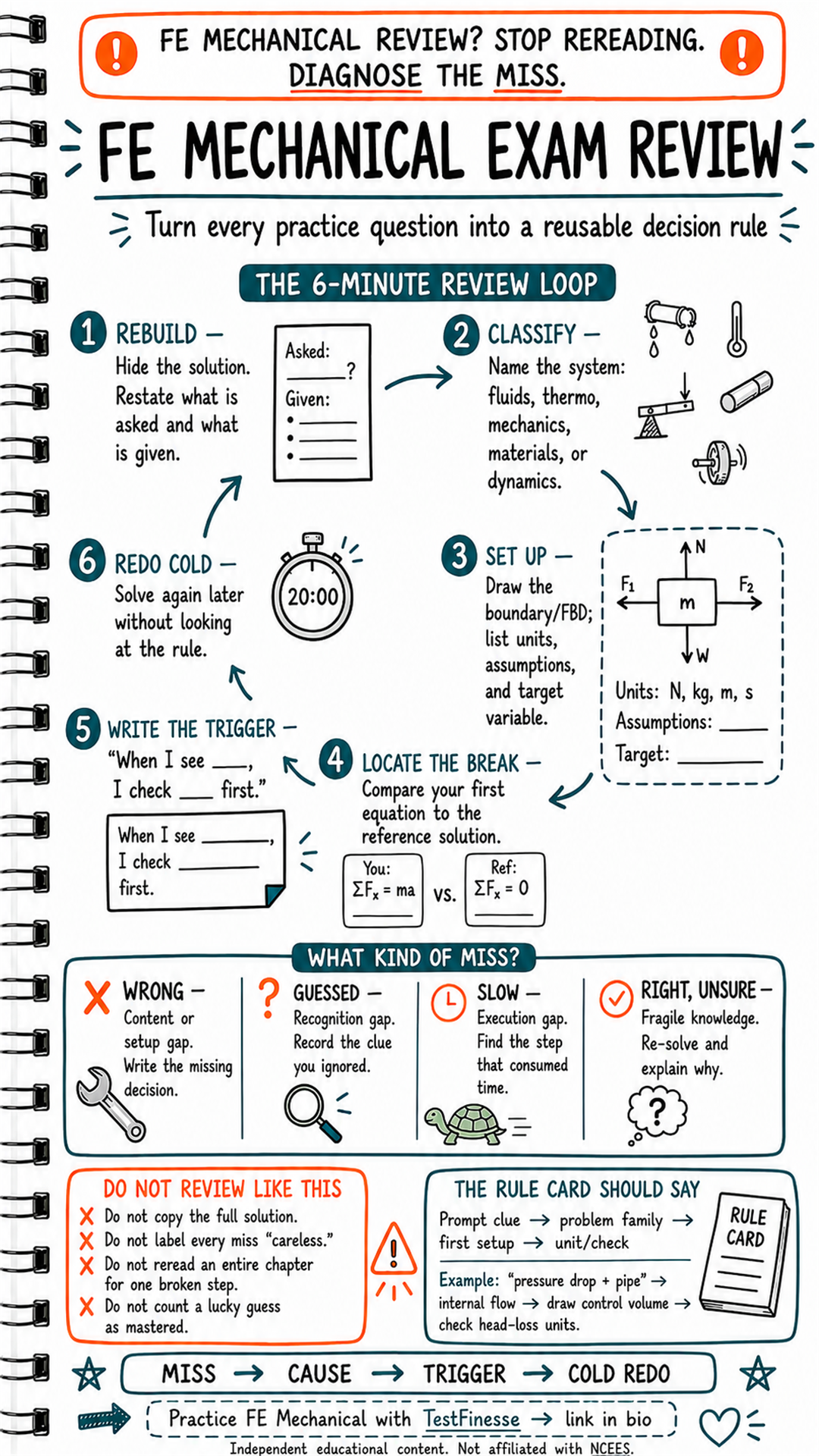
FE Mechanical review can become inefficient when every missed question leads to rereading an entire chapter.
A missed fluid problem does not always mean you need to reread fluid mechanics. A missed dynamics problem does not automatically mean you need more dynamics formulas. The real issue may be the system boundary, the free-body diagram, the sign convention, the unit conversion, or the choice between energy and momentum.
The goal of review is not to copy the solution.
The goal is to turn the question into a reusable decision rule.
Use this six-step loop:
Rebuild → Classify → Set up → Locate the break → Write the trigger → Redo cold
Why Rereading Often Fails
Rereading exposes you to information, but it does not always repair the decision that caused the miss.
A solution can look obvious after you have seen it. You may recognize the equation and feel like you understand the problem. But recognition is not the same as retrieval.
A stronger review asks:
What was the problem actually asking?
What system or body was being analyzed?
What assumptions applied?
What was the first equation I should have written?
Where did my setup diverge from the reference solution?
What clue should trigger the correct model next time?
Review the broken decision, not just the final equation.
1. Rebuild The Problem
Hide the solution first.
Then restate:
What is being asked?
What information is given?
What units are provided?
What conditions or assumptions are stated?
What quantity is unknown?
Use a short template:
Asked: __________________
Given:
- __________________
- __________________
- __________________
Units: _________________
Target: ________________
This step prevents the reference solution from doing the thinking for you.
For example, a fluid problem may provide pressure, diameter, velocity, elevation, roughness, and flow rate. That does not mean every value belongs in the same equation. Rebuilding the prompt forces you to identify the target and separate relevant data from distracting data.
If the problem asks for force on a bend, the target is not simply pressure or velocity. If it asks for pressure drop, the target is not the reaction force. Name the requested quantity before searching for a formula.
2. Classify The System
Next, name the problem family.
The infographic highlights several FE Mechanical categories:
Fluids
Thermodynamics
Mechanics
Materials
Dynamics
You can go one level deeper:
Fluid statics
Internal flow
Energy balance
Momentum balance
Heat transfer
Kinematics
Translation
Rotation
Vibrations
Stress or deformation
Failure analysis
Classification narrows the search space.
For example:
A pressure drop through a pipe may be an internal-flow or head-loss problem.
A force on an elbow may be a momentum problem.
A speed after a height change may be an energy problem.
A block accelerating under applied forces may be a free-body-diagram problem.
A repeated oscillation may require a mass-stiffness-damping model.
The system category should determine your first model, not the first symbol you recognize.
3. Set Up The Model
Now draw the model before calculating.
Depending on the problem, this may be:
A control volume
A free-body diagram
A coordinate system
An energy diagram
A thermodynamic system boundary
A stress element
A vibration model
Then list:
Units
Assumptions
Boundary or body
Inlets and outlets
Forces
Elevations
Sign convention
Target variable
For a force problem, draw the free-body diagram and write the axes.
For a fluid problem, mark the control volume, flow direction, pressure locations, and elevations.
For a thermodynamics problem, identify the system and decide whether heat, work, or mass crosses the boundary.
For a vibration problem, identify mass, stiffness, damping, and forcing.
A clean setup often reveals that the original error occurred before any arithmetic began.
4. Locate The Break
Compare your first equation with the reference solution.
Do not compare only the final number. Compare the first modeling decision.
For example:
Your setup:  ΣFx = ma
Reference:  ΣFx = 0
That difference may indicate a steady-equilibrium problem rather than an accelerating-body problem.
Other possible breaks include:
You used Bernoulli when the question asked for force.
You used momentum when the question asked for energy or head.
You treated a transient system as steady.
You used diameter where area was required.
You omitted a pressure force.
You included a head loss without a physical clue.
You chose the wrong sign convention.
You used a formula from a similar but different problem family.
Find the first divergence, not the last algebraic error.
The first broken decision is usually the most valuable thing to repair.
5. Write The Trigger
Turn the repaired insight into a conditional rule.
Use this format:
When I see ______, I check ______ first.
Examples:
When I see a pressure drop and a pipe, I check the control volume and head-loss units first.
When I see a force at a pin or cable, I draw the free-body diagram first.
When I see a turning path, I separate tangential and normal acceleration.
When I see a pump or turbine, I identify the energy balance and head terms.
When I see oscillation, I separate natural frequency from forcing frequency.
When I see a changing system, I check whether steady-state assumptions apply.
A trigger should be short enough to remember and specific enough to guide action.
“Review fluids” is not a trigger. “Pressure drop plus rough pipe means check internal-flow losses” is much more useful.
A rule card should connect the prompt clue to the first setup.
6. Redo Cold
Do not immediately redo the problem while the solution is still visible in your working memory.
Return later and solve it without looking at the rule card. This can happen later in the day, the next day, or during a mixed review set.
A cold redo should test whether you can:
Recognize the problem family.
Identify the target.
Draw the correct model.
Choose the first equation.
Carry out the calculation.
Check units and direction.
If you need the solution again, the rule may still be too vague. Rewrite the trigger and try a near-twin problem with changed numbers or a different surface story.
A cold redo tests retrieval. Immediate repetition often tests recognition.
What Kind Of Miss Was It?
Not every wrong answer has the same cause.
Wrong
You made a content or setup error.
Repair by writing the missing decision, assumption, or relationship.
Guessed
You may have recognized the topic but lacked a reliable retrieval path.
Record the clue you ignored or the distinction you could not make.
Slow
You may understand the model but lose time during execution.
Find the step that consumed time and build a shorter procedure.
Right, But Unsure
You may have fragile knowledge.
Re-solve the problem and explain why the method works without looking at the reference.
This classification prevents every mistake from being labeled “careless.” A careless label does not tell you what to change.
Avoid These Review Traps
Do not:
Copy the full solution without rebuilding the problem.
Label every miss as careless.
Reread an entire chapter for one broken step.
Count a lucky guess as mastery.
Memorize the final equation without the prompt trigger.
Review only the final answer.
Redo the exact problem immediately and mistake familiarity for learning.
Ignore units, assumptions, or system boundaries.
Add new formulas before repairing repeated model-selection errors.
The purpose of review is not to create longer notes. It is to create better decisions.
Use The TestFinesse Practice Loop
The TestFinesse review loop is:
Answer: Attempt the question independently.
Explain: State the system, assumptions, target, and first setup.
Reveal: Compare your first equation with the reference.
Fix the gap: Write the trigger that would have changed your setup.
Transfer: Solve a near-twin problem.
Redo cold: Return later without the rule card.
Track the type of miss and the trigger that repairs it. Over time, your error log becomes a map of reusable FE Mechanical decisions.
Final Takeaway
FE Mechanical review should not be a cycle of rereading and hoping the formulas feel familiar.
Rebuild the problem. Classify the system. Set up the model. Find the break. Write the trigger. Redo cold.
The goal is not to remember one solution. The goal is to recognize the next problem family and make the correct first move.
Miss → cause → trigger → cold redo.
Independent educational content. Not affiliated with NCEES. Always use the current NCEES exam specifications and reference handbook for your exam date.
Keep studying
Practice Exam Skills
Turn this into a better score
Reading about a skill only gets you so far. TestFinesse's AI coach walks you through exam questions, explains exactly where your reasoning breaks down, and adapts to what you actually need to practice next.
Explore All Exams