FE Mechanical Gear and Belt Ratios: Trace Speed, Torque, and Power
Last updated September 22, 2026
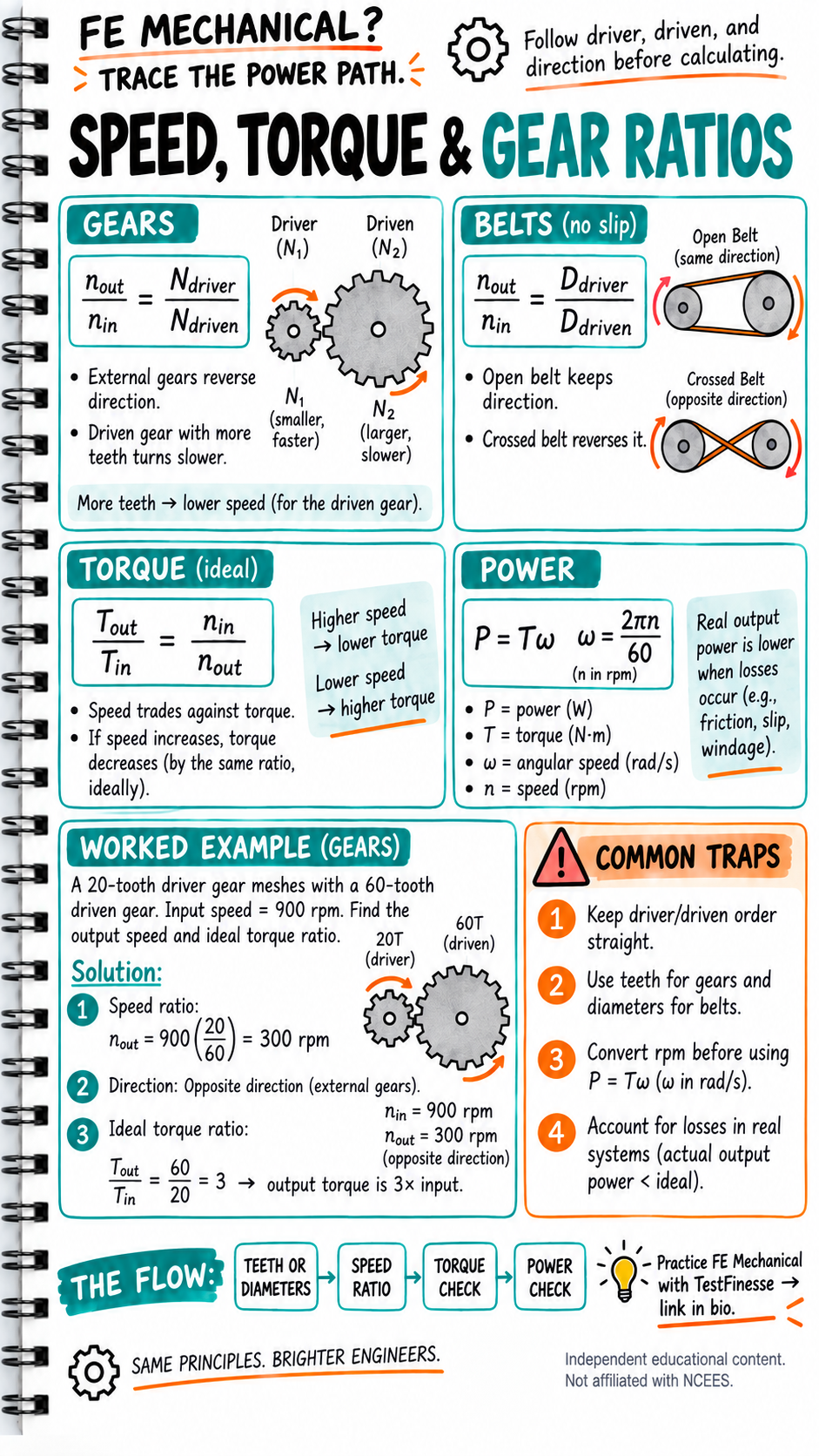
When a mechanical systems problem includes gears or belts, the challenge is often choosing the correct ratio direction. Put the driver and driven components in the wrong order, and the arithmetic can be flawless while the output is wrong.
Start by tracing the power path:
Follow the driver, driven component, and direction before calculating.
This post breaks down the ratio relationships shown in the infographic and adds a repeatable setup method for FE Mechanical practice.
Start With the System
Before writing an equation, identify:
Driver: the component receiving input motion or power
Driven: the component receiving motion from the driver
Target: output speed, direction, torque, or power
Assumption: whether the system is ideal or includes losses
Keep driver and driven labels consistent from the problem statement through the final answer. A quick sketch with arrows often prevents a ratio from being inverted.
Gear Ratios: Use Teeth and Track Direction
For a simple pair of meshing external gears, the speed relationship is:
\[ \frac{n_{\text{out}}}{n_{\text{in}}} = \frac{N_{\text{driver}}}{N_{\text{driven}}} \]
Here, \(n\) is rotational speed and \(N\) is the number of teeth. The output speed is inversely proportional to the driven gear’s tooth count.
A larger driven gear turns more slowly. A smaller driven gear turns faster.
External gears also rotate in opposite directions. That direction change is separate from the speed calculation, so record it explicitly when the question asks for direction.
Example: A 20-tooth driver turns at 900 rpm and meshes with a 60-tooth driven gear.
\[ n_{\text{out}} = 900\left(\frac{20}{60}\right) = 300\text{ rpm} \]
The output rotates in the opposite direction because the gears are external and directly meshed.
Belt Ratios: Use Pulley Diameters
For a belt drive without slip, belt speed is the same at both pulleys. The rotational-speed relationship is:
\[ \frac{n_{\text{out}}}{n_{\text{in}}} = \frac{D_{\text{driver}}}{D_{\text{driven}}} \]
Use pulley diameters for belt problems, not gear tooth counts.
An open belt keeps the pulleys turning in the same direction. A crossed belt reverses the direction. As with gears, determine direction separately from the speed magnitude.
The no-slip assumption matters. If the problem includes belt slip, the ideal ratio alone is not enough to determine actual output speed.
Ideal Torque: Speed Trades Against Torque
For an ideal gear or belt transmission, output power equals input power. Since rotational power is:
\[ P=T\omega \]
where \(T\) is torque and \(\omega\) is angular speed, a reduction in speed corresponds to an increase in torque.
For the 20-tooth driver and 60-tooth driven gear:
\[ \frac{T_{\text{out}}}{T_{\text{in}}} = \frac{N_{\text{driven}}}{N_{\text{driver}}} = \frac{60}{20} = 3 \]
So the ideal output torque is three times the input torque, while the output speed is one-third the input speed.
This is an ideal relationship. In a real system, friction, slip, and other losses reduce output power and can change the actual torque available.
Power: Keep the Units Together
The rotational power relationship is:
\[ P=T\omega \]
If angular speed is given in radians per second, use it directly. If speed is given in revolutions per minute, convert first:
\[ \omega=\frac{2\pi n}{60} \]
where \(n\) is in rpm and \(\omega\) is in rad/s.
Then calculate power using consistent units. In SI, torque is in newton-metres and angular speed is in radians per second, giving power in watts.
Trap: Substituting rpm directly for rad/s creates a unit error. Convert before using \(P=T\omega\).
A Reliable Setup Sequence
Use this sequence on practice problems:
Name the components. Mark driver and driven.
Choose the ratio. Teeth for gears; diameters for belts.
Find output speed. Keep driver and driven positions consistent.
Track direction. External gears reverse; open belts preserve direction; crossed belts reverse.
Find torque or power. Use ideal relationships only when the problem supports that assumption.
Check units and assumptions. Convert rpm when calculating power, and include losses when stated.
The NCEES FE Reference Handbook covers gearing relationships and transmitted power under idealized assumptions. Its guidance is a reminder to keep the model and assumptions aligned with the problem. NCEES FE Reference Handbook
Common Ratio Traps
Reversing driver and driven: Label them before placing values into a ratio.
Using the wrong dimension: Use teeth for gears and diameters for belts.
Forgetting direction: Calculate speed magnitude, then apply the gear or belt direction rule.
Treating ideal torque as actual torque: Real losses lower available output power.
Using rpm in the power equation: Convert to rad/s first.
Mixing up the ratio definition: Write what the ratio represents before simplifying it.
Use the TestFinesse Practice Loop
When a ratio question goes wrong, record the first decision that failed.
Answer: Solve the problem and mark your driver, driven component, and target.
Explain: State why you chose a teeth or diameter ratio and how you determined direction.
Reveal: Compare your setup with the solution, including its assumptions.
Fix the gap: Label the miss as ratio order, component identification, direction, unit conversion, or ideal-versus-real modeling.
Transfer: Try a near-twin question with different tooth counts, pulley sizes, or a crossed belt.
A useful trigger note might be:
When I see meshing external gears, I check the speed ratio and reverse the output direction.
Final Takeaway
Trace the power path first. Use teeth for gears and diameters for belts. Calculate speed, then check torque, power, direction, units, and losses.
Independent educational content. Not affiliated with NCEES. This is exam preparation, not professional engineering advice.
Accuracy sources checked: NCEES FE Reference Handbook, Penn State Mechanics Map: Belt and Gear Driven Systems
Keep studying
Practice Exam Skills
Turn this into a better score
Reading about a skill only gets you so far. TestFinesse's AI coach walks you through exam questions, explains exactly where your reasoning breaks down, and adapts to what you actually need to practice next.
Explore All Exams