FE Mechanical Fluid Mechanics: Use Assumptions Before Equations
Last updated August 27, 2026
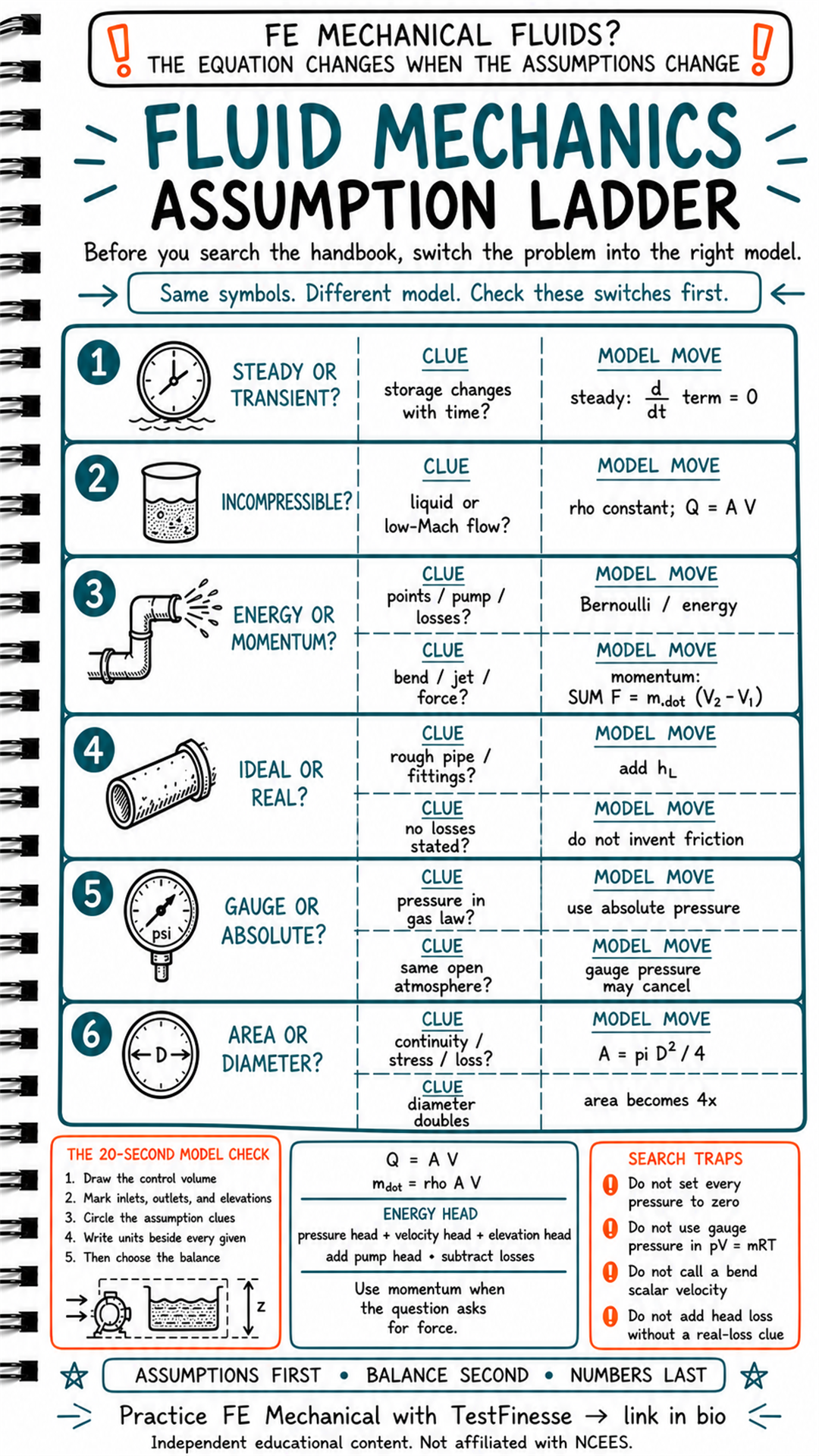
Fluid mechanics problems often look like equation-search problems. You see pressure, velocity, elevation, a pipe, a pump, or a bend, and your first instinct is to search the handbook for a familiar formula.
That instinct can create unnecessary work.
The better FE Mechanical move is to identify the model before choosing the equation. The same symbols can appear in a continuity problem, an energy balance, a momentum balance, or a loss calculation. The correct equation depends on the assumptions and the physical story.
The central workflow is:
Assumptions first → balance second → numbers last
The FE exam is a computer-based exam with 110 questions and a six-hour appointment that includes the exam, tutorial, nondisclosure agreement, and scheduled break. NCEES also provides the electronic reference handbook for the exam, so your goal is not to memorize every equation. Your goal is to recognize which relationship applies and locate it efficiently. NCEES FE Exam
Why Assumptions Matter
An equation is a compressed description of a physical model. When the assumptions change, terms may disappear, remain constant, or need to be added.
For example:
Steady flow may eliminate accumulation terms.
Incompressible flow may allow density to remain constant.
A bend or jet may require a momentum balance.
A rough pipe may require head-loss terms.
Gas-law calculations require absolute pressure.
A diameter change affects area according to \(A = \pi D^2/4\).
The test is often checking whether you can identify the correct model before performing algebra.
1. Steady or Transient?
Ask:
Is mass or energy accumulating in the system over time?
A steady-flow problem assumes that the relevant storage terms do not change with time. In a control-volume balance, the accumulation term is represented by a time derivative such as:
\[ \frac{d(\text{stored quantity})}{dt} \]
For steady operation, that term is zero.
Clues for a steady model may include:
Constant operating conditions
A system that has reached equilibrium
No stated startup or shutdown behavior
No changing tank level, mass, or internal energy
Transient problems are different. If a tank is filling, a reservoir level is changing, or a system is heating over time, accumulation may matter.
Do not automatically assume steady state simply because the problem does not look dynamic. Look for whether storage changes are explicitly stated or implied.
2. Is the Fluid Incompressible?
Incompressibility is a modeling assumption about density. For many liquid-flow problems, density can be treated as constant. Low-Mach-number gas flow may also be approximated as incompressible in appropriate contexts, but do not apply that shortcut without checking the problem’s clues.
For constant-density flow, the continuity relationship commonly becomes:
\[ Q = AV \]
where:
\(Q\) is volumetric flow rate,
\(A\) is cross-sectional area,
\(V\) is average velocity.
Mass flow rate is then:
\[ \dot{m} = \rho Q = \rho AV \]
If density is constant, changes in area and velocity are linked. A smaller pipe area generally corresponds to a larger average velocity for the same flow rate.
The important distinction is this:
Continuity is about conservation of mass. It does not automatically tell you pressure, energy loss, or force.
Use the continuity relationship to connect flow rate, area, velocity, and mass flow. Then determine whether another balance is needed.
3. Energy or Momentum?
This is one of the highest-value classification decisions in fluid mechanics.
Use an energy balance when the problem focuses on:
Pressure differences
Velocity changes
Elevation changes
Pumps or turbines
Head added or removed
Friction or minor losses
Energy between two points
A Bernoulli-style relationship may include pressure head, velocity head, elevation head, pump head, and losses. In symbolic form, the model often resembles:
\[ \frac{P}{\gamma} + \frac{V^2}{2g} + z \]
with pump and loss terms added according to the physical situation.
Use a momentum balance when the question asks about:
Force on a bend
Force on a nozzle
Jet impact
Force on a vane
Changes in velocity direction
Reaction forces
A simplified momentum relationship may be written as:
\[ \sum \mathbf{F} = \dot{m}(\mathbf{V}_2-\mathbf{V}_1) \]
The velocity is a vector. Direction matters.
A common trap is treating a bend as if it only changes the scalar speed. A pipe elbow may have nearly the same speed at the inlet and outlet while still producing a significant force because the velocity direction changes.
Pressure forces also belong in the momentum balance when the control volume requires them. Do not use only the velocity-change term and ignore pressure acting on inlet or outlet areas.
4. Ideal or Real?
Real pipes and fittings create losses. If the problem gives clues such as:
Roughness
Pipe length
Valves
Elbows
Fittings
Entrance or exit effects
A loss coefficient
then the model may need a head-loss term.
A common structure is:
\[ h_L = f\left(\frac{L}{D}\right)\frac{V^2}{2g} + \sum K\frac{V^2}{2g} \]
The exact form depends on the handbook notation and the problem’s data.
Do not add friction simply because the fluid is moving. A loss term needs a physical clue or an applicable model. At the same time, do not delete losses from a real piping system when roughness, length, or fittings are clearly provided.
The distinction is between:
An idealized model with no stated losses
A real-flow model where friction and minor losses matter
5. Gauge or Absolute Pressure?
Pressure reference is a frequent source of avoidable errors.
For gas-law relationships such as:
\[ PV = mRT \]
use absolute pressure. Gauge pressure is measured relative to the local atmosphere and cannot be substituted directly into a gas-law equation unless it has been converted.
The conversion is conceptually:
\[ P_{\text{absolute}} = P_{\text{gauge}} + P_{\text{atmospheric}} \]
For pressure differences in an energy equation, gauge pressure may cancel when both points use the same atmospheric reference. That does not mean gauge pressure is universally interchangeable with absolute pressure.
Use this decision:
Gas-law or thermodynamic absolute-state calculation: use absolute pressure.
Pressure difference between points exposed to the same atmosphere: gauge values may cancel appropriately.
Mixed pressure references: convert before calculating.
Never set every pressure to zero just because the word “gauge” appears. First ask what balance is being written and whether the reference pressure cancels.
6. Area or Diameter?
Flow equations often require area, while the problem may provide diameter.
For a circular pipe:
\[ A = \frac{\pi D^2}{4} \]
The square is the important part. If diameter doubles, area becomes four times larger, not two times larger.
That affects continuity:
\[ Q = AV \]
For a fixed flow rate, a fourfold increase in area produces a quarter of the average velocity.
This is why using diameter directly where area is required can cause a major error. Before searching the handbook, identify whether the relationship needs:
Diameter
Radius
Cross-sectional area
Wetted perimeter
Hydraulic diameter
Keep geometry separate from the balance equation. First convert the geometry into the quantity the model requires, then substitute.
The 20-Second Model Check
Before opening the reference handbook, sketch the control volume and mark:
Inlets and outlets
Elevations
Pressure locations
Velocity directions
Pump or turbine terms
Possible losses
The relevant assumption clues
Then write units beside every given value.
This small setup helps you decide whether the problem is primarily about:
Continuity
Energy
Momentum
Pipe losses
Pump or turbine performance
Fluid statics
A diagram is not wasted time. It is model selection.
Search Traps To Avoid
Do not:
Search for Bernoulli before deciding whether the problem asks for force.
Use diameter in place of area.
Mix pressure head with pressure.
Use gauge pressure in \(PV=mRT\).
Treat a bend as scalar velocity only.
Add head loss without a real-loss clue.
Ignore elevations in an energy balance.
Apply incompressible-flow assumptions without checking the fluid and conditions.
Use an energy equation for a force-on-a-bend problem.
A searchable handbook is useful only after you know what you are searching for. Search terms such as “momentum,” “head loss,” “continuity,” “pump,” or “pressure head” become much more effective once the story has been classified.
Use The TestFinesse Practice Loop
When practicing FE Mechanical fluids, do not record only whether the answer was correct. Record the first modeling decision that failed.
Use this loop:
Answer: Draw the control volume and choose a balance before looking up equations.
Explain: State why the problem is continuity, energy, momentum, or losses.
Reveal: Compare your model with the solution and inspect every assumption.
Fix the gap: Write one trigger rule for the next problem.
Useful error labels include:
Steady-state mistake
Incompressibility mistake
Energy-versus-momentum mistake
Missing head loss
Pressure-reference mistake
Area-versus-diameter mistake
Sign or direction mistake
Unit-conversion mistake
Then solve a near-twin problem. Change the diameter, add a fitting, reverse the flow direction, introduce a pressure reference, or ask for force instead of head. The purpose is to test whether you learned the model rather than memorized the equation.
Final Takeaway
FE Mechanical fluid problems become more manageable when you stop treating every prompt as an equation hunt.
Draw the boundary. Identify the assumptions. Choose the balance. Search the handbook. Then calculate.
The most reliable sequence is:
Assumptions first → balance second → numbers last
Educational exam-prep content only. Always use the current NCEES specifications, reference handbook, and official exam policies for your exam date.
Accuracy sources checked: NCEES FE Exam, NCEES Exam Reference Handbooks, NCEES FE Reference Handbook
Keep studying
Practice Exam Skills
Turn this into a better score
Reading about a skill only gets you so far. TestFinesse's AI coach walks you through exam questions, explains exactly where your reasoning breaks down, and adapts to what you actually need to practice next.
Explore All Exams