FE Mechanical Fluid Mechanics Equation Selector: Classify the Problem Before Using Bernoulli
Last updated August 21, 2026
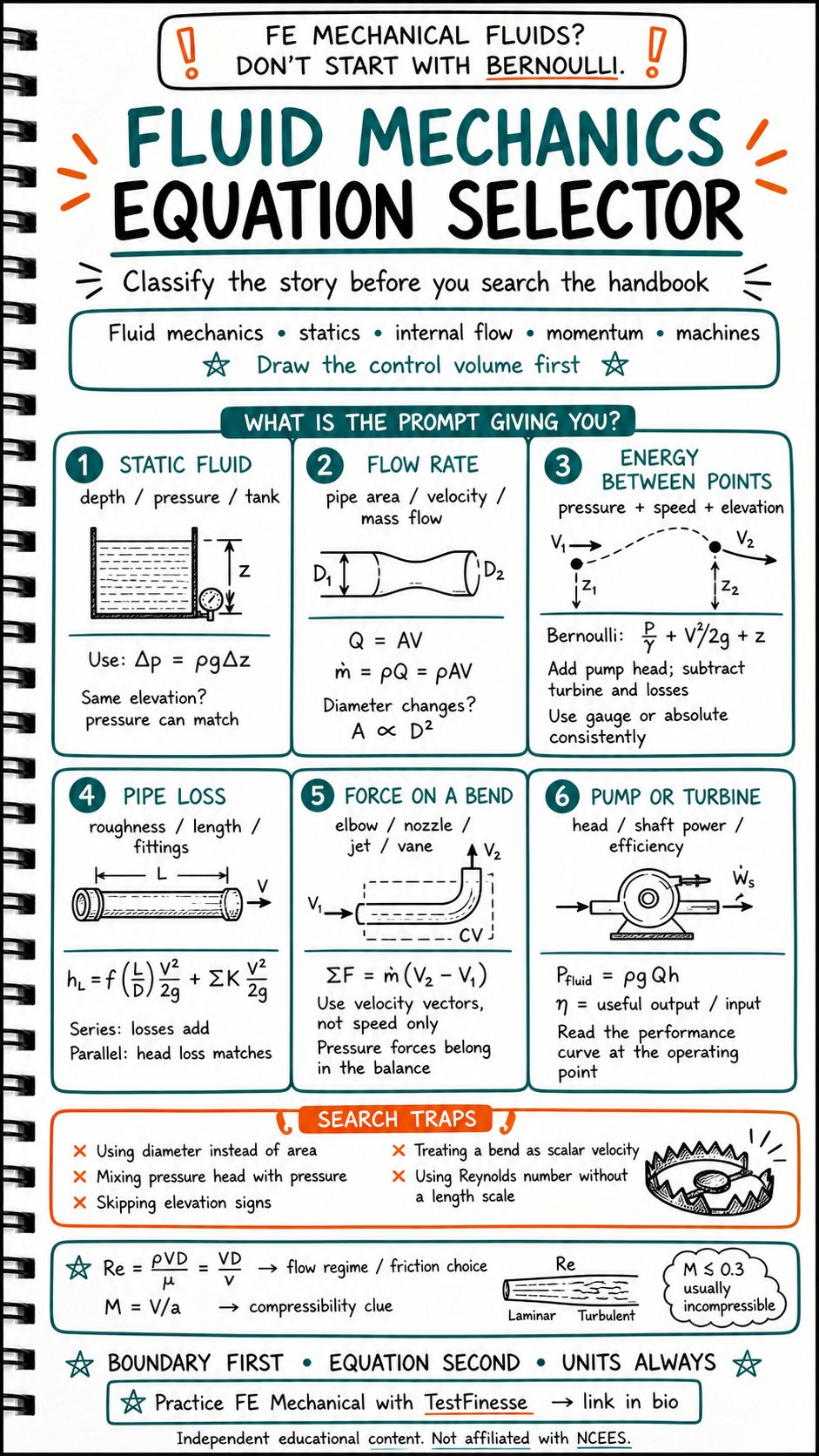
Fluid mechanics problems often feel difficult because several equations seem relevant at the same time. A question may mention pressure, velocity, elevation, pipe diameter, flow rate, roughness, or a pump in only a few lines.
The common mistake is to search for a familiar formula immediately.
A better approach is to classify the physical story first.
Do not begin with Bernoulli just because the problem involves a fluid. Begin by identifying what is being described, what crosses the boundary, and what quantity the question is asking you to find.
That decision usually narrows the equation search considerably.
Draw the Control Volume First
Before selecting an equation, sketch the system or control volume.
Mark:
The inlet and outlet locations.
Pressure at each section.
Velocity direction.
Elevation changes.
Pipe diameter changes.
Pumps, turbines, valves, and fittings.
Forces acting on the fluid or control volume.
Whether mass crosses the boundary.
This step is not decorative. It helps you decide whether you are dealing with a static-fluid relationship, a continuity equation, an energy balance, or a momentum balance.
The NCEES FE Reference Handbook includes the fluid-mechanics relationships commonly used for pressure, flow, energy, Reynolds number, and pipe losses. The practical skill is recognizing which relationship belongs to the problem before searching the handbook.
1. Static Fluid: Look for Depth and Pressure
If the fluid is at rest, the problem usually belongs to fluid statics.
Common clues include:
Tank
Depth
Liquid column
Pressure at a point
Same elevation
Hydrostatic force
For a static fluid, pressure changes with elevation according to the hydrostatic relationship:
\[ \Delta p = \rho g \Delta z \]
Be careful with the sign convention and the direction in which the elevation difference is defined. Pressure generally increases as you move downward through a stationary fluid, but the algebra depends on how the two points are labeled.
If two points in the same connected static fluid are at the same elevation, their pressures may match under the appropriate assumptions.
Static fluid problems are usually asking about pressure variation, not flow energy.
2. Flow Rate: Start With Continuity
When the prompt emphasizes pipe area, velocity, diameter, or mass flow, begin with continuity.
The volumetric flow rate is:
\[ Q = AV \]
The mass flow rate is:
\[ \dot{m} = \rho Q = \rho AV \]
For a circular pipe:
\[ A = \frac{\pi D^2}{4} \]
That means area changes with the square of diameter. A small diameter change can create a much larger area change than students expect.
For steady incompressible flow, if density is constant, a reduction in area generally corresponds to an increase in average velocity. Before using an energy equation, determine whether the question is fundamentally asking about how flow rate, area, and velocity relate.
If the prompt gives diameter and asks about velocity or flow rate, check continuity before reaching for Bernoulli.
3. Energy Between Two Points: Use Bernoulli Carefully
Bernoulli or the extended energy equation belongs to problems involving pressure, velocity, elevation, pumps, turbines, and head loss.
The basic energy relationship connects:
Pressure head
Velocity head
Elevation head
Pump head
Turbine head
Losses
A simplified Bernoulli form for ideal flow is:
\[ \frac{p}{\gamma} + \frac{V^2}{2g} + z = \text{constant} \]
However, the ideal form assumes conditions such as negligible losses and no shaft device between the selected points. Realistic system questions may require pump head, turbine extraction, or friction losses.
Before writing the equation, ask:
Is the flow steady?
Is the fluid incompressible?
Are the two points on the same streamline or represented by a valid one-dimensional model?
Is there a pump or turbine?
Are friction and fitting losses included?
Are pressures gauge or absolute?
Are all terms written as pressure head, energy per unit mass, or another consistent form?
Do not mix pressure directly with pressure head. If you use \(p/\gamma\), keep the rest of the equation in head units.
4. Pipe Loss: Separate Major and Minor Losses
If the question mentions pipe length, roughness, fittings, valves, entrances, exits, or elbows, it may be testing head loss rather than ideal Bernoulli flow.
A common structure is:
\[ h_L = f\left(\frac{L}{D}\right)\frac{V^2}{2g} + \sum K\frac{V^2}{2g} \]
The first term represents distributed or major loss along the pipe. The second represents localized or minor losses from fittings and components.
Watch for:
Using diameter instead of radius incorrectly.
Forgetting that the friction factor depends on the flow regime and roughness.
Adding losses in series incorrectly.
Treating parallel branches like a single series path.
Using the wrong velocity for a section whose diameter changes.
The equation is only as good as the system model behind it.
5. Force on a Bend: Use Momentum, Not Just Energy
An elbow, nozzle, jet, vane, or bend usually points toward a momentum balance.
The velocity is a vector, so direction matters. A bend can create a force even when the inlet and outlet speed magnitudes are equal because the velocity direction changes.
A simplified momentum form is:
\[ \sum \mathbf{F} = \dot{m}(\mathbf{V}_2-\mathbf{V}_1) \]
But the full force balance may also include:
Pressure forces at the inlet and outlet.
Weight of the fluid inside the control volume.
Support reactions.
Wall forces.
Other external forces.
Do not treat the bend as a scalar speed-change problem. Draw velocity vectors and define positive coordinate directions first.
For bends, direction is part of the data.
6. Pump or Turbine: Identify the Machine’s Role
If the prompt includes a pump, turbine, shaft power, head, or efficiency, classify the problem as a machine-energy problem.
Hydraulic power is commonly related to:
\[ P_{\text{fluid}} = \rho g Q h \]
Efficiency then connects useful output and input according to the machine’s definition and the direction of energy transfer.
Ask:
Is the machine adding energy to the fluid?
Is it extracting energy from the fluid?
Is the stated efficiency hydraulic, mechanical, volumetric, or overall?
Does the operating point correspond to the given flow and head?
Are you reading a performance curve at the correct condition?
A pump and a turbine do not enter the energy balance in the same direction. The sign should follow the physical role of the device and the convention used in the problem.
Use Reynolds Number as a Classification Clue
Reynolds number helps identify the flow regime and select the appropriate friction relationship:
\[ Re = \frac{\rho V D}{\mu} \]
or, using kinematic viscosity,
\[ Re = \frac{VD}{\nu} \]
The characteristic length \(D\) must match the geometry. For internal pipe flow, diameter is commonly used, but other geometries may require a hydraulic diameter or another characteristic dimension.
The infographic also highlights Mach number:
\[ M = \frac{V}{a} \]
For many low-speed engineering calculations, \(M < 0.3\) is used as a practical clue that compressibility effects may be small. Treat this as a modeling guideline, not an automatic permission to ignore compressibility in every situation.
Search Traps to Avoid
Before finalizing your equation, check for these common errors:
Using diameter where area is required.
Mixing pressure units and head units.
Forgetting elevation signs.
Treating a bend as scalar velocity.
Using Reynolds number with the wrong length scale.
Ignoring pressure forces in a momentum balance.
Applying ideal Bernoulli when a pump, turbine, or loss term is present.
Mixing gauge and absolute pressure inconsistently.
Ignoring unit cancellation.
Use The TestFinesse Practice Loop
For FE Mechanical fluid problems, use the TestFinesse method:
Answer: Classify the prompt and select the likely equation family.
Explain: State what clues led you there.
Reveal: Compare your model, assumptions, and equation with the solution.
Fix the gap: Record whether the miss came from classification, boundary selection, units, sign convention, or arithmetic.
Build a trap bank with rules such as:
“Diameter changes area quadratically.”
“A bend requires velocity vectors.”
“Pressure head is not pressure.”
“A pump adds energy; a turbine removes energy.”
“Reynolds number needs the correct characteristic length.”
“Draw the control volume before writing the balance.”
Final Takeaway
The fastest FE Mechanical fluid solution is often the one that begins with the best classification.
Boundary first. Equation second. Units always.
Use the NCEES FE Reference Handbook and current exam materials for the version applicable to your exam. Independent educational content. Not affiliated with NCEES.
Accuracy sources checked: NCEES FE Exam, NCEES FE Reference Handbook, NCEES Exam Reference Handbooks
Keep studying
Practice Exam Skills
Turn this into a better score
Reading about a skill only gets you so far. TestFinesse's AI coach walks you through exam questions, explains exactly where your reasoning breaks down, and adapts to what you actually need to practice next.