FE Mechanical Problem Recognizer: How to Classify the Problem Before You Search Formulas
Last updated August 10, 2026
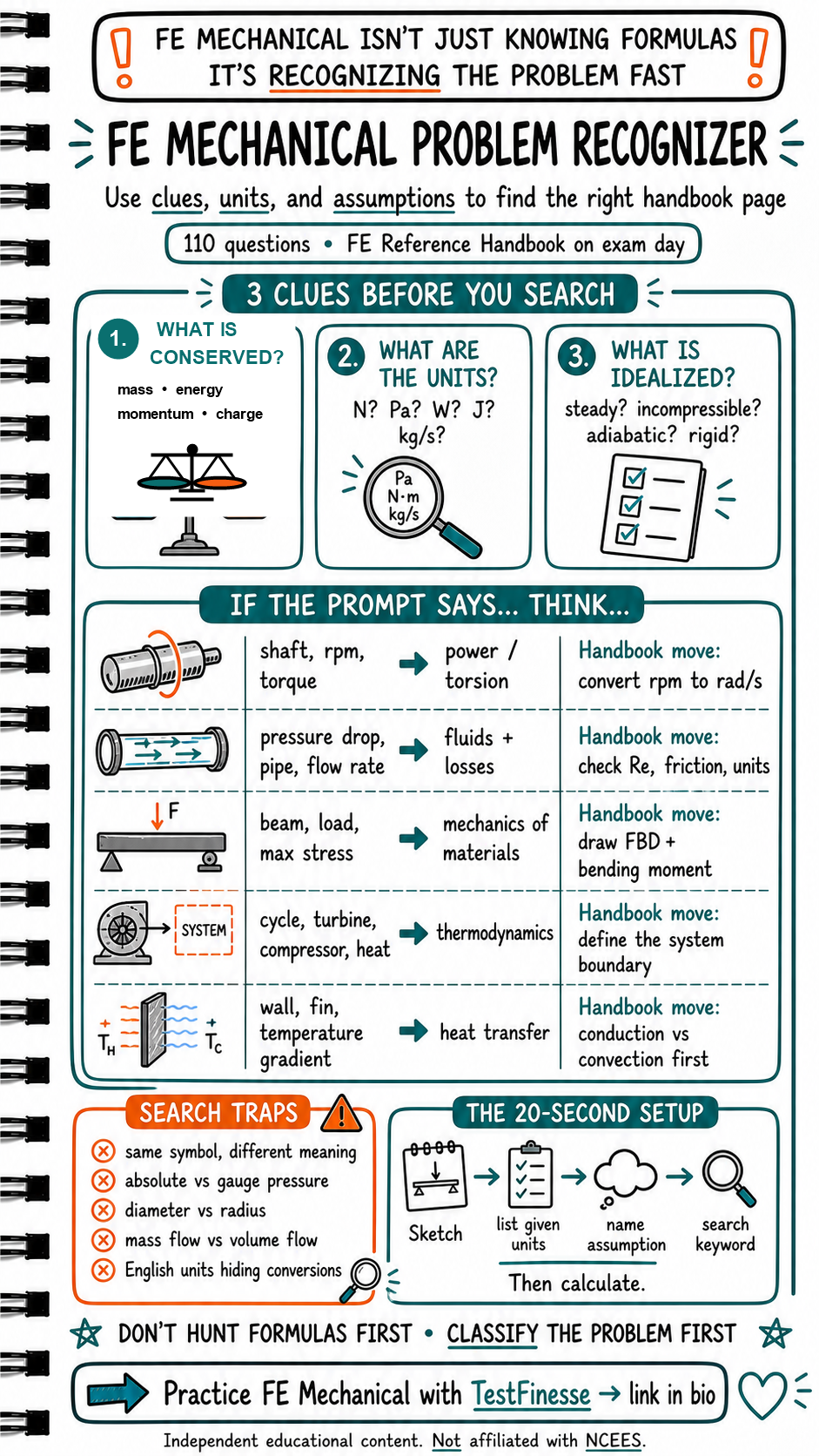
FE Mechanical is not just knowing formulas.
It is recognizing the problem fast.
The FE Mechanical exam gives you access to the electronic FE Reference Handbook, but that does not mean every problem becomes easy. The handbook helps only if you know what to search for, which section you are in, and what assumptions the problem is using.
NCEES lists the FE exam as 110 questions with 5 hours and 20 minutes of exam time inside a 6-hour appointment. The FE Mechanical specifications also confirm that the exam uses both SI and U.S. customary units and is closed book with an electronic reference.
That means speed matters.
But the fastest students are not blindly hunting formulas.
They classify the problem first.
The Real FE Mechanical Skill
A lot of students open the handbook too early.
They see a phrase like shaft, flow, beam, cycle, or temperature gradient, then start searching formulas before they understand the setup.
That creates problems.
You may find a formula, but still choose the wrong one because you missed:
What is conserved
What units are given
What assumptions are implied
What system boundary matters
Whether the problem is rate-based or total
Whether pressure is gauge or absolute
Whether flow is mass flow or volume flow
A better rule is:
Do not hunt formulas first. Classify the problem first.
3 Clues Before You Search
Before opening the handbook search box, ask three questions.
1. What Is Conserved?
Many engineering problems are built around conservation ideas.
Ask what stays balanced or accounted for:
Mass
Energy
Momentum
Charge, when electrical topics are involved
This question points you toward the right family of equations.
If the problem involves a control volume, pipe, turbine, compressor, nozzle, pump, or heat exchanger, conservation of mass and energy may be central.
If it involves forces, motion, impact, vibration, or flow momentum, momentum may matter.
If it involves circuits, motors, generators, voltage, current, or power, charge and electrical relationships may be involved.
The shortcut is:
Name the conserved quantity before searching.
2. What Are The Units?
Units are clues.
If you see:
N, think force, statics, dynamics, or mechanics.
Pa, think pressure, stress, fluids, or thermodynamics.
W, think power or heat transfer rate.
J, think energy or work.
kg/s, think mass flow rate.
m³/s, think volume flow rate.
N·m, think torque or moment.
rad/s, think angular velocity.
K, think thermodynamics or heat transfer.
Units often tell you what the answer must be before the formula does.
If the question asks for power, the final answer should be in watts, horsepower, or another power unit.
If the question asks for stress, the answer should be in pressure units.
If the question asks for heat rate, the answer should be energy per time.
A unit mismatch is often the first sign that you are in the wrong formula family.
3. What Is Idealized?
Engineering problems usually simplify reality.
Look for idealizations such as:
Steady
Incompressible
Adiabatic
Isothermal
Rigid
Frictionless
Negligible losses
Ideal gas
Thin wall
Fully developed flow
These words matter because they decide which terms stay and which terms disappear.
For example:
Adiabatic usually means no heat transfer.
Steady often removes time-accumulation terms.
Incompressible affects density assumptions.
Rigid can remove boundary work.
Thin wall supports thin-pressure-vessel formulas.
Before searching, name the assumption.
It can save you from using a formula that is technically correct but wrong for the problem.
If The Prompt Says... Think...
FE Mechanical problems often announce their category through repeated clue words.
Use those clues to route yourself quickly.
Shaft, RPM, Torque
Think:
Power, torsion, and mechanical design
Handbook move:
Convert RPM to rad/s.
If the problem gives torque and rotational speed, power may be involved:
P = T omega
If it gives a shaft, diameter, torque, and stress, torsional shear may be involved.
Watch for:
RPM vs rad/s
Diameter vs radius
Solid vs hollow shaft
Shear stress vs normal stress
Power transmission wording
Pressure Drop, Pipe, Flow Rate
Think:
Fluid mechanics and losses
Handbook move:
Check Reynolds number, friction, and units.
Pipe-flow problems often involve:
Flow rate
Velocity
Diameter
Pressure drop
Head loss
Friction factor
Pump power
Reynolds number
Watch for:
Mass flow vs volume flow
Diameter vs radius
Laminar vs turbulent clues
Pressure units
Head in meters or feet
If the problem includes flow rate, first decide whether it is m³/s, ft³/s, kg/s, or another flow unit.
Beam, Load, Max Stress
Think:
Mechanics of materials
Handbook move:
Draw the free-body diagram and bending moment.
Beam problems often require setup before formulas.
Ask:
What are the supports?
Where are the loads?
Where is the maximum moment?
Is the question asking stress, deflection, shear, or reaction?
What cross-section property applies?
For bending stress, the formula may be simple, but the moment and geometry drive the answer.
Do not search stress formulas before understanding the loading.
Cycle, Turbine, Compressor, Heat
Think:
Thermodynamics
Handbook move:
Define the system boundary.
Thermodynamics questions often depend on whether you are analyzing:
A closed system
A control volume
A turbine
A compressor
A pump
A heat exchanger
A power cycle
A refrigeration cycle
Before calculating, ask:
Is mass crossing the boundary?
Is heat entering or leaving?
Is work entering or leaving?
Is the process steady?
Are kinetic and potential energy changes negligible?
Are property tables or ideal-gas relationships needed?
The formula is not enough until the system is defined.
Wall, Fin, Temperature Gradient
Think:
Heat transfer
Handbook move:
Decide conduction vs convection first.
Heat transfer problems often give clue words like:
Wall
Fin
Insulation
Temperature gradient
Heat flux
Surface coefficient
Radiation
Heat exchanger
Before searching, classify the mode:
Conduction: heat through a material
Convection: heat between a surface and fluid
Radiation: heat transfer by thermal emission
Many problems combine modes, but naming the first mode keeps the setup cleaner.
Search Traps
Even when you recognize the topic, the FE can still punish sloppy setup.
Watch these traps.
Same Symbol, Different Meaning
Engineering symbols repeat across topics.
For example:
Q can mean heat, flow rate, or charge depending on context.
P can mean pressure or power.
V can mean velocity, volume, or voltage.
T can mean temperature, torque, or tension.
R can mean gas constant, resistance, or radius.
Do not trust the symbol alone.
Trust the units and context.
Absolute Vs Gauge Pressure
Thermodynamics and fluid problems may require absolute pressure.
If the problem gives gauge pressure and the equation requires absolute pressure, convert before calculating.
A common relationship is:
P absolute = P gauge + P atmospheric
If the problem involves ideal gases, property relationships, or thermodynamic states, pressure type matters.
Diameter Vs Radius
Mechanical problems often hide radius and diameter traps.
This matters in:
Area
Moment of inertia
Polar moment of inertia
Stress
Pipe flow
Pressure vessels
Shafts
Before using a formula, check whether it expects d or r.
Mass Flow Vs Volume Flow
Mass flow and volume flow are not the same.
Mass flow rate: kg/s or lbm/s
Volume flow rate: m³/s, ft³/s, L/min, or gal/min
They are related through density:
mass flow rate = density × volume flow rate
If the problem gives one but the formula needs the other, convert.
English Units Hiding Conversions
The FE Mechanical exam uses both SI and U.S. customary units.
That means English-unit conversions can hide inside otherwise simple problems.
Watch for:
inches vs feet
psi vs psf
ft-lbf vs Btu
hp vs ft-lbf/s
lbm vs lbf
minutes vs seconds
gallons vs cubic feet
Do not start calculating until the unit family is consistent.
The 20-Second Setup
Before calculating, spend 20 seconds doing this:
Sketch
List given units
Name the assumption
Search the keyword
Then calculate
This is not wasted time.
It prevents longer mistakes.
A quick sketch reveals force direction, system boundaries, flow direction, heat transfer direction, supports, dimensions, and missing variables.
Listing units tells you what kind of answer the problem wants.
Naming the assumption tells you which terms matter.
Only then should you search the handbook.
Use The TestFinesse Practice Loop
For FE Mechanical prep, use the loop:
Answer
Explain
Reveal
Fix the gap
After each missed problem, ask:
Did I classify the topic correctly?
Did I search the right handbook section?
Did I identify what was conserved?
Did I use the correct units?
Did I name the assumption?
Did I confuse two similar symbols?
Did I calculate before setting up?
Then write one fix rule.
Examples:
Next time, convert RPM to rad/s before power or torsion calculations.
Next time, define the control volume before using the energy equation.
Next time, check whether flow rate is mass flow or volume flow.
Next time, draw the beam before searching bending stress.
Final Takeaway
FE Mechanical problem solving starts before the formula.
Use the recognizer:
What is conserved?
What are the units?
What is idealized?
What clue words identify the topic?
What search trap could flip the answer?
The FE Reference Handbook is useful, but only when you know where to look.
Do not hunt formulas first.
Classify the problem first.
Accuracy sources checked: NCEES FE Exam, NCEES FE Mechanical CBT Exam Specifications PDF, and NCEES Exam Reference Handbooks.