FE Mechanical Dynamics, Kinematics, and Vibrations: Choose the Motion Model First
Last updated September 1, 2026
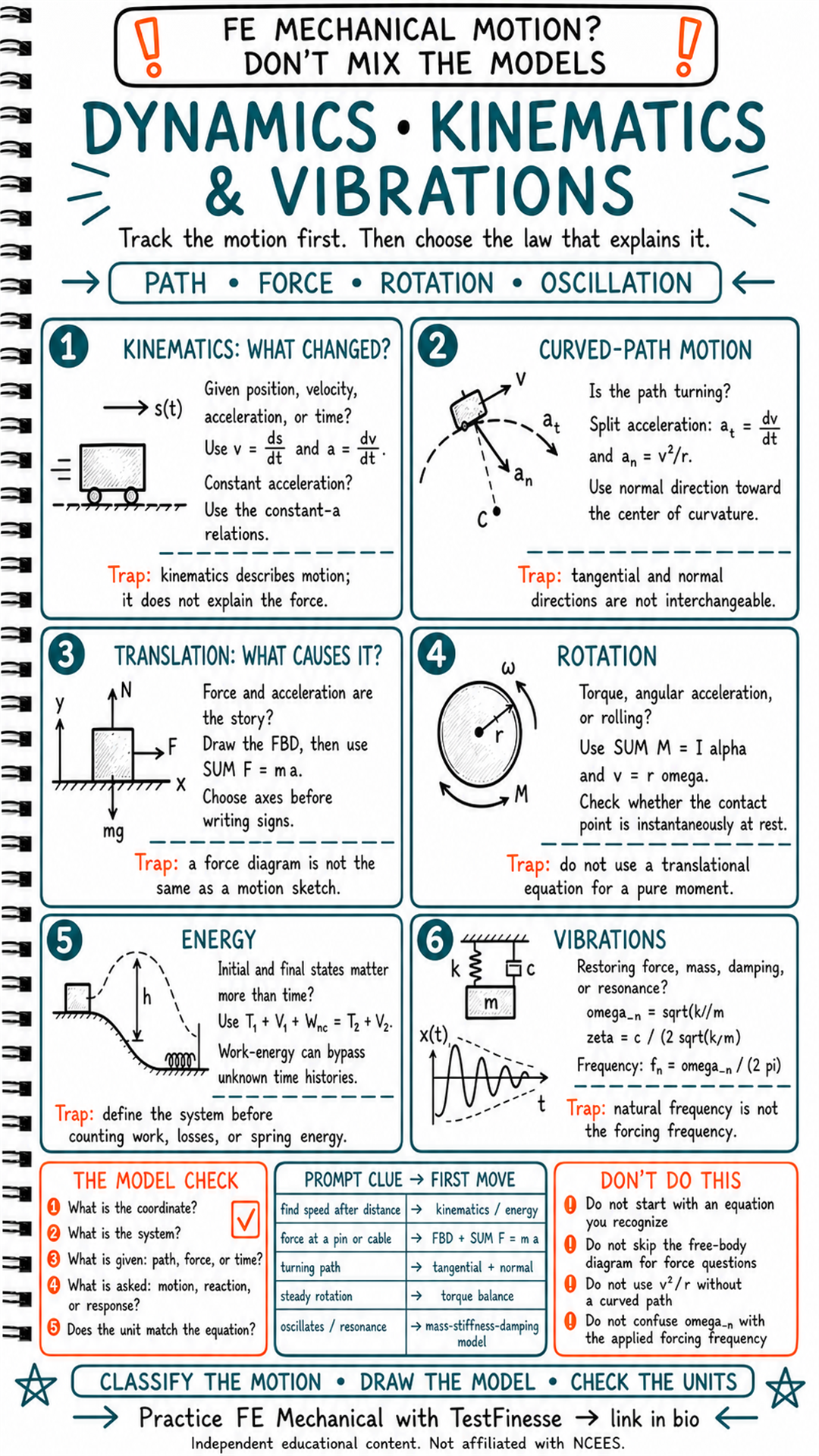
FE Mechanical motion problems can feel difficult because several equations may appear to apply at the same time.
A moving object may have a position, velocity, acceleration, force, rotation, energy change, or oscillation. The challenge is not always remembering the equation. It is identifying which model explains the story.
The same object can be described with kinematics, dynamics, energy, and rotation. But those models answer different questions.
The central workflow is:
Classify the motion → draw the model → choose the law → check the units
The current FE exam is administered as a computer-based exam with 110 questions in a six-hour appointment, including the tutorial, nondisclosure agreement, exam time, and scheduled break. NCEES provides an electronic reference handbook, so efficient model recognition matters more than trying to memorize every relationship. NCEES FE Exam
The First Question: What Is the Story About?
Before opening the handbook, ask:
Is the prompt describing a path?
Is it asking what causes the motion?
Is the object turning?
Is energy easier to track than time?
Is the system oscillating?
Is the question asking for motion, force, reaction, or response?
These questions separate the major models.
A quick classification guide:
Prompt clueFirst model to considerPosition, speed, acceleration, or timeKinematicsForce, cable tension, reaction, or contactFree-body diagram and \(\sum F = ma\)Turning, torque, or rollingRotationInitial and final statesWork-energyRepeated motion, damping, or resonanceVibration model
Do not start with the first equation you recognize. Start with the physical behavior.
1. Kinematics: What Changed?
Kinematics describes motion without explaining its cause.
If the problem gives position as a function of time, such as \(s(t)\), use derivatives to connect the motion variables:
\[ v = \frac{ds}{dt} \]\[ a = \frac{dv}{dt} \]
You may also integrate when velocity or acceleration is given and position is required.
Use kinematics when the problem focuses on:
Position
Displacement
Velocity
Acceleration
Time
A known motion profile
If acceleration is constant, the constant-acceleration relationships may be efficient:
\[ v = v_0 + at \]\[ s = s_0 + v_0t + \frac{1}{2}at^2 \]\[ v^2 = v_0^2 + 2a(s-s_0) \]
The trap is using a kinematics equation to explain a force. Kinematics can tell you how an object moves, but it does not tell you what caused the motion.
Motion description and force explanation are different layers.
2. Curved-Path Motion: Separate Tangential and Normal Effects
When the path turns, acceleration has two components:
\[ a_t = \frac{dv}{dt} \]\[ a_n = \frac{v^2}{r} \]
Tangential acceleration changes the speed. Normal acceleration changes the direction of the velocity and points toward the center of curvature.
This distinction is essential:
\(a_t\) is tangent to the path.
\(a_n\) points inward toward the center of curvature.
The total acceleration is the vector combination of both components.
A vehicle moving around a curve at constant speed still has normal acceleration. Its speed is not changing, but its velocity direction is changing.
The common trap is treating tangential and normal directions as interchangeable. They are not. Draw the path, mark the tangent, locate the center of curvature, and place the normal direction inward.
If the problem asks for force, continue from acceleration to dynamics:
\[ \sum \mathbf{F} = m\mathbf{a} \]
Resolve forces into the tangential and normal directions as appropriate.
3. Translation: What Causes the Motion?
Translation problems focus on forces and linear acceleration.
Typical clues include:
A force applied to a block
Cable tension
Normal force
Friction
Weight
Pin or support reactions
Linear acceleration
Start with a free-body diagram. Include all external forces acting on the body, then choose coordinate axes before assigning signs.
For a simple translational model:
\[ \sum F_x = ma_x \]\[ \sum F_y = ma_y \]
The free-body diagram is not the same as a motion sketch. A motion sketch shows how the object moves. A free-body diagram shows the forces acting on it.
This difference matters because a clean motion picture can still omit a reaction force, friction force, or constraint force that controls the answer.
Use this sequence:
Isolate the body.
Draw external forces.
Choose axes.
Assign signs.
Write force balances.
Solve for the requested force or acceleration.
Check whether the result matches the physical direction.
Draw the force model before writing \(\sum F = ma\).
4. Rotation: Track Torque and Angular Motion
Rotation problems involve angular displacement, angular velocity, angular acceleration, torque, or rolling.
The rotational equivalent of a force balance is:
\[ \sum M = I\alpha \]
where \(I\) is the mass moment of inertia and \(\alpha\) is angular acceleration.
For a point on a rotating body:
\[ v = r\omega \]
The radius matters. A point farther from the axis can have a larger linear speed even when every point on the rigid body shares the same angular velocity.
For rolling without slipping, the contact point is instantaneously at rest relative to the surface. That does not mean the entire wheel is at rest. It is a local kinematic condition that connects translation and rotation.
Ask:
Is the body rotating about a fixed axis?
Is there a pure moment?
Is the body translating and rotating?
Is there rolling contact?
Where is the moment taken?
What direction is positive?
A common error is using a translational equation for a pure moment or treating angular quantities like linear quantities.
Rotation requires rotational coordinates, rotational inertia, and torque balance.
5. Energy: Compare Initial and Final States
Work-energy methods are often effective when the initial and final states are known but the detailed time history is not.
A general work-energy structure is:
\[ T_1 + V_1 + W_{nc} = T_2 + V_2 \]
where:
\(T\) represents kinetic energy,
\(V\) represents potential energy,
\(W_{nc}\) represents work by nonconservative forces.
Depending on the problem, energy may include:
Translational kinetic energy
Rotational kinetic energy
Gravitational potential energy
Spring potential energy
Work by applied forces
Work by friction or other nonconservative forces
Energy can bypass unknown time histories. If the question asks for speed after a change in height, distance, or spring compression, an energy approach may be shorter than solving for acceleration over time.
But define the system first.
Ask:
What is inside the system?
What is the initial state?
What is the final state?
Which forces do work?
Is friction present?
Is spring energy included?
Is rotational energy included?
The trap is counting work, losses, or spring energy without first deciding what system and sign convention you are using.
6. Vibrations: Identify the Oscillation Model
Vibration problems involve a restoring force, mass, damping, natural frequency, forcing frequency, or resonance.
For a simple undamped mass-spring system:
\[ \omega_n = \sqrt{\frac{k}{m}} \]
The natural frequency in cycles per unit time is:
\[ f_n = \frac{\omega_n}{2\pi} \]
For a damped single-degree-of-freedom system, a damping ratio may be written as:
\[ \zeta = \frac{c}{2\sqrt{km}} \]
The natural frequency describes how the system tends to oscillate based on its mass and stiffness. The forcing frequency describes how fast an external input is applied.
These are not the same quantity.
The system may respond strongly when the forcing frequency approaches the natural frequency, depending on damping and the model assumptions. Therefore, do not confuse:
Natural frequency
Applied forcing frequency
Damped natural frequency
Resonance condition
Before using a vibration equation, identify:
Mass
Stiffness
Damping
Initial conditions
External forcing
The requested response
Natural frequency belongs to the system. Forcing frequency belongs to the input.
The FE Mechanical Model Check
Before calculating, ask:
What coordinate system is being used?
What is the system or body?
What is given: path, force, time, rotation, or response?
What is being asked: motion, force, reaction, energy, or frequency?
Do the units match the chosen equation?
This check prevents model mixing.
Examples:
“Find speed after traveling a distance” may be kinematics or energy.
“Find force at a pin” requires a free-body diagram and force balance.
“Find acceleration around a curve” requires tangential and normal components.
“Find torque or angular acceleration” requires rotational dynamics.
“Find maximum response” may require a vibration model and forcing information.
Common Dynamics Traps
Avoid these mistakes:
Starting with an equation before identifying the model.
Using kinematics to explain force.
Skipping the free-body diagram in a force problem.
Using \(v^2/r\) without a curved path.
Treating normal acceleration as tangential acceleration.
Using a translational equation for a pure rotation problem.
Forgetting rotational kinetic energy in an energy balance.
Mixing degrees and radians in angular calculations.
Confusing natural frequency with forcing frequency.
Ignoring the direction of a vector or reaction.
Checking numbers without checking the units.
A result can be mathematically clean and physically wrong. Direction, system boundaries, and units are part of the solution.
Use The TestFinesse Practice Loop
When practicing FE Mechanical dynamics, label the modeling error instead of recording only “wrong.”
Use this loop:
Answer: Classify the motion before looking up an equation.
Explain: State why the problem is kinematics, force, rotation, energy, or vibration.
Reveal: Compare your model with the solution.
Fix the gap: Write one trigger rule.
Examples:
“If the path turns, split acceleration into tangential and normal parts.”
“If the question asks for a pin force, draw the free-body diagram.”
“If only initial and final states matter, test work-energy.”
“If the body rotates, look for torque and moment of inertia.”
“If the system oscillates, separate natural frequency from forcing frequency.”
Then solve a near-twin problem with changed numbers, directions, or requested quantities. That tests whether you learned the model instead of memorizing the equation.
Final Takeaway
FE Mechanical motion problems become clearer when you stop mixing the models.
Classify the motion. Draw the model. Choose the law. Check the units.
Kinematics describes motion. Dynamics explains causes. Rotation tracks torque. Energy compares states. Vibrations describe repeated response.
The fastest FE move is often not calculating faster. It is choosing the correct model before the calculation begins.
Educational exam-prep content only. Not affiliated with NCEES. Always use the current NCEES exam specifications and reference handbook for your exam date.
Accuracy sources checked: NCEES FE Exam, NCEES Exam Reference Handbooks
Keep studying
Practice Exam Skills
Turn this into a better score
Reading about a skill only gets you so far. TestFinesse's AI coach walks you through exam questions, explains exactly where your reasoning breaks down, and adapts to what you actually need to practice next.
Explore All Exams