FE Thermodynamics: Ask What Stays Constant First
Last updated August 19, 2026
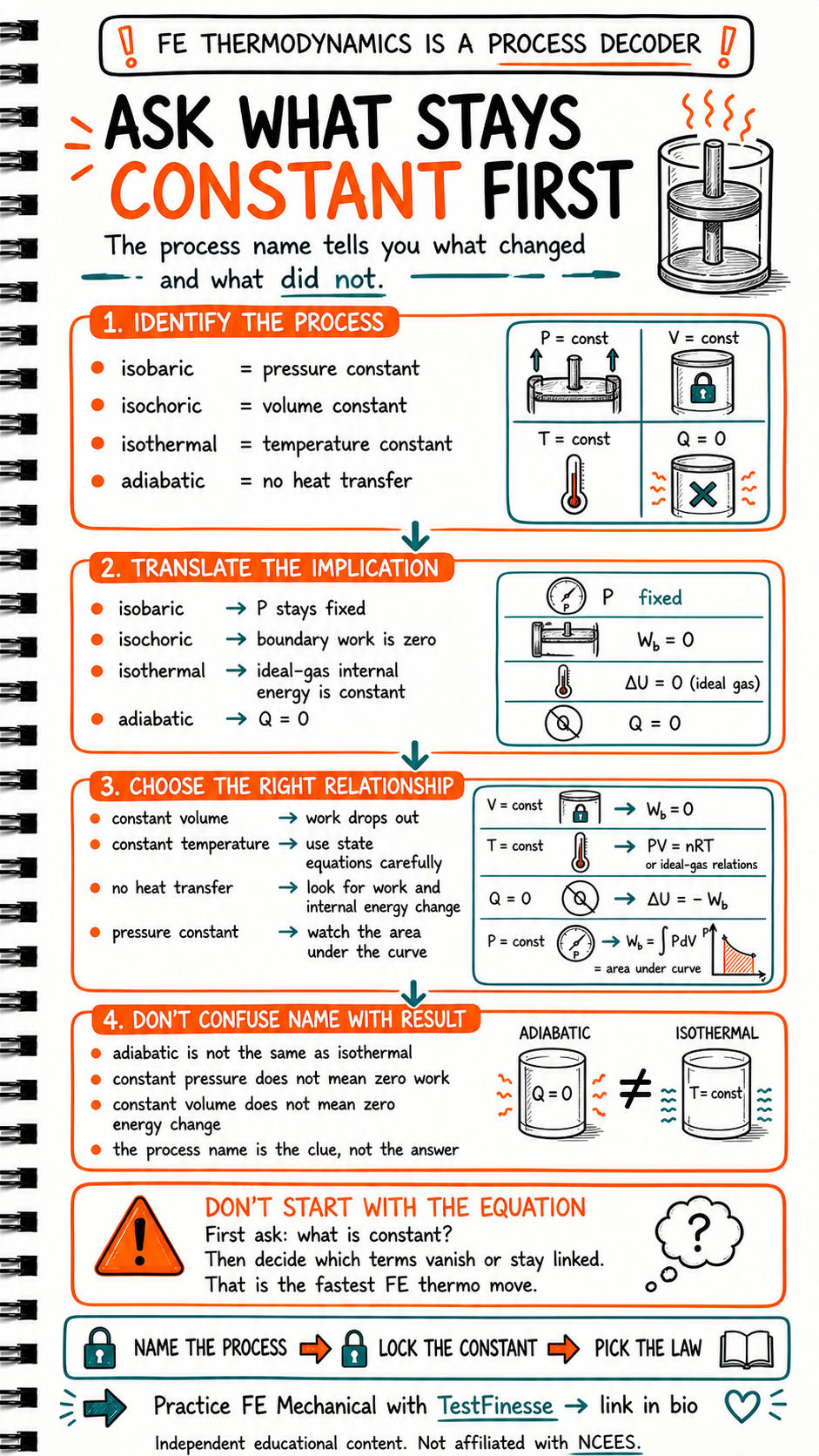
FE thermodynamics gets easier when you stop treating every problem like a formula hunt.
The better move is simpler: identify the process first, then choose the relationship. That is what the infographic is really teaching. The process name is not decorative language. It is a clue. It tells you what stayed fixed, what changed, and which terms usually drop out.
That matters on FE problems because thermodynamics questions often hide the same structure in different words. If you can spot the process quickly, you stop wasting time trying random equations and start solving the actual model.
A useful FE habit is this:
Ask what stays constant
Translate that into a process
Choose the law or state relation that matches
Only then do the math
That is the whole decoder.
The current FE exam is still a 110-question, 6-hour appointment, and NCEES provides the electronic FE Reference Handbook during the exam. That makes process recognition even more valuable: you do not want to browse the handbook from zero when the problem is already telling you what family it belongs to.
1. Identify the Process
The four process names in this graphic are the ones you should lock in fast:
Isobaric = pressure constant
Isochoric = volume constant
Isothermal = temperature constant
Adiabatic = no heat transfer
That first label is your entry point. If the prompt says the piston moves at constant pressure, the problem is already telling you the path. If the tank is rigid, that is not just context - that is a volume clue. If the problem says insulated, that is usually adiabatic territory.
Why this works: process names narrow the equation set before you calculate. That saves time and prevents the most common FE thermodynamics mistake: starting with the equation instead of the condition.
2. Translate the Implication
Once you know the process, translate it into what that means physically.
Isobaric
If pressure is constant, then:
P stays fixed
Boundary work is often the important term
The area under the \(P\)-\(V\) curve matters
This is where students lose time by overcomplicating things. If pressure is fixed, the path is already simpler than a general process.
Isochoric
If volume is constant, then:
Boundary work is zero
The system may still change energy
Heat can still flow
This is a classic trap. Constant volume does not mean nothing happens. It only means the boundary does not move, so the boundary work term drops out.
Isothermal
If temperature is constant, then:
For ideal-gas problems, internal energy is usually constant
State equations matter
You should be careful not to assume every fluid behaves exactly the same way
That last point matters. The FE often uses ideal-gas shortcuts, but the safe habit is to check what model the problem gives you. If the problem explicitly says ideal gas, you can use the familiar shortcut more confidently. If not, slow down and read the assumptions.
Adiabatic
If a process is adiabatic:
Q = 0
The energy balance simplifies
Work and internal energy are usually the moving pieces
Adiabatic does not automatically mean isothermal. That is one of the cleanest traps in the whole topic. A process can have no heat transfer and still have a changing temperature.
3. Choose the Right Relationship
Once you have the process, the equation choice becomes much more obvious.
Use the process to decide which terms vanish or stay linked:
Constant volume → work drops out
Constant temperature → use state equations carefully
No heat transfer → focus on work and internal energy change
Constant pressure → watch the area under the curve
This is the FE move: not memorizing formulas in isolation, but matching the equation family to the path.
A clean way to think about it:
If the boundary cannot move, work is usually gone
If the temperature is fixed, energy relations may simplify
If heat transfer is blocked, the first law gets sharper
If pressure is fixed, the \(P\)-\(V\) curve becomes the story
That is why the infographic says “process decoder.” The process is the clue that unlocks the equation.
4. Don’t Confuse Name With Result
This is where good students still miss points.
The process name tells you the setup, not every final number.
A few examples:
Adiabatic is not the same as isothermal
Constant pressure does not mean zero work
Constant volume does not mean zero energy change
The process name is the clue, not the answer
That last line is the mental shift.
If a problem says the gas is in a rigid tank, do not conclude the internal energy is unchanged. If a problem says insulated, do not assume the temperature stays fixed. If a piston moves at constant pressure, do not forget the work term just because the pressure is simple.
The better habit is to ask:
What is fixed?
What changed?
Which term disappeared?
Which term now matters most?
That is visible thinking. That is how you turn a vague thermodynamics prompt into a solvable FE problem.
5. Don’t Start With the Equation
The biggest trap in FE thermodynamics is starting with the formula before you know the process.
That usually leads to one of two problems:
You pick the wrong relation family
You force a shortcut that does not match the path
The safer sequence is:
Identify the process
Lock the constant
Pick the law
Then calculate
That order protects you from a lot of score leaks.
When the problem says “isobaric,” your brain should go to pressure-fixed behavior. When it says “isochoric,” your brain should go to zero boundary work. When it says “adiabatic,” your brain should go to heat-transfer off. When it says “isothermal,” your brain should go to temperature-fixed state relations.
Do that first, and the equation choice stops feeling random.
Use The TestFinesse Practice Loop
The TestFinesse method here is:
Answer
Explain
Reveal
Fix the gap
For thermodynamics, that means:
Answer: Solve the process from memory
Explain: Say out loud what stayed constant and why
Reveal: Check whether the process was isobaric, isochoric, isothermal, or adiabatic
Fix the gap: Write one rule for the next similar problem
Examples of fix-rules:
“If the tank is rigid, I check for zero boundary work.”
“If the process is adiabatic, I check for Q = 0 first.”
“If temperature is constant, I ask whether the problem is using ideal-gas behavior.”
“If pressure is constant, I watch the \(P\)-\(V\) path before choosing the equation.”
That is how you build a trap bank instead of a pile of memorized formulas.
Final Takeaway
FE thermodynamics gets faster when you stop hunting equations and start decoding processes.
Ask what stays constant first. Then translate that clue into the right model, the right relationship, and the right simplification. That is how you avoid unnecessary algebra and protect points on exam day.
The short version:
Process first
Constant second
Law third
Math last
If you can do that consistently, thermodynamics stops being a guessing game and starts looking like a structured decision tree.
Accuracy sources checked: NCEES FE Exam, NCEES Examinee Guide
Keep studying
- FE Mechanical Fluid Mechanics: Use Assumptions Before Equations
- FE Mechanical Fluid Mechanics Equation Selector: Classify the Problem Before Using Bernoulli
- FE Mechanical System Boundary X-Ray: Draw the Boundary Before the Equation
- FE Mechanical Problem Recognizer: How to Classify the Problem Before You Search Formulas
Practice Exam Skills
Turn this into a better score
Reading about a skill only gets you so far. TestFinesse's AI coach walks you through exam questions, explains exactly where your reasoning breaks down, and adapts to what you actually need to practice next.