FE Mechanical System Boundary X-Ray: Draw the Boundary Before the Equation
Last updated August 16, 2026
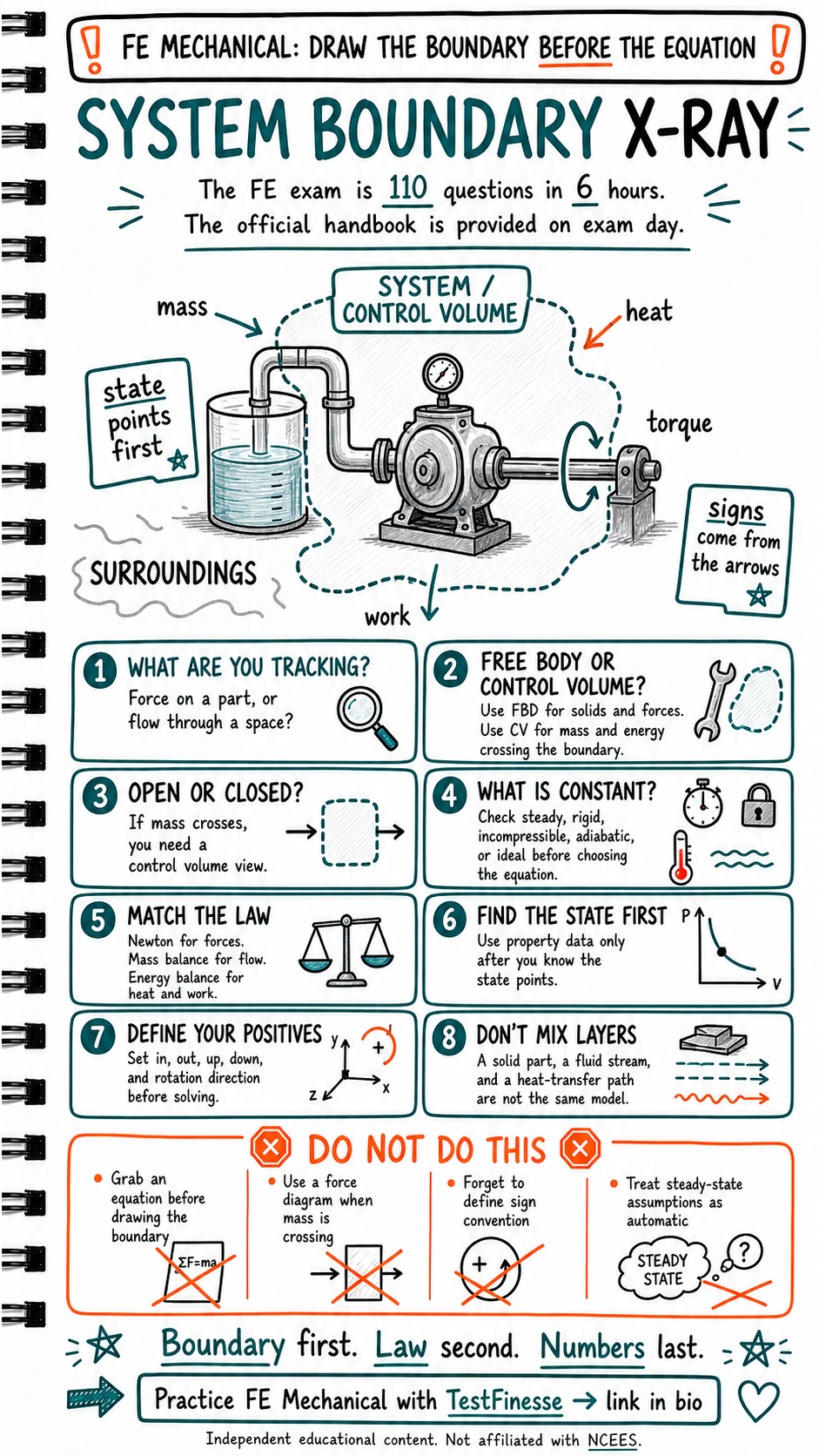
FE Mechanical gets easier when you stop starting with equations.
That is the whole point of this study note. A lot of students see a thermodynamics, fluids, or mechanics problem and immediately hunt for a familiar formula. That feels efficient, but it often creates the wrong setup. The better move is to draw the boundary first, decide what you are tracking, and then choose the law that matches the system.
That matters on the FE because the exam is broad, timed, and reference-heavy. NCEES says the FE exam includes 110 questions in a 6-hour appointment, and NCEES provides an electronic reference handbook on exam day. That means you are not trying to memorize every equation from scratch. You are trying to identify the model quickly and use the handbook correctly.
The TestFinesse rule here is simple:
Boundary first. Law second. Numbers last.
Why Boundary Thinking Matters
In FE Mechanical, the same physical situation can be modeled more than one way.
A rotating shaft might be a mechanics problem.
A flowing fluid stream might be a control volume problem.
A tank may be open or closed.
A device may be steady or transient.
Heat and work may be crossing the boundary, or they may not.
If you do not define the boundary first, you can easily pick the wrong equation family. That is how students lose points even when they know the topic. The math may be fine. The model is wrong.
A good boundary sketch gives you three things:
what is inside the system
what crosses the system boundary
what stays constant, changes, or gets ignored
That is why the infographic calls it an X-ray. You are trying to see the hidden structure before solving.
1. What Are You Tracking?
Before choosing a formula, decide what quantity you are tracking.
Ask:
Force on a part?
Flow through a space?
Mass entering or leaving?
Energy crossing the boundary?
Heat transfer?
Torque on a shaft?
That question tells you which family of tools belongs on the page.
If you are tracking a solid part under force, you may need a free body diagram.
If you are tracking mass or energy moving through a device, you may need a control volume.
TestFinesse rule: If you cannot name the tracked quantity, you are not ready to choose the equation.
2. Free Body Or Control Volume?
This is the first major model choice.
Use a free body diagram when you are focused on a solid object and the external forces acting on it.
Use a control volume when mass or energy is crossing the boundary.
That distinction matters because the same device can be viewed differently depending on the question. A free body diagram is not the right tool for a flow problem. A control volume is not the right tool for a pure force balance on a solid.
If the problem mentions:
fluid entering or leaving
mass flow
heat transfer
work crossing the boundary
think control volume.
If the problem mentions:
support reactions
forces on a body
torque on a shaft
equilibrium of a part
think free body first.
3. Open Or Closed?
Ask whether mass crosses the boundary.
If mass crosses, you are dealing with a control volume view.
If mass does not cross, the system may be closed.
That one decision changes the whole setup.
A closed system may still exchange energy.
An open system may have mass, energy, heat, and work crossing the boundary.
Boundary rule: Mass crossing usually means control volume thinking.
4. What Is Constant?
Before selecting equations, check the assumptions.
The infographic highlights the usual constants and modeling shortcuts:
steady
rigid
incompressible
adiabatic
ideal
These are not decorative words. They decide whether a simpler equation is valid.
Ask:
Is the state steady or changing with time?
Is the volume rigid?
Can the fluid be treated as incompressible?
Is heat transfer negligible?
Can the gas be treated as ideal?
If you assume these without checking, you may choose a formula that does not fit the problem.
TestFinesse rule: State points and assumptions first, then equations.
5. Match The Law
Now choose the law that matches the model.
The big families are:
Newton’s laws for force and motion
Mass balance for flow and continuity
Energy balance for heat and work
That is the order that matters.
If the question is about a force on a part, Newton belongs there.
If it is about mass entering and leaving, mass balance belongs there.
If it is about heat, work, or energy change, energy balance belongs there.
Do not grab an equation because it looks familiar. Grab the law that matches the boundary.
6. Find The State First
For property problems, identify the state points before touching the tables or data.
That is the hidden move that saves time.
Ask:
What are the state points?
What do I know at each point?
What property data do I need?
Which values are given, and which are unknown?
If you look up properties too early, you may waste time on the wrong state. If you define the state first, the data becomes useful instead of noisy.
State rule: Know the points before you hunt property values.
7. Define Your Positives
This is where many FE errors happen in thermodynamics and mechanics.
Before solving, define your sign convention:
What is positive in?
What is positive out?
What direction is up?
What direction is down?
What direction is rotation?
The image says it clearly: signs come from the arrows.
That is exactly right. Your arrows are not decoration. They tell you how the equation should be read.
If you do not define the positive direction first, you can get the algebra right and the answer sign wrong.
8. Don’t Mix Layers
A solid part, a fluid stream, and a heat-transfer path are not the same model.
That is a very useful FE warning.
Do not apply the wrong layer of thinking to the wrong object:
A solid part may need force balance.
A fluid stream may need control volume analysis.
A heat path may need thermal resistance or energy balance.
If you mix them, the setup gets muddy fast.
Layer rule: Match the physical object to the correct model.
Do Not Do This
The red flag section on the page is worth keeping:
do not grab an equation before drawing the boundary
do not use a force diagram when mass is crossing
do not forget to define sign convention
do not treat steady-state assumptions as automatic
That is the anti-pattern. It looks fast, but it usually costs time and points.
Why This Is The FE Mechanical Advantage
FE Mechanical is not trying to trick you into impossible math. The real challenge is choosing the right framework quickly enough to finish with confidence.
That is why boundary work matters. If you can classify the problem correctly, the equation almost chooses itself.
The best students are not the ones who know the most formulas by heart. They are the ones who can look at a problem and say:
What am I tracking?
What is inside the boundary?
What crosses it?
What stays constant?
What law fits this model?
Once those answers are clear, the numbers become much easier.
Use The TestFinesse Practice Loop
The TestFinesse method is:
Answer
Explain
Reveal
Fix the gap
For FE Mechanical, make the explanation part explicit:
What was the boundary?
Was it a free body or a control volume?
Was the system open or closed?
What assumptions were valid?
What sign convention did I use?
Which law should have been applied first?
Then tag the miss:
boundary miss
model miss
assumption miss
sign miss
state-point miss
equation-family miss
That turns a wrong answer into a correction you can reuse.
Final Takeaway
If you want cleaner FE Mechanical answers, do not start with equations.
Start with the boundary.
Boundary first. Law second. Numbers last.
Draw the system, choose the model, define the signs, then solve.
Educational exam prep only. Independent content. Not affiliated with NCEES.
Accuracy sources checked: NCEES FE Exam, NCEES Exam Reference Handbooks, FE Mechanical Interactive Practice Exam.
Keep studying
Practice Exam Skills
Turn this into a better score
Reading about a skill only gets you so far. TestFinesse's AI coach walks you through exam questions, explains exactly where your reasoning breaks down, and adapts to what you actually need to practice next.
Explore All Exams