10 GMAT Score Moves: How to Prep for the Current GMAT Format
Last updated August 9, 2026
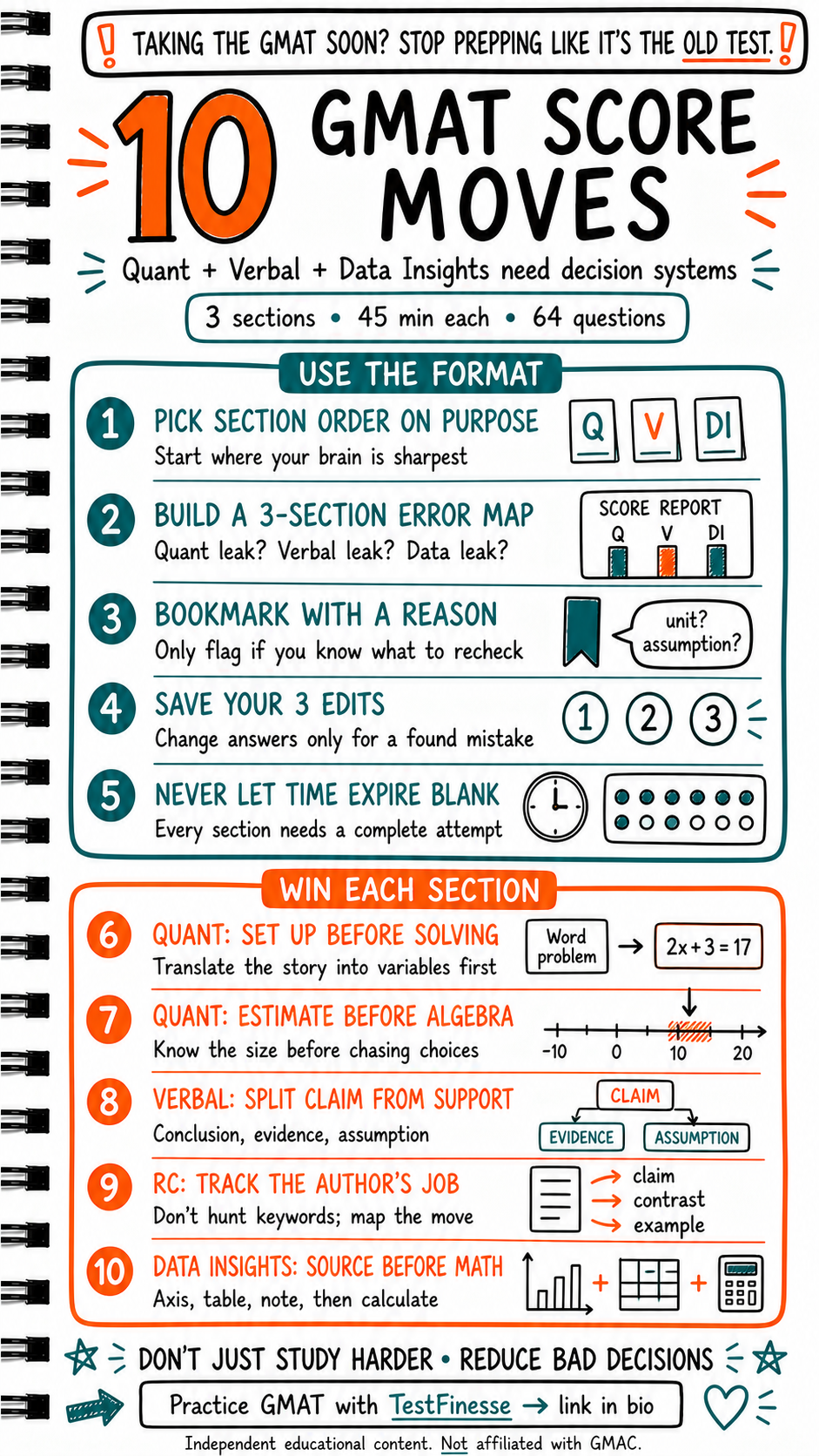
If you are taking the GMAT soon, do not prep like it is the old test.
The current GMAT is shorter, more focused, and built around three scored sections:
Quantitative Reasoning
Verbal Reasoning
Data Insights
Each section is 45 minutes, and the full exam includes 64 total questions.
That matters because your prep should not only be about learning more content. It should also be about building better decision systems.
On the GMAT, strong performance comes from knowing what to solve, when to move, what to review, and how to protect your time. The test rewards problem-solving, critical reasoning, and data literacy, but it also punishes messy pacing and unclear decisions.
The goal is simple:
Do not just study harder. Reduce bad decisions.
Use The Format
The current GMAT gives you more control than many students realize. You can choose your section order, bookmark questions, review questions within a section, and change up to three answers per section if time remains.
That does not mean you should review everything randomly.
It means you need a plan before test day.
1. Pick Section Order On Purpose
The GMAT lets you choose the order of the three sections.
That is a real strategy opportunity.
Some students should begin with their strongest section to build confidence. Others should start with the section that requires the most focus while their brain is fresh.
Ask yourself:
When is my focus strongest?
Which section drains me fastest?
Which section do I recover from most easily?
Where do I make the most careless mistakes?
For example:
If Quant takes the most mental energy, you may want to do it first.
If Verbal warms you up, you may want to start there.
If Data Insights feels detail-heavy, you may want to avoid saving it for last.
Do not pick your section order based on habit. Pick it based on performance data from practice tests.
2. Build A Three-Section Error Map
Your GMAT prep should not produce one big pile of missed questions.
It should produce a clear error map across the three sections:
Quant leak
Verbal leak
Data Insights leak
A Quant leak might mean you know the math but set up word problems incorrectly.
A Verbal leak might mean you understand the passage but miss the author’s logic.
A Data Insights leak might mean you can calculate, but you pull the wrong number from the chart or table.
After every practice set, label the miss:
Content gap
Setup mistake
Timing problem
Careless slip
Misread question
Wrong source
Bad review decision
This turns your prep into diagnosis.
You are not just asking, “What did I miss?”
You are asking:
“What kind of mistake keeps costing me points?”
3. Bookmark With A Reason
The GMAT’s Question Review & Edit feature lets you bookmark and review questions within a section. But bookmarking only helps if you know why you marked the question.
Do not bookmark because you feel uncertain.
Bookmark because you have a specific recheck task.
Good bookmark reasons include:
Check the unit
Recheck the assumption
Verify the table value
Compare two answer choices
Confirm the conclusion
Redo the arithmetic
Look for a wording trap
Bad bookmark reasons sound like:
“I don’t know.”
“Maybe?”
“This feels hard.”
“I’ll figure it out later.”
A useful bookmark should tell your future self what to do.
Before you move on, write the reason mentally:
“I am bookmarking this to recheck the denominator.”
That is much better than returning later and having no idea what worried you.
4. Save Your 3 Edits
On the current GMAT, you can change up to three answers per section if you have time remaining.
That makes edits valuable.
Do not spend them on feelings. Spend them on found mistakes.
A good edit happens when you can say:
I found a calculation error.
I used the wrong row in the table.
I missed the word except.
I identified the actual conclusion.
I found evidence that eliminates my first choice.
A weak edit happens when you say:
“I just feel like B is better.”
“I always second-guess C.”
“This one seemed too easy.”
Changing answers can help when you find a real error. Random second-guessing usually creates noise.
Your rule should be:
Change answers only for a found mistake.
5. Never Let Time Expire Blank
This one matters.
Official GMAT scoring information states that unanswered questions can penalize your score. The current GMAT also requires you to fully submit an answer before time expires for it to count.
That means every section needs a complete attempt.
Do not spend four minutes chasing one question while several questions remain unseen.
A better pacing rule is:
Make a first pass
Answer every question
Bookmark only with a reason
Use remaining time to review
Submit before time expires
Your goal is not to be perfect on every question.
Your goal is to give yourself a chance to earn points across the whole section.
Win Each Section
Once your format strategy is solid, each section needs its own decision system.
The current GMAT is not just “Quant plus Verbal.” Data Insights is its own major section, and Verbal no longer includes Sentence Correction. Your prep should match the current test.
6. Quant: Set Up Before Solving
The Quantitative Reasoning section measures algebraic and arithmetic reasoning through Problem Solving questions.
Many Quant misses happen before the math really begins.
The student rushes into calculation without translating the problem.
Before solving, ask:
What is the unknown?
What are the given values?
What relationship connects them?
Can I write an equation?
Are the units consistent?
For word problems, translate the story into variables first.
Example:
“Three more than twice a number is 17” becomes:
2x + 3 = 17
That setup step protects you from chasing answer choices too early.
7. Quant: Estimate Before Algebra
Estimation is not a shortcut for students who cannot do algebra.
It is a control system for students who want fewer careless mistakes.
Before you calculate, ask:
Should the answer be positive or negative?
Should it be bigger or smaller than the starting value?
Is it closer to 10 or 100?
Does the answer need to be an integer?
Would a very large answer make sense?
Estimation helps you notice when your algebra has gone off track.
If the answer choices are spread apart, you may not need a perfect calculation. If the choices are close together, estimation still gives you a reasonableness check.
The point is:
Know the size before chasing choices.
8. Verbal: Split Claim From Support
The Verbal Reasoning section includes Reading Comprehension and Critical Reasoning.
For Critical Reasoning, the key is structure.
Most arguments include:
Claim
Evidence
Assumption
Conclusion
Gap
Do not read a Critical Reasoning prompt like a paragraph of interesting information. Read it like a machine.
Ask:
What is the author trying to prove?
What evidence is offered?
What assumption connects the evidence to the claim?
Does the question ask me to strengthen, weaken, explain, infer, or identify a flaw?
If you can separate claim from support, answer choices become easier to judge.
You are no longer asking, “Does this sound right?”
You are asking:
“What does this do to the argument?”
9. Reading Comprehension: Track The Author’s Job
For Reading Comprehension, do not hunt keywords without understanding the passage structure.
Track the author’s job.
A paragraph may be doing one of several things:
Making a claim
Providing evidence
Giving an example
Showing contrast
Explaining a cause
Introducing a problem
Rejecting an old view
Qualifying a conclusion
This is more useful than trying to memorize every detail.
When a question asks for main idea, inference, function, or structure, your map of the author’s moves helps you return to the right part of the passage.
A simple note might look like:
Paragraph 1: old theory
Paragraph 2: new evidence
Paragraph 3: author’s conclusion
That is enough to keep you oriented.
10. Data Insights: Source Before Math
Data Insights measures your ability to analyze information from multiple sources and formats. It can include tables, graphics, text, data sufficiency, multi-source reasoning, and two-part analysis.
The biggest mistake is calculating before identifying the source.
Before doing math, ask:
Which chart matters?
Which table row matters?
What does the axis measure?
Are the units dollars, percentages, years, or rates?
Is there a note or condition?
Do I need all the information or only one source?
Your order should be:
Read the task
Find the source
Check labels and notes
Then calculate
Data Insights is designed to test judgment, not just arithmetic.
The right number in the wrong table is still the wrong answer.
Use The TestFinesse Practice Loop
The TestFinesse practice loop is:
Answer
Explain
Reveal
Fix the gap
For GMAT prep, use that loop section by section.
After a Quant miss, ask:
Did I set it up correctly?
Did I estimate first?
Did I make an arithmetic mistake?
Did I solve for the wrong value?
After a Verbal miss, ask:
Did I identify the conclusion?
Did I understand the question type?
Did I pick an answer that sounded good but did not do the job?
After a Data Insights miss, ask:
Did I use the right source?
Did I read the axis correctly?
Did I miss a note, condition, or unit?
Did I calculate before understanding the task?
That is how practice becomes useful.
You are not just trying to get more questions done. You are training the decisions you want to make on test day.
Final Takeaway
The current GMAT rewards more than content knowledge.
It rewards clean decisions.
To improve your score, focus on these 10 moves:
Pick section order on purpose
Build a three-section error map
Bookmark with a reason
Save your three edits for found mistakes
Never let time expire blank
Set up Quant before solving
Estimate before algebra
Split Verbal claims from support
Track the author’s job in Reading Comprehension
Find the Data Insights source before doing math
The best GMAT prep does not just teach you more.
It makes your test-day decisions automatic.
Accuracy sources checked: GMAT Exam Structure, GMAT Exam Content, GMAT Scores, Official Score Reports, and GMAT Test Day Expectations.
Keep studying
Practice Exam Skills
Turn this into a better score
Reading about a skill only gets you so far. TestFinesse's AI coach walks you through exam questions, explains exactly where your reasoning breaks down, and adapts to what you actually need to practice next.
Explore All Exams