CFA Level I Exam Review Map: Diagnose the Miss, Don’t Just Reread
Last updated September 10, 2026
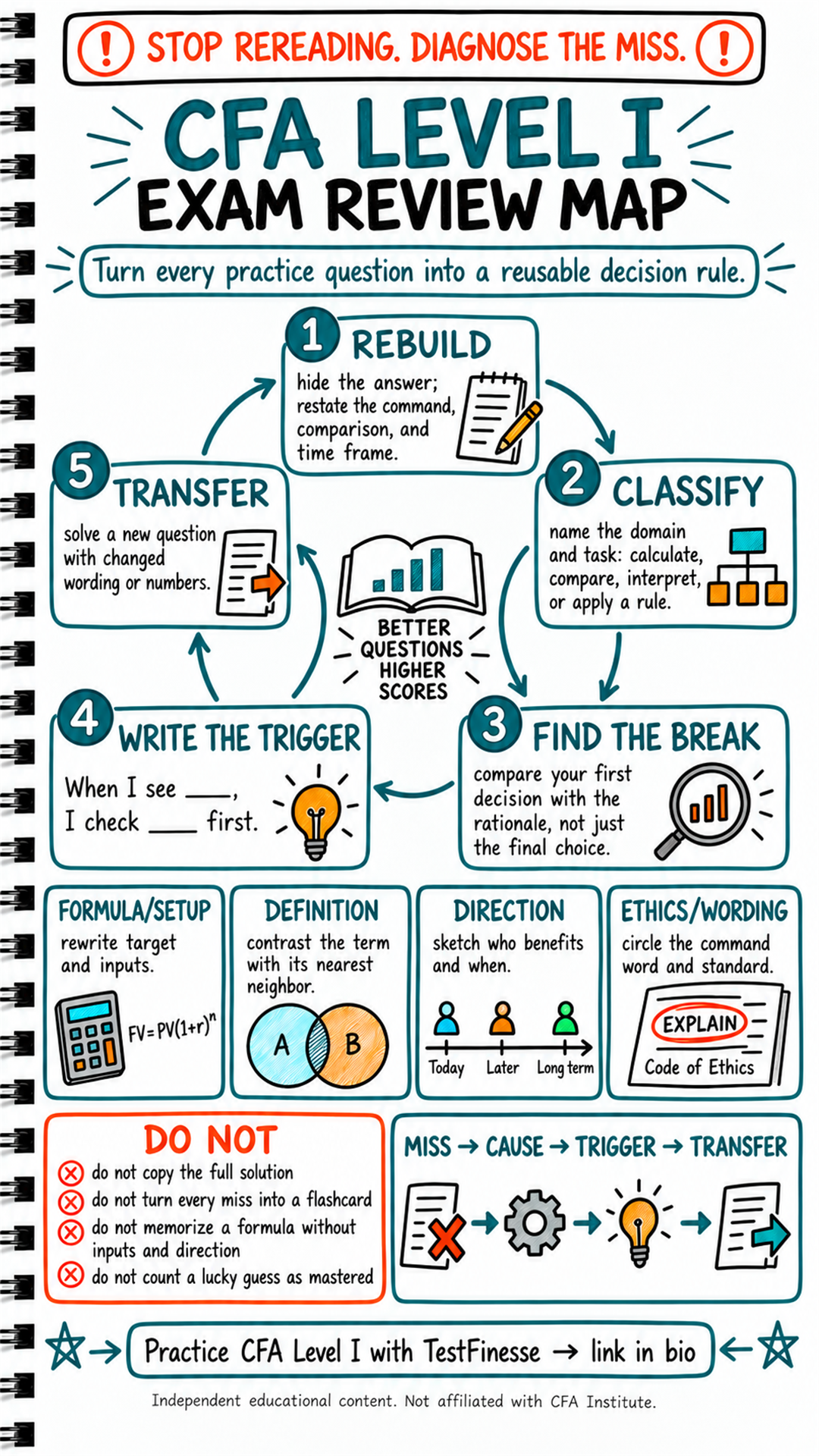
CFA Level I review becomes inefficient when every missed question leads to more rereading.
You miss a question, check the explanation, copy the solution, and move on. The answer makes sense, so you assume the problem is fixed.
Then a differently worded question appears and the same mistake returns.
The problem is not always a lack of content. It may be a setup error, a definition mismatch, a direction error, or an Ethics wording problem. That is why the best review process does not simply explain the final answer.
It rebuilds the decision that should have happened before the answer.
The review loop is:
Rebuild → Classify → Find the break → Write the trigger → Transfer
Why Copying the Solution Is Not Enough
A copied solution can show you what the correct path looked like. It does not prove that you can find that path independently.
CFA Level I questions cover multiple domains, including Ethical and Professional Standards, Quantitative Methods, Economics, Financial Statement Analysis, Corporate Finance, Equities, Fixed Income, Derivatives and Risk Management, Alternative Investments, and Portfolio Construction. CFA Institute also reports current topic weights by exam year, so your review should align with the correct curriculum outline for your sitting. CFA Institute Level I Exam
A strong review asks:
What did the question ask?
What domain and task did it represent?
What was my first decision?
Where did my reasoning split from the solution?
What cue should trigger the correct move next time?
Can I transfer the fix to a new question?
1. Rebuild the Question
Hide the answer and restate the prompt.
Write down:
The command
The comparison
The time frame
The target quantity
The relevant inputs
Any stated assumptions
For example, do not summarize a question as “bond math.” Rewrite it more precisely:
“Calculate the bond price after a change in yield over the stated period.”
Do not summarize an Ethics question as “conflict.” Identify the task:
“Determine whether the conduct violates the applicable standard.”
This prevents the solution from thinking for you.
A question may contain many facts, but only some determine the answer. Rebuilding forces you to separate the requested task from the surrounding story.
2. Classify the Domain and Task
Next, name both the subject area and the question type.
The domain might be:
Ethics
Quantitative Methods
Financial Statement Analysis
Equities
Fixed Income
Derivatives
Portfolio Construction
Economics
Corporate Finance
Alternative Investments
The task might be asking you to:
Calculate
Compare
Interpret
Apply a rule
Identify a violation
Determine direction
Evaluate a definition
Select the most appropriate conclusion
This classification matters because the same words can behave differently in different domains.
For example:
“Return” may require a calculation in Quantitative Methods but a conceptual interpretation in Equities.
“Risk” may refer to duration, credit, portfolio exposure, or an Ethics concern.
“Value” may mean present value, intrinsic value, market value, or a calculated output.
Name the domain and task before searching for the formula.
3. Find the Break
Compare your first decision with the rationale, not only your final answer.
The most valuable question is:
Where did my reasoning first diverge?
Possible breaks include:
Choosing the wrong formula family
Using the wrong input
Misreading the time frame
Reversing price or yield direction
Comparing ratios with different definitions
Applying the wrong Ethics standard
Confusing a definition with its nearest neighboring term
Misreading what the question asked
Ignoring an assumption
For example, suppose your answer used the correct time-value-of-money formula but produced the wrong result. The break may not be the formula. It may be:
Incorrect sign convention
Wrong number of periods
Annual versus periodic rate mismatch
Cash flow entered in the wrong field
Wrong target date
This distinction matters because rereading the formula will not repair a calculator or timeline problem.
Find the first broken decision, not just the final wrong number.
4. Write the Trigger
Turn the repair into a conditional rule.
Use this sentence:
When I see ______, I check ______ first.
Examples:
When I see a time-value question, I draw the timeline before using the calculator.
When I see bond yields rising, I check price direction before calculating.
When I see two ratios being compared, I verify that their definitions match.
When I see an Ethics scenario, I identify the applicable standard before judging the tone.
When I see a derivative position, I sketch who benefits when the underlying moves.
When I see a financial statement question, I identify the accounting treatment before interpreting the ratio.
A trigger is not a flashcard definition. It connects a prompt clue to a decision.
That makes it useful under pressure.
Repair by Miss Type
Different misses need different repairs.
Formula or Setup Miss
Rewrite the target and inputs. Then rebuild the relationship before substituting values.
Definition Miss
Contrast the unfamiliar term with its nearest neighbor.
For example:
Price versus value
Growth versus return
Systematic versus unsystematic risk
Revenue versus cash flow
Yield versus coupon
Direction Miss
Sketch who benefits and when. Use a timeline, arrow, or two-column comparison.
Ethics or Wording Miss
Circle the command word and identify the relevant standard. Do not choose the answer that simply sounds most professional.
5. Transfer the Skill
The final step is to solve a new question with changed wording or numbers.
This is where you find out whether the rule transferred.
A transfer question should change the surface while preserving the underlying skill:
New bond data, same price-yield relationship
New company, same financial-statement treatment
New Ethics scenario, same standard
New derivative, same long-versus-short direction
New cash flows, same present-value setup
Do not immediately repeat the original question and call it mastery. Immediate repetition can test memory of the answer rather than understanding of the method.
Transfer is proof that your repair works beyond the original item.
What Not to Do
Avoid these review habits:
Copying the full solution
Turning every miss into a flashcard
Memorizing a formula without its inputs and direction
Treating a lucky guess as mastery
Rereading an entire chapter for one broken step
Looking only at the final answer
Ignoring correct answers that were low-confidence
Repeating the same question immediately
Your review should be smaller than your original study session, but more precise.
Use the TestFinesse Practice Loop
Apply this sequence to each meaningful miss:
Rebuild: Restate the command, comparison, time frame, target, and inputs.
Classify: Name the CFA domain and task.
Find the break: Compare your first decision with the reference solution.
Write the trigger: Create one “when I see this, I check that” rule.
Transfer: Solve a fresh question using changed wording or numbers.
This produces a reusable decision rule instead of a copied explanation.
Final Takeaway
CFA Level I review is not about rereading until the solution looks familiar.
It is about diagnosing the miss precisely enough to change your next decision.
Miss → cause → trigger → transfer
That is how practice questions become better questions, and better questions become stronger exam performance.
Independent educational content. Not affiliated with CFA Institute.
Accuracy sources checked: CFA Institute Level I Exam, CFA Institute Curriculum Overview
Keep studying
- CFA Level I Question Decoder: Classify the Task Before You Calculate
- CFA Level I Study Plan Map: Use Topic Weights and Weaknesses to Study Smarter
- CFA Level I Study Heavyweights First: Use Exam Weights to Decide What Earns Daily Reps
- 10 CFA Level I Score Moves: Fast Decisions for Multiple-Choice Finance Questions
Practice Exam Skills
Turn this into a better score
Reading about a skill only gets you so far. TestFinesse's AI coach walks you through exam questions, explains exactly where your reasoning breaks down, and adapts to what you actually need to practice next.
Explore All Exams