10 CFA Level I Score Moves: Fast Decisions for Multiple-Choice Finance Questions
Last updated August 12, 2026
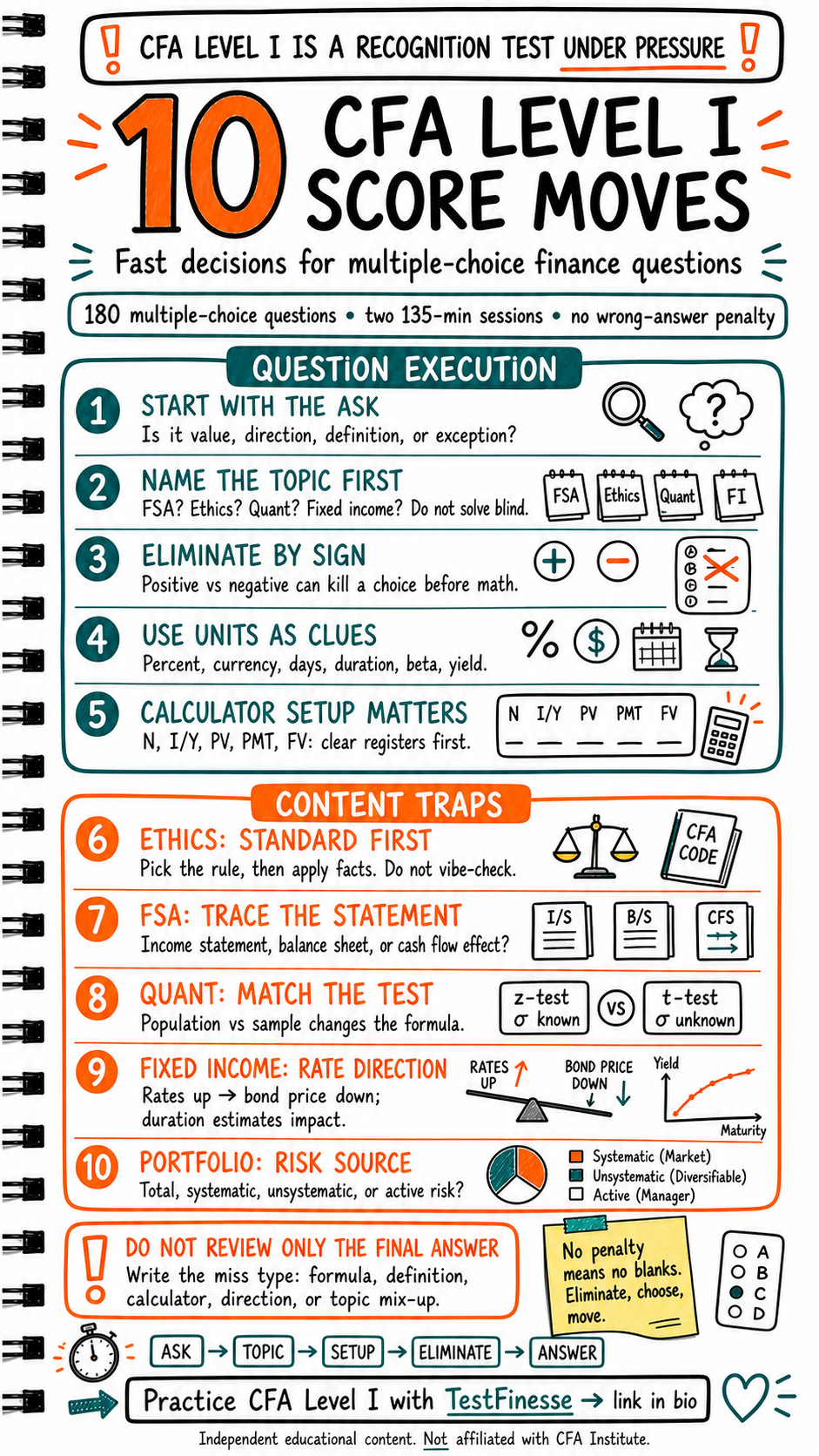
CFA Level I is a recognition test under pressure.
Yes, you need formulas. Yes, you need definitions. Yes, you need to understand ethics, financial statement analysis, quant, fixed income, portfolio management, and the rest of the curriculum. But on exam day, the challenge is not only “Do I know this?”
The real challenge is:
Can I recognize what the question is testing fast enough to choose the right answer?
CFA Institute describes Level I as 180 multiple-choice questions across two 135-minute sessions, with 90 questions per session. Each item has three answer choices, all questions are equally weighted, and there is no penalty for an incorrect answer.
That means blank answers are wasted opportunities.
The TestFinesse flow for CFA Level I is:
Ask → Topic → Setup → Eliminate → Answer
Why CFA Level I Feels So Broad
Level I covers a wide range of finance and investment foundations. Candidates are expected to move quickly between topics such as:
Ethical and Professional Standards
Quantitative Methods
Economics
Financial Statement Analysis
Corporate Issuers
Equity Investments
Fixed Income
Derivatives
Alternative Investments
Portfolio Management
That breadth is exactly why “just solve harder” is not enough.
A question may look like math, but actually test units.
A question may look like ethics, but actually test the exact Standard.
A question may look like FSA, but actually test which statement is affected.
A question may look like fixed income, but actually test rate direction.
The score move is to classify before calculating.
1. Start With The Ask
Before you solve, identify what the stem wants.
Ask:
Is it asking for a value?
Is it asking for a direction?
Is it asking for a definition?
Is it asking for the most likely or least likely answer?
Is it asking for an exception or contrast?
This matters because CFA Level I answer choices can be close. If you start solving before naming the task, you may answer a different question than the one being asked.
Score move: Rewrite the ask in five words or fewer before calculating.
Examples:
“Find ending inventory.”
“Choose least appropriate action.”
“Identify cash flow effect.”
“Calculate bond price direction.”
“Name the risk type.”
That tiny pause prevents avoidable misses.
2. Name The Topic First
Do not solve blind.
Before you start calculating, classify the topic:
FSA
Ethics
Quant
Fixed Income
Portfolio
Equity
Economics
Corporate Issuers
This is not just organization. It changes the rule set.
An “income” question in FSA is not handled the same way as a “yield” question in fixed income. A “risk” question in portfolio management is not the same as a “standard deviation” question in quant.
Topic recognition is the first formula.
If you cannot name the topic, slow down before you speed up.
3. Eliminate By Sign
Positive vs. negative can kill an answer before you do full math.
For example:
If rates rise, many bond prices move down.
If expenses increase, net income may decrease.
If duration is positive, price sensitivity has a direction.
If a covariance or correlation sign is known, some outcomes become impossible.
This does not replace calculation. It protects you from bad answer choices early.
Score move: Before using the calculator, ask whether the answer should be positive, negative, higher, lower, increasing, or decreasing.
If one answer violates the expected direction, eliminate it.
4. Use Units As Clues
Units are not decoration. They tell you what family the question belongs to.
Watch for:
Percent
Currency
Days
Duration
Beta
Yield
Basis points
Ratios
Shares
Cash flows
A percent answer and a dollar answer are not interchangeable. A yield and a price are not the same target. A duration measure and a time period can look similar but behave differently.
Score move: Circle or write the final unit before calculating.
If your setup ends in the wrong unit, the arithmetic does not matter.
5. Calculator Setup Matters
CFA Level I allows only approved calculator models under CFA Institute’s calculator policy, including the Texas Instruments BA II Plus family and Hewlett Packard 12C family. If you use a financial calculator, you need to know it cold before exam day.
For time value of money questions, the common fields are:
N
I/Y
PV
PMT
FV
But the calculator only does what you tell it.
Common calculator score leaks include:
Forgetting to clear registers
Mixing monthly and annual periods
Entering the wrong sign for cash inflows/outflows
Using percent format incorrectly
Forgetting payments per year settings
Score move: Clear registers first, then label the inputs before pressing compute.
6. Ethics: Standard First
Ethics is not a vibe-check.
Do not ask, “What feels professional?” Ask:
Which Standard applies, and how do the facts fit it?
For ethics questions, the wrong answer may sound reasonable but fail the exact rule. You need to identify the issue first:
Duties to clients
Duties to employers
Conflicts of interest
Misrepresentation
Market integrity
Confidentiality
Suitability
Priority of transactions
Score move: Pick the rule before applying the facts.
7. FSA: Trace The Statement
Financial Statement Analysis questions often test where the effect lands.
Ask:
Is this an income statement effect?
Is this a balance sheet effect?
Is this a cash flow statement effect?
Is it an operating, investing, or financing classification?
Does the event affect assets, liabilities, equity, revenue, or expense?
A common miss is knowing the concept but putting the impact on the wrong statement.
Score move: Before calculating, name the statement being affected.
8. Quant: Match The Test
Quant questions often hinge on matching the correct statistical test, formula, or assumption.
For example:
Population vs. sample can change the formula.
Known vs. unknown variance can change the test.
One-tailed vs. two-tailed changes the rejection region.
Nominal vs. effective rates change the setup.
Do not rush into numbers before identifying the structure.
Score move: Ask, “What condition changes the formula?”
9. Fixed Income: Rate Direction
Fixed income questions often reward directional understanding before calculation.
Core rule:
Rates up → bond prices down.
Rates down → bond prices up.
Duration estimates price sensitivity, but you still need the direction. Yield curve shape, maturity, coupon, convexity, and duration can all affect the size of the move.
Score move: Predict the direction before touching the calculator.
If your final answer moves the wrong way, check the setup.
10. Portfolio: Risk Source
Portfolio questions often ask what kind of risk is being described.
Sort the source:
Total risk
Systematic risk
Unsystematic risk
Active risk
Market risk
Diversifiable risk
Manager risk
This is a recognition problem. If the question describes risk that diversification can reduce, that points one way. If it describes market-wide exposure, that points another way.
Score move: Name the risk source before choosing the answer.
Do Not Review Only The Final Answer
The worst CFA review habit is checking only whether you picked A, B, or C.
That hides the real miss.
After every missed question, write the miss type:
Formula miss
Definition miss
Calculator miss
Direction miss
Topic mix-up
Ethics standard miss
Unit miss
Time-pressure miss
If you only write “wrong,” you will repeat the error. If you write “forgot to clear calculator registers” or “mixed up systematic and unsystematic risk,” you have a fixable rule.
No Penalty Means No Blanks
Because CFA Institute states there is no penalty for incorrect answers, every question deserves an answer.
That does not mean guessing randomly from the start. It means:
Eliminate what you can.
Use sign, unit, and topic clues.
Choose the best remaining answer.
Move before one item steals time from several others.
No penalty means no blanks. Eliminate, choose, move.
Use The TestFinesse Practice Loop
The TestFinesse method is:
Answer
Explain
Reveal
Fix the gap
For CFA Level I, make the explanation topic-specific:
What was the ask?
What topic was tested?
What setup was required?
What could be eliminated before math?
What miss type should go in the trap bank?
The goal is not just to know more finance. The goal is to make faster, cleaner decisions under Level I pacing.
Final Takeaway
CFA Level I rewards breadth, recognition, and disciplined execution.
Before you calculate, move through the sequence:
Ask → Topic → Setup → Eliminate → Answer
That simple routine helps you avoid solving blind, mixing topics, trusting the calculator too early, or leaving points blank.
Independent educational content. Not affiliated with CFA Institute.
Accuracy sources checked: CFA Institute Level I Exam, CFA Institute Calculator Policy.
Keep studying
Practice Exam Skills
Turn this into a better score
Reading about a skill only gets you so far. TestFinesse's AI coach walks you through exam questions, explains exactly where your reasoning breaks down, and adapts to what you actually need to practice next.
Explore All Exams