CFA Level I Study Heavyweights First: Use Exam Weights to Decide What Earns Daily Reps
Last updated August 17, 2026
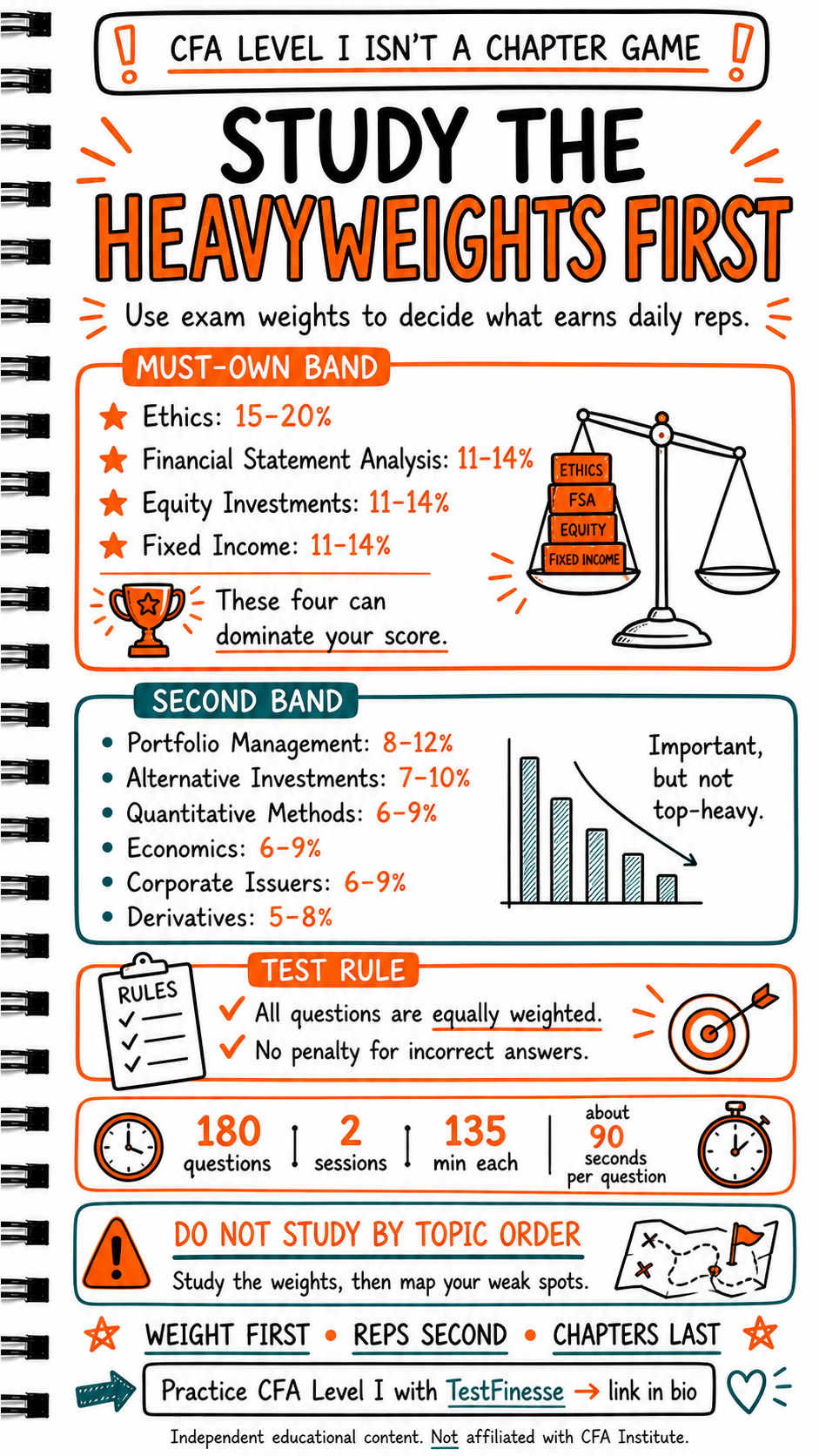
CFA Level I is not a chapter game.
That is the trap. Students often try to study in textbook order, or they spread time evenly across every topic because “everything matters.” That sounds disciplined, but it is not the same as efficient.
The better move is to study the topics that matter most first.
CFA Institute’s current Level I topic weights make the priority pattern very clear. The heaviest topics are:
Ethics and Professional Standards: 15-20%
Financial Statement Analysis: 11-14%
Equity Investments: 11-14%
Fixed Income: 11-14%
Those four areas can dominate the score. After that come the second-band topics:
Portfolio Management: 8-12%
Alternative Investments: 7-10%
Quantitative Methods: 6-9%
Economics: 6-9%
Corporate Issuers: 6-9%
Derivatives: 5-8%
That does not mean the smaller topics are unimportant. It means the weight tells you what should earn daily reps first.
Why The Weight Map Matters
The Level I exam is broad, but it is not flat.
CFA Institute says Level I consists of 180 multiple-choice questions across two 135-minute sessions, with 90 questions per session. CFA Institute also says all questions are equally weighted and there is no penalty for an incorrect answer.
So the exam is not rewarding you for being “kind of familiar” with everything. It is rewarding you for being strong where the question volume and weight make the biggest difference.
That is why the image’s idea is correct:
Use exam weights to decide what earns daily reps.
If you try to study every chapter the same way, you will waste time on low-return work while leaving big holes in the areas that matter most.
1. Study The Must-Ow
n Band First
The first band is the set of topics that can carry or sink the score:
Ethics
Financial Statement Analysis
Equity Investments
Fixed Income
These are the heavyweights because they combine high weight with high conceptual demand. They are also the areas where weak fundamentals can create repeated misses across multiple question styles.
Ethics
Ethics is not just a definition drill. It is a judgment layer.
CFA Institute’s standards emphasize professionalism, objectivity, and truthful representation. On the exam, ethics questions often test whether you can apply the standard to the fact pattern, not just recite the rule.
Daily rep idea: Work ethics with short, repeated scenario judgments.
Financial Statement Analysis
FSA is where candidates often lose points through weak statement logic, ratio confusion, or poor recognition of how reporting affects analysis.
CFA Institute’s Level I curriculum places major emphasis on financial statement interpretation and analysis techniques, which makes this a core score area.
Daily rep idea: Practice statement-level cause-and-effect, not just isolated formulas.
Equity Investments
Equity questions test valuation logic, market structure, and security analysis concepts. They often reward clean definition plus clean interpretation.
Daily rep idea: Build a repetition habit around valuation drivers, not just formula memorization.
Fixed Income
Fixed income is one of the most important weighted areas because small conceptual mistakes can produce large chain-reaction errors.
Duration, yield, price relationships, and term structure logic show up again and again.
Daily rep idea: Train rate direction, price movement, and bond math as a single system.
2. Respect The Second Band
The second band is not “easy.” It is just lower weight than the top four.
These topics still matter:
Portfolio Management
Alternative Investments
Quantitative Methods
Economics
Corporate Issuers
Derivatives
If you ignore them, they become score leaks. But if you spend too much time here before the heavier topics are secure, you can end up with a balanced-looking study plan that produces a weak total.
The image is right to label them “important, but not top-heavy.”
Portfolio Management
This topic matters because it pulls together risk, return, and decision logic.
Alternative Investments
These questions can be smaller in weight but still test terminology, structure, and product differences.
Quantitative Methods
Quant often looks smaller than it is. It supports multiple other topics, so weak quant can leak into FSA, fixed income, and portfolio questions.
Economics
Economics rewards understanding of relationships, not just isolated terms.
Corporate Issuers
This topic often overlaps with capital structure, governance, and financing choices.
Derivatives
Derivatives is the smallest-weight band on the image, but it still deserves steady attention because derivative logic tends to be cumulative.
Study rule: Lower weight does not mean zero reps. It means reps after the heavyweights.
3. Use The Test Rule Correctly
CFA Institute states that all questions are equally weighted and there is no penalty for incorrect answers.
That means two things:
You should never leave a question blank just because you are unsure.
You should study for decision quality, not just memorization.
When there is no guessing penalty, the real skill becomes eliminating the wrong choices, recognizing the tested concept, and moving on without overworking one item.
Test rule: No penalty means no blanks.
That is useful in practice and in strategy. It means your prep should include speed, elimination, and confidence under pressure.
4. Use The Timing Reality
CFA Institute says to allow about 90 seconds per multiple-choice question on Level I. The exam is built around two 135-minute content sessions.
That is not a lot of time to think your way into every problem from scratch.
So your study should train:
fast topic recognition
clean calculator use
quick elimination
confidence on weighted topics
controlled pacing across the session
If a topic takes you too long in practice, that is a signal. It may not only be a content gap. It may also be a route-selection problem.
Timing rule: The score is not just what you know. It is how quickly you recognize what is being asked.
5. Do Not Study By Topic Order
This is one of the most useful warnings in the image.
Do not study in chapter order just because the curriculum is arranged that way.
Study the weights first, then map your weak spots.
A better sequence is:
Ethics
FSA
Equity
Fixed Income
Portfolio
The remaining topics in a weighted rotation
That does not mean you ignore the curriculum order entirely. It means your daily reps should follow return on effort, not page order.
Weight-first rule: Study the topics that earn the most points before you polish the smallest ones.
What This Means In Practice
A strong CFA Level I plan is not “study everything every day.”
It is:
heavyweights daily
second-band topics on rotation
weak areas tracked by pattern
ethics revisited often
timed practice used early
elimination skill practiced constantly
That is a much better use of time than trying to make every chapter feel equally important.
Use The TestFinesse Practice Loop
The TestFinesse method is:
Answer
Explain
Reveal
Fix the gap
For CFA Level I, your explanation should include:
Which topic weight did this question belong to?
Was this a heavyweight or second-band topic?
Was the miss due to content, timing, or route?
Did I choose a blank when I should have eliminated and moved?
Which daily rep should I add next?
That turns a practice question into a score-weight decision.
Final Takeaway
CFA Level I is not a chapter game.
It is a weighting game.
Study the heavyweights first, protect the second band, and use the exam structure to guide daily reps.
Weight first. Reps second. Chapters last.
Independent educational content. Not affiliated with CFA Institute.
Accuracy sources checked: CFA Institute Level I Exam, CFA Program Exam Information, CFA Level I Topic Weights, CFA Exam Day Guide.
Keep studying
Practice Exam Skills
Turn this into a better score
Reading about a skill only gets you so far. TestFinesse's AI coach walks you through exam questions, explains exactly where your reasoning breaks down, and adapts to what you actually need to practice next.
Explore All Exams