CFA Level I Question Decoder: Classify the Task Before You Calculate
Last updated August 30, 2026
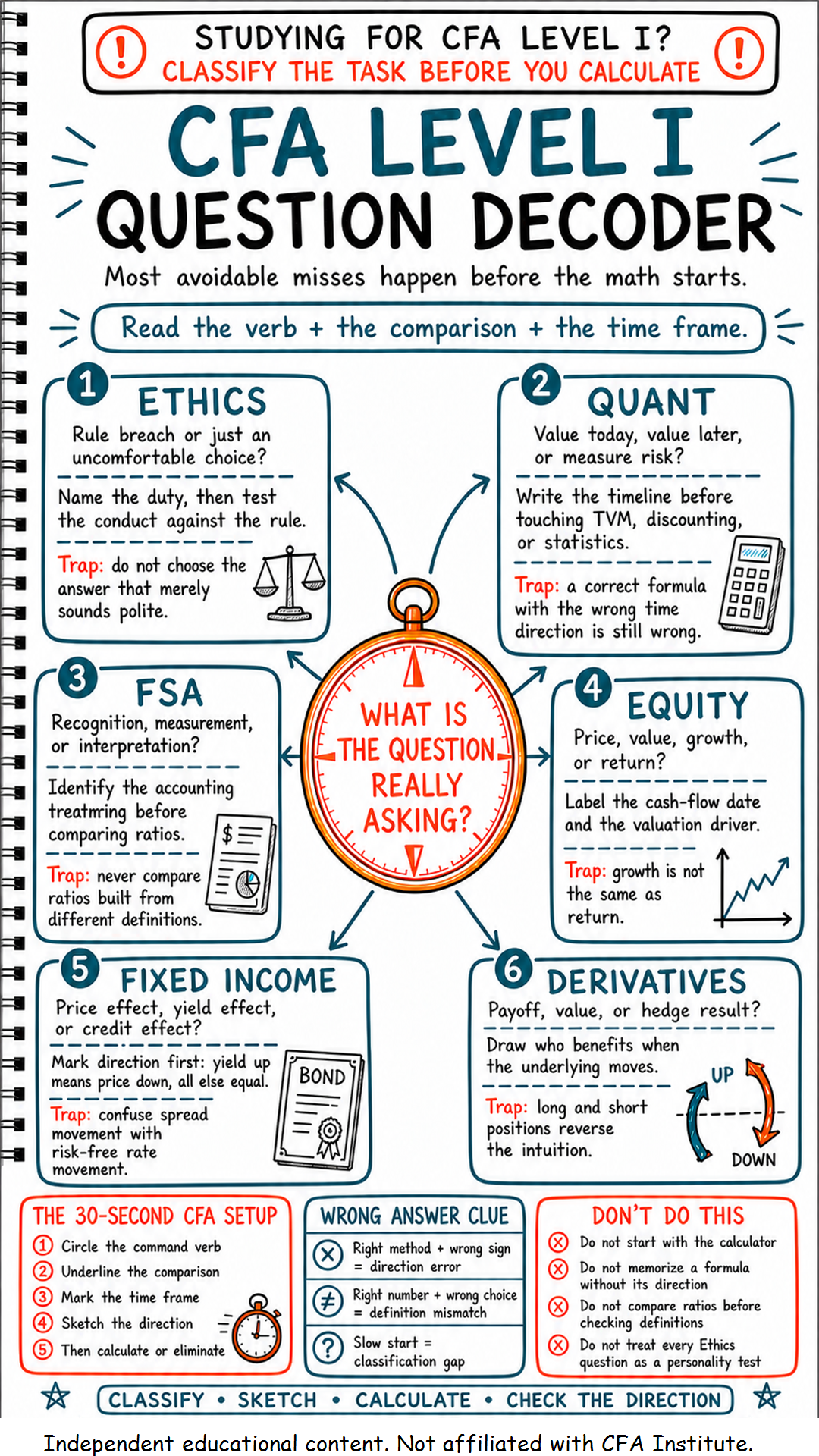
Many CFA Level I misses happen before the math begins.
A candidate may remember the correct formula, enter the numbers correctly, and still choose the wrong answer because the question asked for something different. Was it asking for value today, value later, growth, return, price effect, yield effect, or a rule-based judgment?
The formula is only useful after the task is clear.
The core CFA Level I move is:
Read the verb. Identify the comparison. Mark the time frame. Sketch the direction. Then calculate.
The current CFA Institute Level I curriculum covers ten topic areas, including Ethics, Quantitative Methods, Financial Statement Analysis, Equities, Fixed Income, Derivatives and Risk Management, and Portfolio Construction. Current topic weights vary by area, so use the official outline for your exam window rather than relying on an old chart or study guide. CFA Institute Level I Exam
The 30-Second CFA Setup
Before touching your calculator, make five quick decisions:
Circle the command verb.
Underline the comparison.
Mark the time frame.
Sketch the direction.
Then calculate or eliminate.
This setup is fast because it prevents you from solving the wrong problem efficiently.
1. Ethics: Rule Breach or Uncomfortable Choice?
Ethics questions are not personality tests. They are rule-application questions.
Start by identifying the professional duty or standard involved:
Is there a conflict of interest?
Was material nonpublic information used?
Was a client treated unfairly?
Was disclosure required?
Did the action violate a specific standard?
Is the issue related to performance presentation, suitability, or professional conduct?
A choice can sound polite, cautious, or professional and still be wrong. The correct answer depends on the applicable rule and the facts provided.
Use this sequence:
Identify the conduct.
Name the duty or standard.
Test the conduct against the rule.
Eliminate choices that add facts not present in the vignette.
Do not choose the answer that merely sounds the most ethical. Choose the answer supported by the standard being tested.
When two answers feel close, ask:
What specific rule makes one answer more defensible?
2. Quantitative Methods: What Is the Time Direction?
Quantitative questions often become confusing when the timeline is left implicit.
Before using time value of money, discounting, or statistics, label:
What is known today?
What occurs in the future?
What is being discounted?
What is being compounded?
Is the question asking for a rate, value, return, or risk measure?
A correct formula with the wrong time direction still produces the wrong answer.
For a present-value problem, cash flows are brought backward. For a future-value problem, values are moved forward. Draw a simple timeline before entering numbers:
Today -------- period 1 -------- period 2 -------- FutureThen mark the cash flow and the requested value.
For statistics questions, classify the measure before calculating:
Central tendency
Dispersion
Probability
Correlation
Return
Risk
The timeline comes before the calculator.
3. Financial Statement Analysis: Recognition, Measurement, or Interpretation?
Financial Statement Analysis questions often use familiar ratios and accounting terms. That familiarity can create a trap: you may compare numbers before confirming that the numbers were built under comparable definitions.
First ask what the question is testing:
Recognition
Measurement
Classification
Disclosure
Ratio interpretation
Accounting treatment
Effect on a financial statement
Then identify the accounting treatment before comparing ratios.
A ratio is meaningful only when its numerator, denominator, period, and accounting basis are understood. Do not compare two ratios automatically just because they have the same name.
Check:
Are both companies using comparable accounting treatments?
Are the periods the same?
Is the ratio affected by a classification choice?
Does the question ask what changed, why it changed, or what the change implies?
Definition mismatch is often more important than arithmetic.
4. Equities: Price, Value, Growth, or Return?
Equity questions frequently use words that sound related but describe different outputs.
Separate:
Price from value
Growth from return
Earnings from cash flow
Expected return from realized return
Value today from value at a future date
If the question asks for a valuation result, identify the cash-flow date and the valuation driver. If it asks about return, identify the beginning value, ending value, income received, and time period.
Growth is not automatically return. A company can grow earnings without producing the same percentage return for an investor. Price movement, dividends, changes in valuation multiples, and investor expectations may all affect return.
Before calculating, complete this sentence:
“The question wants me to find the ______ caused by ______ over ______.”
That sentence often reveals whether you need a valuation model, a return formula, or a conceptual explanation.
5. Fixed Income: Mark the Direction First
Fixed income questions reward directional thinking.
A foundational relationship is:
When yields rise, bond prices generally fall, all else equal.
When yields fall, bond prices generally rise. But the question may be asking about something more specific:
Price effect
Yield effect
Duration
Spread movement
Credit effect
Risk-free rate movement
Coupon income
Reinvestment risk
Do not confuse a change in the risk-free rate with a change in credit spread. Both can affect a bond’s required return, but they do not represent the same risk source.
Write the direction before using numbers:
Yield up → Price down
Yield down → Price up
Then determine whether the question is asking about the bond’s price, yield, spread, or credit condition.
Direction is a setup step, not a final check.
6. Derivatives: Who Benefits When the Underlying Moves?
Derivatives questions become easier when you draw the payoff direction.
Ask:
Who is long?
Who is short?
What is the underlying asset?
Does the underlying move up or down?
Is the question asking for payoff, value, profit, or hedge result?
Are premiums or other cash flows included?
Long and short positions reverse the intuitive outcome. A position that benefits from an increase in the underlying will generally lose value when the underlying falls, subject to the specific contract and payoff structure.
Create a tiny two-column sketch:
Underlying up   | Who benefits?
Underlying down | Who benefits?
For options, distinguish the option holder’s right from the writer’s obligation. For futures and forwards, identify the direction of the contract and the economic exposure being hedged.
Do not rely on memorized slogans. Draw who benefits.
The Wrong-Answer Clues
The answer choices often reveal the type of mistake being tested.
Right Method, Wrong Sign
You selected the correct relationship but reversed the direction. This is common in bond price-yield questions, derivative payoffs, and changes in present or future value.
Right Number, Wrong Choice
Your arithmetic may be sound, but the answer uses the wrong definition or answers a different part of the question.
Slow Start
If you spend most of your time deciding what the question means, the gap may be classification rather than calculation.
Familiar Formula, Wrong Time Frame
You remembered the equation but applied it to the wrong date, period, or cash-flow direction.
Treat these patterns as error labels. They are more useful than simply marking a question “wrong.”
Common CFA Level I Traps
Avoid these habits:
Starting with the calculator.
Memorizing formulas without their direction.
Comparing ratios before checking definitions.
Treating growth as the same as return.
Confusing price, value, payoff, and profit.
Treating every Ethics question as a judgment about personality.
Ignoring the time frame.
Choosing an answer because it sounds polished.
Adding outside assumptions that the vignette never provides.
The official CFA Institute topic outline is the authority for current topic names and weights. The infographic’s decision framework is useful, but older study graphics may show outdated weight ranges. For example, the current CFA Institute page lists Ethical and Professional Standards at 10–15% for Level I, not every historical range found in older materials. CFA Institute Curriculum Overview
Use The TestFinesse Practice Loop
Turn each missed CFA question into a decoder exercise:
Answer: Commit before looking at the solution.
Explain: State the verb, comparison, time frame, and direction.
Reveal: Compare your setup with the explanation.
Fix the gap: Write one rule that would prevent the same miss.
Examples:
“If the question asks for value later, mark the future date before calculating.”
“If a bond’s yield rises, test the price direction before entering numbers.”
“If two ratios are compared, verify their definitions first.”
“If the question asks about a rule breach, identify the standard before judging tone.”
“If a derivative position is unclear, draw who benefits when the underlying moves.”
Then solve a near-twin question with different numbers or wording. The goal is to transfer the classification skill, not memorize the original answer.
Final Takeaway
CFA Level I questions are easier to solve when you classify the task before calculating.
Verb first. Comparison second. Time frame third. Direction fourth. Math last.
The best formula is still the wrong tool when it answers the wrong question. Build the setup, test the direction, and use the calculation only after you know exactly what the prompt is asking.
Independent educational content. Not affiliated with CFA Institute or any exam provider.
Accuracy sources checked: CFA Institute Level I Exam, CFA Institute Curriculum Overview
Keep studying
- CFA Level I Exam Review Map: Diagnose the Miss, Don’t Just Reread
- CFA Level I Study Plan Map: Use Topic Weights and Weaknesses to Study Smarter
- CFA Level I Study Heavyweights First: Use Exam Weights to Decide What Earns Daily Reps
- 10 CFA Level I Score Moves: Fast Decisions for Multiple-Choice Finance Questions
Practice Exam Skills
Turn this into a better score
Reading about a skill only gets you so far. TestFinesse's AI coach walks you through exam questions, explains exactly where your reasoning breaks down, and adapts to what you actually need to practice next.
Explore All Exams