The 20-Minute Sunday Study Week Reset: Plan From Evidence, Not Panic
Last updated August 31, 2026
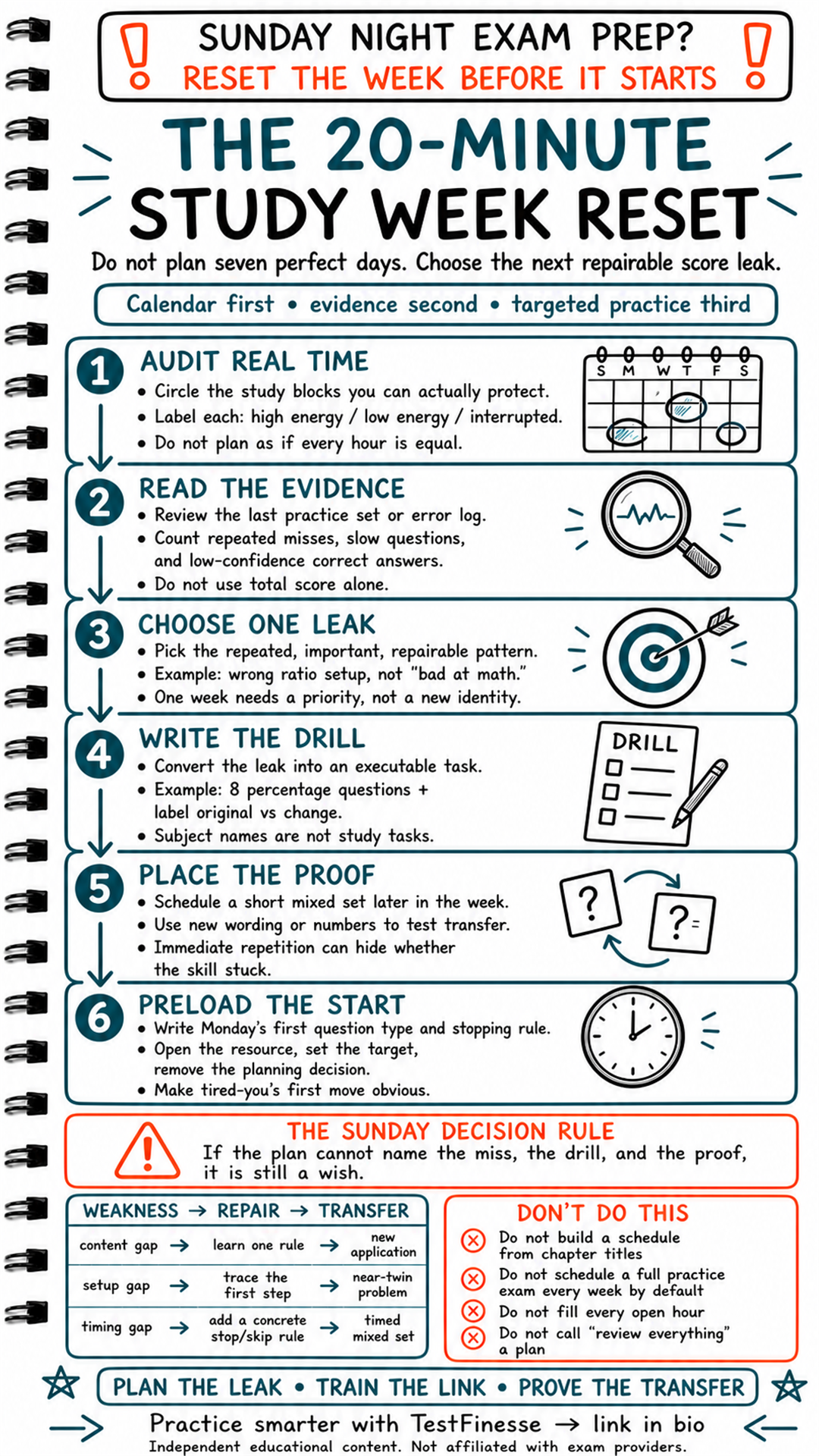
Sunday night can easily become a second exam.
You open your calendar, remember everything you have not finished, and try to build a perfect study plan for the next seven days. The result is usually too ambitious, too vague, or impossible to follow once real life interrupts it.
A better weekly reset takes about 20 minutes and begins with evidence.
Do not plan seven ideal days. Choose the next repairable score leak.
The goal is not to create a beautiful schedule. The goal is to decide:
When can you realistically study?
What weakness is costing points?
What specific drill will repair it?
How will you prove the skill transferred?
What is Monday’s first action?
The workflow is:
Calendar first → evidence second → targeted practice third
1. Audit Your Real Time
Start with the week you actually have.
Look at work, classes, commuting, appointments, family responsibilities, meals, sleep, and recovery. Then circle the study blocks you can genuinely protect.
Not every hour has the same value. Label each possible block:
High energy: best for new material, difficult questions, and timed sets
Low energy: useful for flashcards, formula recall, error-log review, and light retrieval
Interrupted: appropriate only for small tasks that can survive distractions
This prevents a common planning mistake: assigning your hardest work to the time of day when your attention is already depleted.
A realistic schedule may include only:
Two short maintenance blocks
One protected high-energy session
One mixed review block
One recovery or overflow period
That is enough to create momentum when the tasks are specific.
A protected 30-minute block is more useful than a promised three-hour session that never starts.
2. Read The Evidence
Next, review your most recent practice set, error log, or score report.
Do not look only at your total score. A total score can hide the pattern that matters most.
Count:
Repeated misses
Slow questions
Low-confidence correct answers
Questions missed because of wording
Questions missed because of setup
Questions missed because of careless execution
Topics where accuracy drops under time pressure
A correct answer with low confidence is still useful evidence. It may show that you recognized the answer but could not reliably retrieve or explain the rule.
A slow correct answer is also informative. It may indicate that the content is understood but the decision process is not automatic yet.
Ask:
What kind of failure keeps appearing?
The answer may be more useful than the subject label.
For example, “math” is broad. “I keep confusing original value with changed value in percentage questions” is actionable.
3. Choose One Leak
Choose one repeated, important, and repairable weakness.
The best weekly target is not always your hardest topic. It is often the pattern that:
Appears more than once
Matters on the exam
Can improve with focused practice
Has a clear next action
Examples include:
Reversing a dosage setup
Missing the command word in reading questions
Confusing bond price direction
Choosing a treatment before assessing priority
Using the wrong formula family
Losing points to unit conversion
Spending too long on one question type
Do not describe the target as an identity statement:
“I am bad at math.”
“I cannot do pharmacology.”
“I am terrible at reading.”
Describe it as a behavior:
“I choose the wrong denominator.”
“I answer the topic instead of the question.”
“I skip the priority cue.”
“I calculate before labeling the units.”
One week needs a priority, not a new identity.
4. Write The Drill
Turn the weakness into an executable task.
“Study Quantitative Methods” is not a drill. “Review math” is not a drill. Those labels describe a subject, not an action.
A strong drill includes:
A number of questions
A specific skill
A visible rule
An error label
A stopping point
For example:
Complete eight percentage questions and label the original value, change, and new value before calculating.
Other examples:
Solve six dosage problems and write the wanted unit first.
Complete five priority questions and identify the immediate threat in each stem.
Review ten missed vocabulary words, then use each in a sentence.
Do one timed reading passage and label detail, inference, function, and main-idea questions.
Complete six bond questions and write the yield-price direction before calculating.
The task should be small enough to start without another planning session.
Subject names are not study tasks. Verbs create plans.
5. Place The Proof
Schedule a later opportunity to prove that the repair transferred.
Immediate repetition can feel successful because the original explanation is still fresh. A delayed mixed set is more revealing.
Place a short proof block later in the week using:
New wording
Different numbers
A different scenario
A mixed question set
A timed condition
A near-twin problem
If the original mistake involved percentage change, change the numbers. If it involved a clinical priority decision, change the patient scenario. If it involved a formula, alter the requested variable.
The goal is to test whether you learned the relationship, not whether you remember the original answer.
Match the proof to the weakness:
WeaknessRepairProofContent gapLearn one ruleNew applicationSetup gapTrace the first decisionNear-twin problemTiming gapAdd a stop or skip ruleTimed mixed setWording trapMark the command wordNew stem with similar distractors
A plan is incomplete until it includes a way to test the repair.
6. Preload Monday’s Start
Before ending the Sunday reset, write Monday’s first action.
Make it concrete:
Open the question set.
Set a 25-minute timer.
Complete five targeted questions.
Label each miss before checking the rationale.
Stop after the planned drill.
Also write a stopping rule. For example:
Stop after five questions or 25 minutes, then review the misses.
This removes the planning decision from Monday morning or the end of a long workday. Tired-you should not have to decide what resource to open, what topic to choose, or how much work counts.
Prepare the materials in advance:
Calculator
Notebook
Error log
Question set
Formula sheet
Water
The exact first task
Make the first move obvious.
The Sunday Decision Rule
If your plan cannot name the miss, the drill, and the proof, it is still a wish.
A useful study plan should answer:
What failed?
What will I do to repair it?
How will I know the repair worked?
When will I do each step?
This keeps your schedule connected to actual performance.
Avoid These Planning Traps
Do not:
Build your schedule from chapter titles alone.
Fill every open hour.
Schedule a full practice exam every week by default.
Plan around your ideal energy instead of your real energy.
Use “review everything” as a task.
Restart your plan every Monday.
Add more content before repairing a repeated miss.
Treat one difficult day as proof that the entire plan failed.
A bad study day is information. Adjust the volume while keeping the learning loop alive.
Use The TestFinesse Practice Loop
The TestFinesse method fits naturally into the weekly reset:
Answer: Complete the question without checking the explanation first.
Explain: State why you chose the answer and what rule you used.
Reveal: Compare your reasoning with the rationale.
Fix the gap: Label the miss and write one repair rule.
Transfer: Solve a new question using the same hidden skill.
Retest: Return later and use the rule without notes.
This turns a Sunday plan into a feedback system. You are not just scheduling hours. You are scheduling diagnosis, repair, transfer, and proof.
Final Takeaway
A good weekly reset does not promise perfect discipline. It creates a clear next move.
Plan the leak. Train the link. Prove the transfer.
Use your real calendar, your recent practice evidence, and one specific repairable weakness. Then preload Monday so the first action is already decided.
Twenty focused minutes on Sunday can make the entire week more useful than another hour spent building an unrealistic plan.
Independent educational content. Not affiliated with any exam provider.
Keep studying
Practice Exam Skills
Turn this into a better score
Reading about a skill only gets you so far. TestFinesse's AI coach walks you through exam questions, explains exactly where your reasoning breaks down, and adapts to what you actually need to practice next.
Explore All Exams