CFA Level I Study Plan Map: Use Topic Weights and Weaknesses to Study Smarter
Last updated August 22, 2026
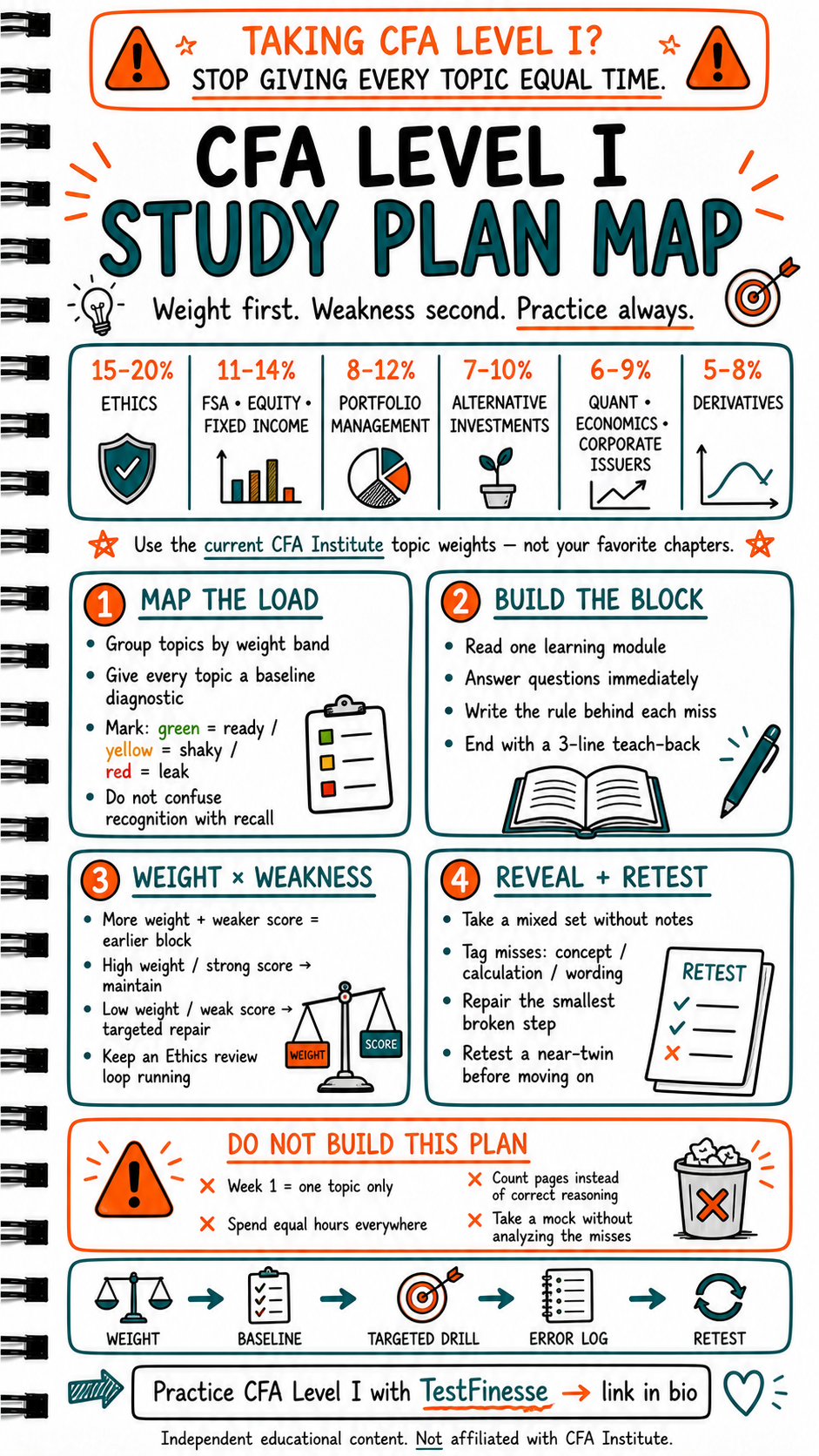
Studying every CFA Level I topic for the same amount of time may feel fair, but it is rarely the most efficient strategy.
The exam does not distribute questions evenly across every topic. Some areas represent larger portions of the exam, while others appear in smaller but still meaningful ranges. Your own performance also varies by topic. That creates a practical planning principle:
Study priority should be based on both exam weight and personal weakness.
The best study plan is not simply “finish one chapter per week.” It is a decision system that answers three questions:
What topics carry the most potential points?
Which topics are currently producing the largest score leaks?
What specific practice will repair those leaks?
The current CFA Institute Level I topic weights show Ethics and Professional Standards at 15–20%. Financial Statement Analysis, Equity Investments, and Fixed Income each carry 11–14%. Portfolio Management is 8–12%, Alternative Investments is 7–10%, Quantitative Methods, Economics, and Corporate Issuers are each 6–9%, and Derivatives is 5–8%.
These are ranges, not guarantees for an individual exam form. They are also not a reason to ignore lower-weight subjects. They are a way to decide how to allocate your limited study time.
Use the Current Weight Map
Before building a calendar, group the topics by weight band.
Higher-weight topics
Ethics and Professional Standards
Financial Statement Analysis
Equity Investments
Fixed Income
Middle-weight topics
Portfolio Management
Alternative Investments
Quantitative Methods
Economics
Corporate Issuers
Lower-weight topic
Derivatives
This does not mean that every student should study the higher-weight subjects first and ignore everything else. A student who is already strong in Fixed Income but repeatedly misses Quantitative Methods may need a targeted Quantitative Methods repair block.
Topic weight tells you how large the opportunity is. Your diagnostic score tells you how urgent the weakness is.
1. Map the Load
Start with a baseline diagnostic across all major topics.
Your baseline should show more than a total score. Record performance by topic and, when possible, by subtopic or question type.
Use a simple color system:
Green: Reliable and explainable.
Yellow: Inconsistent, slow, or dependent on recognition.
Red: Repeatedly missed or impossible to explain.
A correct answer is not automatically green. If you guessed correctly or could not explain the reasoning, mark it yellow.
That distinction matters because recognition is not the same as recall. You may recognize a familiar formula when you see it but fail to retrieve it in a new context. You may also remember a definition without being able to apply it to a vignette.
For each topic, ask:
Can I explain the core ideas without notes?
Can I complete representative calculations?
Can I distinguish similar concepts?
Can I identify the assumption behind the answer?
Can I explain why the wrong choices are wrong?
2. Build the Study Block
Once you know the topic and the weakness, study in compact blocks.
A productive block might look like this:
Read one learning module or focused concept group.
Answer practice questions immediately.
Write the rule behind every meaningful miss.
Finish with a short teach-back.
The teach-back should be brief. Explain the concept as if you were teaching it to someone who has not studied it.
For example:
“Bond prices generally move inversely to yields.”
“The time-weighted return removes the effect of external cash flows when evaluating investment performance.”
“A stronger ethical answer must be consistent with the applicable standard, not merely reasonable in a business setting.”
“A valuation result depends on the assumptions used in the model.”
If you cannot explain the concept in a few clear sentences, the block is not finished.
Questions should follow learning quickly. Delaying practice until the end of an entire topic makes it harder to discover whether you actually understood the material.
3. Multiply Weight by Weakness
Use a simple prioritization model:
Study priority = topic weight × weakness level
A high-weight topic with a weak score becomes an early study block.
A high-weight topic with a strong score should remain in maintenance review.
A lower-weight topic with a serious weakness may need targeted repair, but probably should not displace every higher-value topic in your plan.
A practical decision table looks like this:
Topic situationRecommended actionHigh weight, weak scorePrioritize early and revisit repeatedlyHigh weight, strong scoreMaintain with mixed practiceLow weight, weak scoreUse a focused repair blockLow weight, strong scoreReview periodically, then move on
Ethics deserves a special place in the plan. Even when your other topics improve, maintain an ongoing Ethics review loop. Ethics questions often depend on precise wording and application, so passive familiarity can create false confidence.
4. Reveal and Retest
A study block should not end when you finish reading. It should end when you can demonstrate the skill.
Take a mixed set without notes and tag each miss:
Concept
Calculation
Wording
Formula selection
Assumption
Time management
Careless execution
Then repair the smallest broken step.
If you missed a calculation, do not automatically reread the entire chapter. Determine whether the problem was:
Selecting the wrong formula.
Misreading the variables.
Entering the calculator incorrectly.
Using the wrong sign.
Rounding too early.
Misinterpreting what the question asked.
After the repair, complete a near-twin question. A near-twin uses the same underlying skill but changes the numbers, context, or wording.
Retesting is what proves that the repair transferred.
Do Not Build This Plan
Avoid study plans that:
Spend equal hours on every topic regardless of weight or weakness.
Dedicate an entire week to one topic without mixed retrieval.
Count pages read instead of questions explained.
Treat every missed question the same way.
Take mock exams without analyzing the misses.
Confuse time spent with evidence of improvement.
A full mock exam is valuable only when the review changes what you do next. “I knew that” is not an error analysis. Write the exact reason the answer was missed and the rule that should guide the next attempt.
Use The TestFinesse Practice Loop
Adapt the TestFinesse loop to CFA Level I:
Answer the question without immediately checking the solution.
Explain the formula, concept, and assumption you used.
Reveal the official reasoning and compare it with yours.
Fix the gap by writing one rule and solving a near-twin question.
Then track the trend by topic.
Your error log should help you see whether misses are shrinking, moving from red to yellow, or repeating under different wording. That information is more useful than a single overall practice score.
Important CFA Institute Update
The topic weights in the infographic align with the CFA Institute’s current Level I weights for the 2026 curriculum. CFA Institute has also announced curriculum updates for candidates beginning exams in February 2027, including changes focused primarily on Quantitative Methods and Equity Investments.
Confirm the topic outline for your specific exam year before finalizing your study plan.
Final Takeaway
Do not give every topic equal time just because every topic appears in the curriculum.
Use the official weight map to understand the opportunity, your diagnostic results to identify the leak, and targeted practice to repair it.
Weight first. Weakness second. Practice always.
Independent educational content. Not affiliated with CFA Institute.
Accuracy sources checked: CFA Program Level I Exam and Current Topic Weights, CFA Program Curriculum Overview, CFA Institute 2027 Curriculum Update
Keep studying
Practice Exam Skills
Turn this into a better score
Reading about a skill only gets you so far. TestFinesse's AI coach walks you through exam questions, explains exactly where your reasoning breaks down, and adapts to what you actually need to practice next.
Explore All Exams