GMAT Quant Question Route Selector: Pick the Fastest Path Before Doing the Math
Last updated August 11, 2026
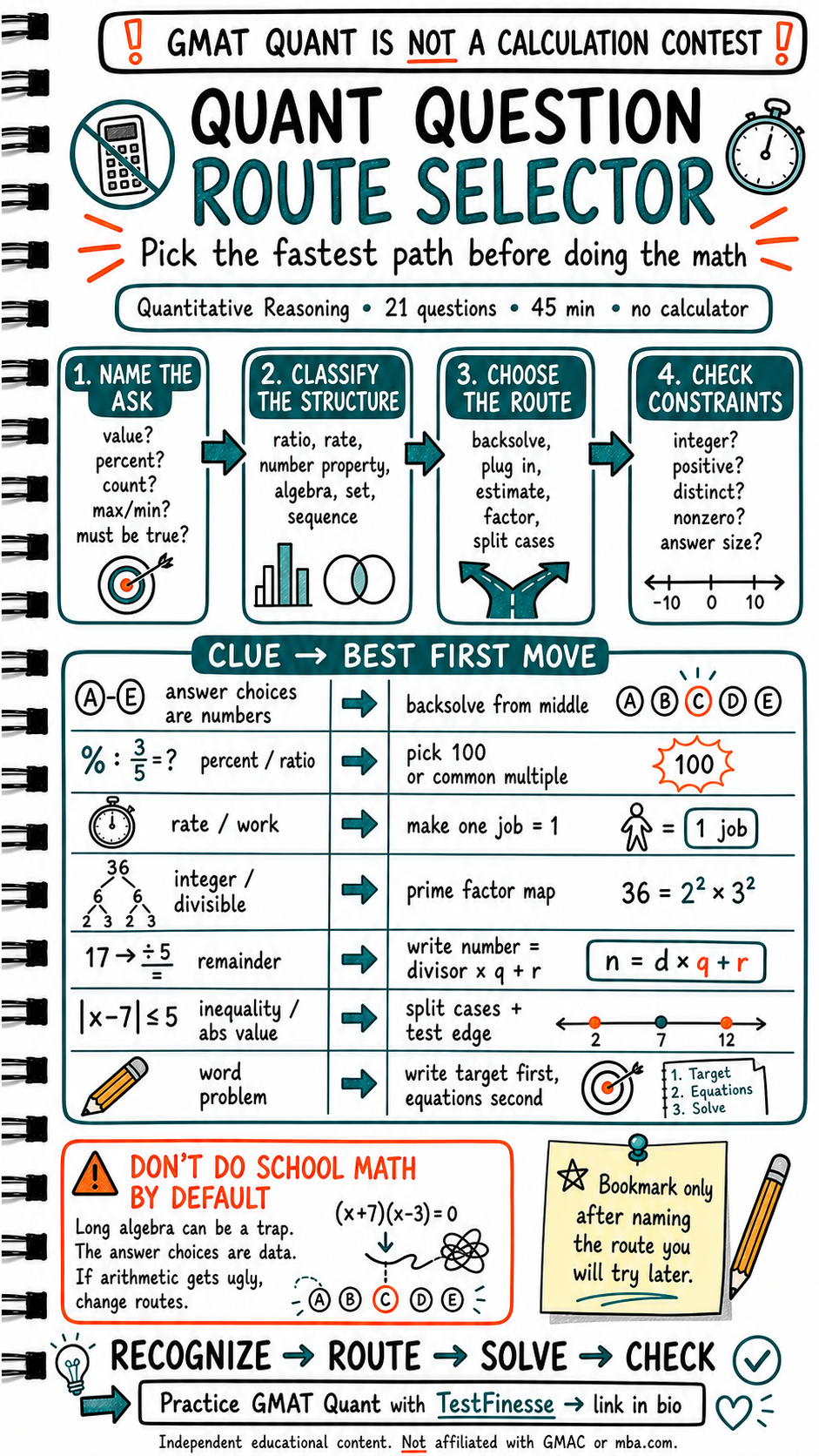
GMAT Quant is not a calculation contest.
That is the first mindset shift. The current GMAT Quantitative Reasoning section has 21 Problem Solving questions in 45 minutes, and the official GMAT exam content page states that you cannot use a calculator on Quantitative Reasoning. That means the test is not designed to reward long arithmetic. It is designed to reward fast recognition, clean setup, flexible problem solving, and logical decision-making.
The mistake many students make is starting every question like a school math problem:
Read the prompt.
Write equations.
Do algebra.
Hope the answer appears.
Sometimes that works. But often, it is too slow.
A better GMAT Quant habit is:
Recognize → Route → Solve → Check
Before doing the math, decide what kind of problem you are looking at and what route is most efficient.
The Core GMAT Quant Problem
A GMAT Quant question usually has more than one possible path. You might be able to solve with algebra, but you might also be able to:
Backsolve from answer choices
Plug in numbers
Estimate
Use number properties
Factor
Split cases
Test constraints
Use answer choices as data
The fastest students are not doing more math. They are choosing better routes.
That is why this infographic is built around a “route selector.” It gives you a pause point before calculation, so you do not automatically take the longest path.
1. Name The Ask
Before solving, identify what the question is actually asking.
Look for the target:
Value: What is the exact number?
Percent: What percent, percent change, or fraction is required?
Count: How many cases, arrangements, items, or outcomes?
Max/min: What is the largest or smallest possible value?
Must be true: Which statement has to follow from the information?
This step matters because many GMAT Quant misses are not math misses. They are task misses.
A student solves for x, but the question asks for x + 3.
A student finds the total, but the question asks for the difference.
A student calculates one case, but the question asks for all possible cases.
TestFinesse rule: If you cannot name the ask in a short phrase, you are not ready to calculate.
Write the target first. Then solve toward it.
2. Classify The Structure
Next, classify the problem family.
Common GMAT Quant structures include:
Ratios and percents
Rates and work
Number properties
Algebra
Sets
Sequences
Remainders
Inequalities and absolute value
Word problems
This is where speed comes from. If the structure is percent/rate, the first move is different from an integer divisibility problem. If it is a remainder problem, you need the remainder form. If it is an inequality, you need to watch edge cases and sign changes.
Classification prevents over-solving.
For example, a word problem with answer choices might not need full symbolic algebra. A percent question might become easier if you pick 100. A work-rate question may collapse if you define the whole job as 1.
The structure tells you the route.
3. Choose The Route
Once you know the ask and structure, choose how to solve.
This is the main difference between GMAT Quant and ordinary classroom math. In school, the expected method is often fixed. On the GMAT, the answer choices, constraints, and number patterns can all help you solve faster.
Possible routes include:
Backsolve: Start with answer choices and test them.
Plug in: Choose simple numbers that match the condition.
Estimate: Use answer size to eliminate impossible choices.
Factor: Break numbers into primes or useful components.
Split cases: Test separate possible scenarios.
Use constraints: Check integer, positive, distinct, or nonzero rules.
The right route is the one that gets to a reliable answer with the least friction.
That does not mean guessing. It means using the test design intelligently.
4. Check Constraints
GMAT Quant loves constraints.
Before committing to an answer, check whether the problem says or implies:
Integer
Positive
Negative
Distinct
Nonzero
Consecutive
Even or odd
Prime
Maximum or minimum
Greater than / less than
Constraints can completely change the answer.
For example, if a variable must be an integer, a decimal answer may be impossible. If values must be distinct, repeated values do not work. If a number must be positive, a negative algebraic solution may be extraneous.
Do not just solve the equation. Solve the question under its rules.
Clue → Best First Move
Use these common GMAT Quant clues to pick a better first move.
Answer Choices Are Numbers: Backsolve From The Middle
If the answer choices are numerical and the question asks for a specific value, consider backsolving.
Start with the middle answer choice when the choices are ordered. If it is too big or too small, move accordingly.
This is especially useful when:
The algebra looks messy
The answer choices are simple
The question asks for a final value
Testing a choice is faster than deriving the value
Backsolving turns answer choices into tools.
Percent Or Ratio: Pick 100 Or A Common Multiple
Percent questions often become easier when you choose a convenient starting number.
If the problem uses percentages, try 100.
If the problem uses fractions or ratios, choose a common multiple that keeps values whole.
This reduces abstract wording and lets you see the relationship.
Example:
If something increases by 20%, starting with 100 makes the new value 120. If a ratio is 3:5, starting with 15, 30, or another common multiple may keep the math clean.
Pick numbers that make the structure visible.
Rate Or Work: Make One Job Equal 1
For work-rate problems, define the whole job as 1 job.
Then rates become fractions of the job per unit time.
This helps with questions about:
People working together
Machines filling or emptying something
Time to complete a task
Combined rates
Instead of chasing big numbers, ask:
What fraction of the job happens per hour, minute, or day?
Integer Or Divisible: Use A Prime Factor Map
When a question involves divisibility, factors, multiples, or integer restrictions, prime factors are often the cleanest route.
For example:
36 = 2² × 3²
That factor map tells you what must be included for divisibility, greatest common factor, least common multiple, or possible integer values.
This is faster than guessing numbers randomly.
Remainder: Write The Remainder Form
For remainder questions, use:
n = divisor × quotient + remainder
This keeps the relationship clear.
If a number leaves remainder 2 when divided by 5, write:
n = 5q + 2
That form helps you test constraints, combine conditions, and avoid vague “number sense” mistakes.
Inequality Or Absolute Value: Split Cases And Test Edges
Inequalities and absolute value questions often require casework.
For absolute value, think about distance.
For inequalities, watch negative multiplication and boundary points.
Do not only solve mechanically. Test the edges.
Ask:
Where does the expression change behavior?
What happens at the boundary?
Which intervals satisfy the condition?
This is where answer size and number-line thinking can save time.
Word Problem: Write Target First, Equations Second
For word problems, resist the urge to translate every sentence immediately.
First write:
Target
Given information
Relationship
Equation or route
The target controls which facts matter. Without it, you may build a beautiful equation for the wrong quantity.
GMAT word problems reward setup before algebra.
Don’t Do School Math By Default
Long algebra can be a trap.
That does not mean algebra is bad. It means algebra is not always the fastest route.
If the arithmetic gets ugly, pause and ask:
Can I backsolve?
Can I plug in cleaner numbers?
Can I estimate and eliminate?
Can I factor?
Can I use the answer choices?
Did I miss a constraint?
The answer choices are part of the test. Use them.
Bookmark With A Reason
The current GMAT includes a Question Review & Edit feature within each section, but bookmarking only helps if you know what you will do when you return.
Do not bookmark because a question “feels hard.”
Bookmark with a route:
“Return and backsolve.”
“Return and test edge cases.”
“Return and estimate between B and C.”
“Return and plug in 100.”
“Return and check integer constraint.”
A bookmark without a plan can become a second round of panic. A bookmark with a route becomes a controlled second attempt.
Use The TestFinesse Practice Loop
The TestFinesse method is:
Answer
Explain
Reveal
Fix the gap
For GMAT Quant, add one specific requirement:
Explain your route before checking the answer.
After each question, write:
What was the ask?
What was the structure?
What route did I choose?
Was there a faster route?
Which constraint mattered?
Did I do school math by default?
That turns every practice question into route training.
Final Takeaway
GMAT Quant is not about proving you can grind through every calculation.
It is about seeing the problem clearly enough to choose the right path.
Before you calculate, ask:
What is the question asking?
What structure is this?
What route is fastest?
What constraints could change the answer?
Then solve.
Recognize → Route → Solve → Check.
Independent educational content. Not affiliated with GMAC or mba.com.
Accuracy sources checked: mba.com GMAT Exam Structure, mba.com GMAT Exam Content.
Keep studying
Practice Exam Skills
Turn this into a better score
Reading about a skill only gets you so far. TestFinesse's AI coach walks you through exam questions, explains exactly where your reasoning breaks down, and adapts to what you actually need to practice next.
Explore All Exams