The Almost-Right Answer Trap: True Is Not Enough on Exam Questions
Last updated September 5, 2026
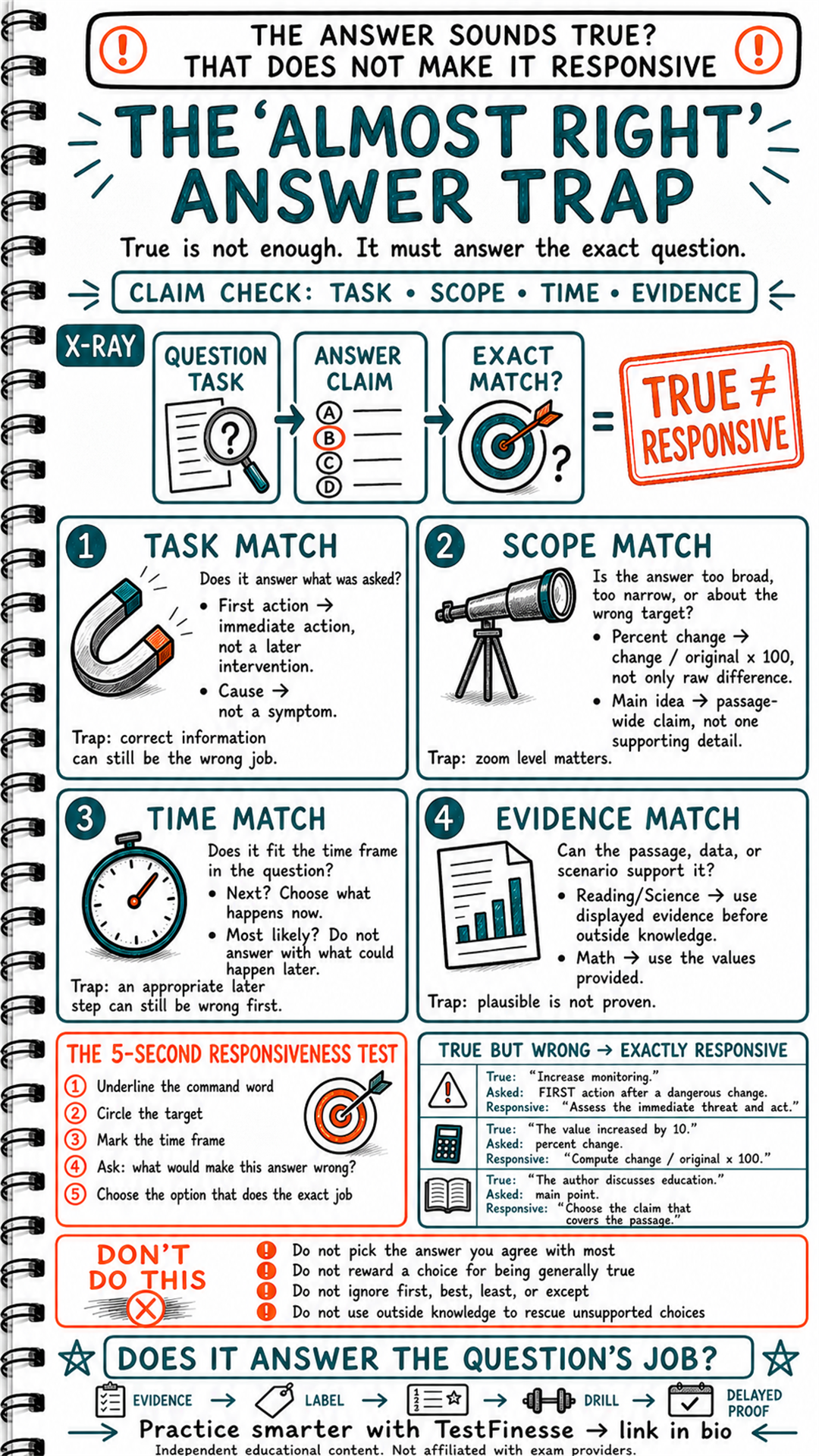
One of the most frustrating exam mistakes is choosing an answer that is technically true but still wrong.
The statement may be reasonable. It may describe something that could happen. It may even be supported by part of the question. But if it does not answer the exact task, it is not the best answer.
That is the almost-right answer trap.
The key distinction is:
True does not automatically mean responsive.
A responsive answer must match the question’s:
Task
Scope
Time frame
Evidence
Use this claim check before committing:
Task → Scope → Time → Evidence
What Makes An Answer “Almost Right”?
An almost-right answer usually contains a piece of correct information but fails somewhere else.
It may:
Answer a later step instead of the first action
Describe a symptom instead of the cause
Use a narrow detail for a main-idea question
Calculate a raw difference when the question asks for percent change
State what could happen later when the question asks what happens next
Rely on outside knowledge instead of the evidence provided
Use a broad statement that is not proven by the passage or data
These choices are dangerous because they feel safe. You recognize something familiar and stop checking whether it performs the exact job required by the prompt.
Do not ask only, “Is this true?” Ask, “Does this answer the question being asked?”
1. Task Match
First, determine the question’s job.
Look for command words such as:
First
Best
Least
Most likely
Except
Main idea
Cause
Effect
Compare
Infer
Calculate
Estimate
Explain
Next
The command word controls the answer.
If the question asks for the first action, an answer describing an appropriate later intervention may still be wrong.
If the question asks for the cause, an answer describing a symptom is not responsive.
If the question asks for the main idea, one supporting detail is too narrow.
If the question asks for percent change, a raw numerical difference is incomplete.
Before reading the choices, complete this sentence:
“The question wants me to…”
Examples:
“…identify the immediate action.”
“…find the cause.”
“…calculate percent change.”
“…choose the claim that covers the passage.”
“…determine what happens next.”
Then test each answer against that sentence.
Correct information can still be the wrong job.
2. Scope Match
Next, check whether the answer is operating at the correct level.
Answers can be:
Too broad
Too narrow
Focused on the wrong target
About the wrong person, variable, or time period
For example, a main-idea answer should cover the passage as a whole, not just one supporting detail.
A percent-change answer should use the relevant relationship:
\[ \text{Percent change} = \frac{\text{new} - \text{original}}{\text{original}} \times 100 \]
A raw change of 10 may be true, but it does not answer a percent-change question without comparing the change to the original value.
Scope also matters in clinical, science, and technical questions. An answer may describe a real issue but not the specific system, patient, variable, or process included in the stem.
Ask:
Is this answer about the same target?
Is it addressing the whole problem or only one part?
Is it too general to prove?
Is it so narrow that it misses the question’s purpose?
Zoom level matters. Match the answer’s scope to the question’s scope.
3. Time Match
Many almost-right answers are correct at the wrong time.
Pay attention to words such as:
First
Now
Next
Immediately
Before
After
Eventually
Most likely
Initially
An appropriate later step can still be the wrong first step.
For example, a question may ask what should happen immediately after a dangerous change. “Increase monitoring” may be generally reasonable, but the better response may be to assess and address the immediate threat before settling into routine monitoring.
Similarly, “most likely” asks you to identify the best-supported outcome, not every possible outcome. “Next” asks what should happen now, not what could happen after several additional steps.
Create a simple timeline:
Current state → first action → next step → later outcomeThen place each answer on the timeline.
A correct answer from the future is still wrong when the question asks for the present.
4. Evidence Match
Finally, ask whether the passage, scenario, graph, table, or numbers actually support the answer.
Plausibility is not proof.
In reading and science questions:
Use the displayed passage or data first.
Locate the supporting line or trend.
Check whether every part of the answer is supported.
Avoid outside knowledge that rescues an unsupported choice.
In math questions:
Use the values provided.
Confirm which value is original, new, total, or partial.
Match the requested unit.
Do not substitute an assumption because it makes the answer easier.
An answer can sound scientifically reasonable and still contradict the graph. A statement can be true in real life and still not be supported by the passage.
The evidence in the question outranks your outside associations.
The Five-Second Responsiveness Test
Before committing, run this quick check:
Underline the command word.
Circle the target.
Mark the time frame.
Ask what would make the answer wrong.
Choose the option that performs the exact job.
This prevents you from choosing an answer simply because you agree with it or recognize the wording.
For each choice, ask:
Does it answer the task?
Is it about the right target?
Does it fit the time frame?
Can the evidence support it?
If one answer passes all four checks, it is more responsive than a choice that is merely familiar or generally true.
True But Wrong Versus Exactly Responsive
Consider these examples.
First Action
True but incomplete: “Increase monitoring.”
More responsive: “Assess and act on the immediate dangerous change.”
The first may be reasonable later, but it does not necessarily identify the first required action.
Percent Change
True but incomplete: “The value increased by 10.”
More responsive: “Compute the change relative to the original value.”
The raw difference does not answer the percentage question by itself.
Main Idea
True but too narrow: “The author discusses education.”
More responsive: “Choose the claim that captures the passage’s central purpose.”
The narrow statement may be present in the passage without summarizing its main point.
Common Almost-Right Traps
Watch for answer choices that:
Sound compassionate but ignore priority
State a true fact but answer another question
Add an assumption not included in the stem
Jump to intervention before assessment
Use one supporting detail as the main idea
Describe a later step as the first action
Calculate the wrong quantity
Use a familiar formula with the wrong time direction
Treat an absolute statement as proven without evidence
Depend on outside knowledge when the prompt supplies its own data
These answers are designed to reward recognition without precision.
Use The TestFinesse Practice Loop
When you miss an almost-right answer, do not record only the topic. Record the mismatch.
Use this loop:
Answer: Commit to the choice before checking the explanation.
Explain: State the task, scope, time frame, and evidence you used.
Reveal: Compare your reasoning with the rationale.
Fix the gap: Name the exact mismatch.
Useful error labels include:
Wrong task
Wrong scope
Wrong time
Unsupported claim
Outside-knowledge trap
Wrong target quantity
Incomplete evidence
Later-step answer
Symptom-for-cause substitution
Then rewrite the answer so it becomes responsive.
For example:
“The choice is true, but it answers what happens later. The question asks for the first action.”
That sentence teaches a reusable rule.
Practice With Near-Twin Questions
To make the skill transfer, practice questions that change one feature at a time:
First action versus next action
Cause versus symptom
Raw change versus percent change
Detail versus main idea
Most likely versus possible
Passage evidence versus outside knowledge
Total quantity versus one component
The goal is to notice how one command word changes the correct answer.
Final Takeaway
The best answer is not always the most familiar, detailed, reassuring, or generally true.
It is the answer that matches the question’s exact job.
Check the task. Check the scope. Check the time. Check the evidence.
Then choose the answer that is not merely true, but exactly responsive.
Independent educational content. Not affiliated with any exam provider.
Keep studying
Practice Exam Skills
Turn this into a better score
Reading about a skill only gets you so far. TestFinesse's AI coach walks you through exam questions, explains exactly where your reasoning breaks down, and adapts to what you actually need to practice next.
Explore All Exams