10 FE Mechanical Exam Traps: Easy Points Students Lose Under Pressure
Last updated August 9, 2026
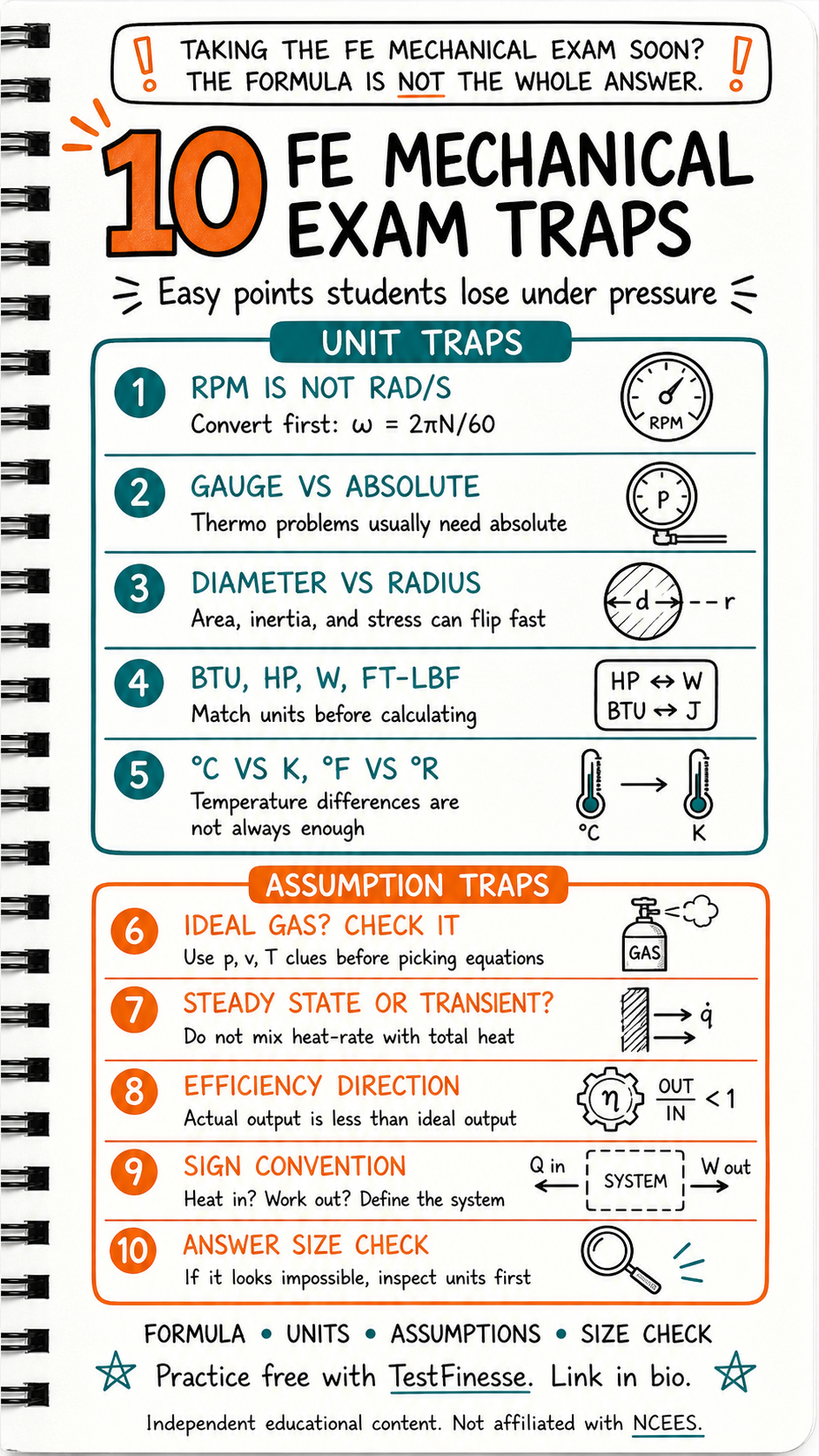
The FE Mechanical exam is not just a formula test.
Yes, the NCEES FE Reference Handbook matters. You need to know where formulas live, how variables are defined, and which equation fits the problem. But the formula is not the whole answer.
Many FE Mechanical mistakes happen after a student finds the right equation.
They plug in RPM instead of radians per second.
They use gauge pressure instead of absolute pressure.
They confuse diameter and radius.
They mix heat rate with total heat.
They forget that temperature equations often need an absolute scale.
Those are not always knowledge failures.
They are execution traps.
The FE Mechanical exam rewards students who can combine:
Formula
Units
Assumptions
Size check
That is the real skill.
Why FE Mechanical Mistakes Happen Under Pressure
The FE exam is broad and timed. NCEES lists the FE exam as a computer-based exam with 110 questions and 5 hours 20 minutes of actual exam time. You also have access to the official electronic reference handbook during the exam.
That creates a very specific challenge.
You may be able to find the formula, but still lose the point if you do not control the setup.
Mechanical problems often depend on small details:
Is the pressure gauge or absolute?
Is the speed in RPM or rad/s?
Is the given dimension a radius or diameter?
Is the question asking for a rate or a total amount?
Is the device producing work or consuming work?
Is the system closed, open, steady, or transient?
The exam is not only asking:
“Do you know the equation?”
It is asking:
“Can you use the equation correctly under pressure?”
Unit Traps
The first five traps are unit traps. These are easy to overlook because the numbers look familiar.
1. RPM Is Not Rad/S
Rotational speed is one of the easiest places to lose a point.
RPM means revolutions per minute.
Radians per second means angular velocity.
If a formula needs angular velocity, convert first:
omega = 2 pi N / 60
Where:
omega = angular velocity in rad/s
N = rotational speed in RPM
For example, if a shaft rotates at 1,800 RPM:
omega = 2 pi(1800) / 60 = 188.5 rad/s
Do not plug 1,800 directly into a formula that expects rad/s.
That mistake can make the answer wildly wrong.
2. Gauge Vs. Absolute Pressure
Thermodynamics problems often require absolute pressure, not gauge pressure.
Gauge pressure is measured relative to atmospheric pressure.
Absolute pressure is measured relative to a vacuum.
The relationship is:
P absolute = P gauge + P atmospheric
This matters in equations like the ideal gas law:
PV = mRT
or
PV = nRT
Those equations require absolute pressure and absolute temperature.
If a problem gives gauge pressure and you use it directly, the answer may be wrong even if the formula is right.
Exam habit:
If the problem involves gases, check whether pressure is gauge or absolute before calculating.
3. Diameter Vs. Radius
Mechanical problems love circular geometry.
That means diameter and radius errors can spread fast.
Remember:
Radius = diameter / 2
Area of a circle = pi r²
Area using diameter = pi d² / 4
This matters for:
Fluid flow area
Stress
Moment of inertia
Polar moment of inertia
Shafts
Pipes
Cylinders
A diameter-radius mistake is not a small mistake. Because radius is often squared or raised to the fourth power, the error can become huge.
For example, many circular-section formulas use d⁴. If you accidentally use radius where the formula expects diameter, the answer can be off by a major factor.
Before calculating, label the dimension:
Is this d or r?
4. BTU, HP, W, And Ft-Lbf
FE Mechanical questions may mix U.S. customary and SI units.
That means you need to match units before calculating.
Watch for:
BTU and joules
horsepower and watts
ft-lbf and joules
psi and psf
lbm and lbf
inches and feet
minutes and seconds
A common trap is using a correct formula with inconsistent units.
For example, horsepower and watts are both power units, but they are not interchangeable without conversion.
Likewise, pressure in psi and area in ft² do not naturally match unless you convert.
Exam habit:
Before the formula, check the unit family.
If the problem gives mixed units, clean them up first.
5. Celsius Vs. Kelvin, Fahrenheit Vs. Rankine
Temperature traps are common in thermodynamics and heat transfer.
Use absolute temperature scales when the equation requires absolute temperature.
That usually means:
Celsius to Kelvin
Fahrenheit to Rankine
For ideal gas relationships, use absolute temperature.
For many heat transfer temperature differences, the difference is what matters:
A temperature difference of 1°C equals a difference of 1 K
A temperature difference of 1°F equals a difference of 1°R
But be careful. A temperature difference is not the same as an absolute temperature.
If the formula uses T in a thermodynamic property relationship, check whether it needs K or R.
Exam habit:
If temperature appears in a denominator, gas equation, or property relation, check the absolute scale.
Assumption Traps
The next five traps are assumption traps. These are not just about units. They are about choosing the right model.
6. Ideal Gas? Check It
Do not automatically use the ideal gas law just because a problem mentions gas.
First, check the clues.
Ideal gas problems usually provide or imply:
Pressure
Volume
Temperature
Mass or moles
Gas constant
The ideal gas law is useful, but only when the assumptions fit the situation or the problem clearly directs you there.
Also remember:
Pressure should be absolute.
Temperature should be absolute.
The gas constant must match the units and mass basis.
For example:
Use the correct R for the gas.
Do not mix molar and mass-based forms.
Do not use Celsius directly in the ideal gas law.
Exam habit:
Before picking the ideal gas equation, identify P, V, T, and the correct form of R.
7. Steady State Or Transient?
Heat transfer and thermodynamics problems often depend on whether the system is steady or changing with time.
Steady state means properties do not change with time at a point.
Transient means the system is changing with time.
Do not mix:
Heat rate, usually written as q dot
Total heat, usually written as Q
A heat rate is energy per time.
A total heat amount is energy.
For example:
W or BTU/hr is a rate
J, kJ, or BTU is an amount
If a problem asks for energy over time, you may need:
Q = q dot × time
If it asks for rate, do not multiply by time unless required.
Exam habit:
Circle words like rate, per second, over 10 minutes, steady, and transient.
Those words tell you what kind of answer the problem wants.
8. Efficiency Direction
Efficiency questions are easy to flip.
For many work-producing devices, such as turbines, actual output is less than ideal output.
A common form is:
Efficiency = actual output / ideal output
But be careful.
For work-consuming devices, such as pumps or compressors, the comparison may be written differently because the ideal device would require less input than the actual device.
That means you cannot memorize only one direction and apply it everywhere.
Ask:
Is this device producing work or consuming work?
Is the question asking for actual work or ideal work?
Is the efficiency comparing output, input, or isentropic performance?
The basic concept is:
Real devices perform worse than ideal devices.
But the formula direction depends on the device and definition.
Exam habit:
Before using efficiency, identify what is actual, what is ideal, and whether the device is producing or consuming work.
9. Sign Convention
Sign convention can change the meaning of your energy balance.
A common thermodynamics convention is:
Heat into the system is positive
Work done by the system is positive
Using that convention, a simple closed-system energy balance can be written as:
Delta E = Q - W
But not every setup is written the same way. Some courses, textbooks, or references define work differently.
The FE trap is not that one convention is always the only convention.
The trap is failing to define the system.
Before solving, ask:
What is the system?
Is heat entering or leaving?
Is work entering or leaving?
Is this a closed system or control volume?
What sign convention does the equation assume?
Exam habit:
Draw the system boundary and label Q and W before plugging in signs.
10. Answer Size Check
A size check is your final defense.
After calculating, ask:
Does this answer make physical sense?
Examples:
A thermal efficiency greater than 100% should raise a flag.
A negative absolute temperature should raise a flag.
A tiny shaft carrying huge torque should raise a flag.
A pressure drop larger than the system pressure should raise a flag.
A velocity that is physically unrealistic should raise a flag.
A result with the wrong units should raise a flag.
An answer that looks impossible usually means one of three things happened:
Unit mistake
Formula mismatch
Bad assumption
Do not ignore that feeling.
Inspect the setup before moving on.
The FE Mechanical Exam Habit That Saves Points
Use this four-part check:
Formula
Units
Assumptions
Size check
Before calculating:
What formula applies?
What units does it require?
What assumptions does it make?
What size should the answer roughly be?
After calculating:
Are the units correct?
Is the sign reasonable?
Is the magnitude believable?
Did I answer what the question asked?
This is how you turn the FE Reference Handbook from a formula list into a working tool.
How To Practice These Traps
Do not only practice full problems.
Practice identifying traps.
For each missed FE Mechanical question, label the cause:
Unit conversion
Gauge vs absolute
Diameter vs radius
Temperature scale
Wrong assumption
Rate vs total
Efficiency direction
Sign convention
Arithmetic
Used the wrong formula
Then write one rule for next time.
Examples:
Next time, convert RPM to rad/s before using angular velocity.
Next time, use absolute pressure for ideal gas calculations.
Next time, check whether the given length is diameter or radius.
Next time, identify whether the problem asks for heat rate or total heat.
Next time, define the system before assigning signs.
That turns a missed question into a reusable correction.
Final Takeaway
The FE Mechanical exam is not just about finding formulas.
It is about using formulas correctly under pressure.
The biggest traps are often small:
RPM is not rad/s
Gauge pressure is not absolute pressure
Diameter is not radius
BTU, horsepower, watts, and ft-lbf must be matched
Temperature scales matter
Ideal gas assumptions must be checked
Steady-state and transient problems are different
Efficiency direction depends on the device
Sign convention must be defined
Impossible-looking answers need inspection
Do not stop at the equation.
Use the full check:
Formula. Units. Assumptions. Size check.
That is how you protect easy points on FE Mechanical exam day.
Accuracy sources checked: NCEES FE Exam, NCEES Exam Reference Handbooks, and NCEES FE Mechanical Practice Exam information.