Working 9-to-5 and Studying for an Exam: Build a Plan Around Real Energy
Last updated August 25, 2026
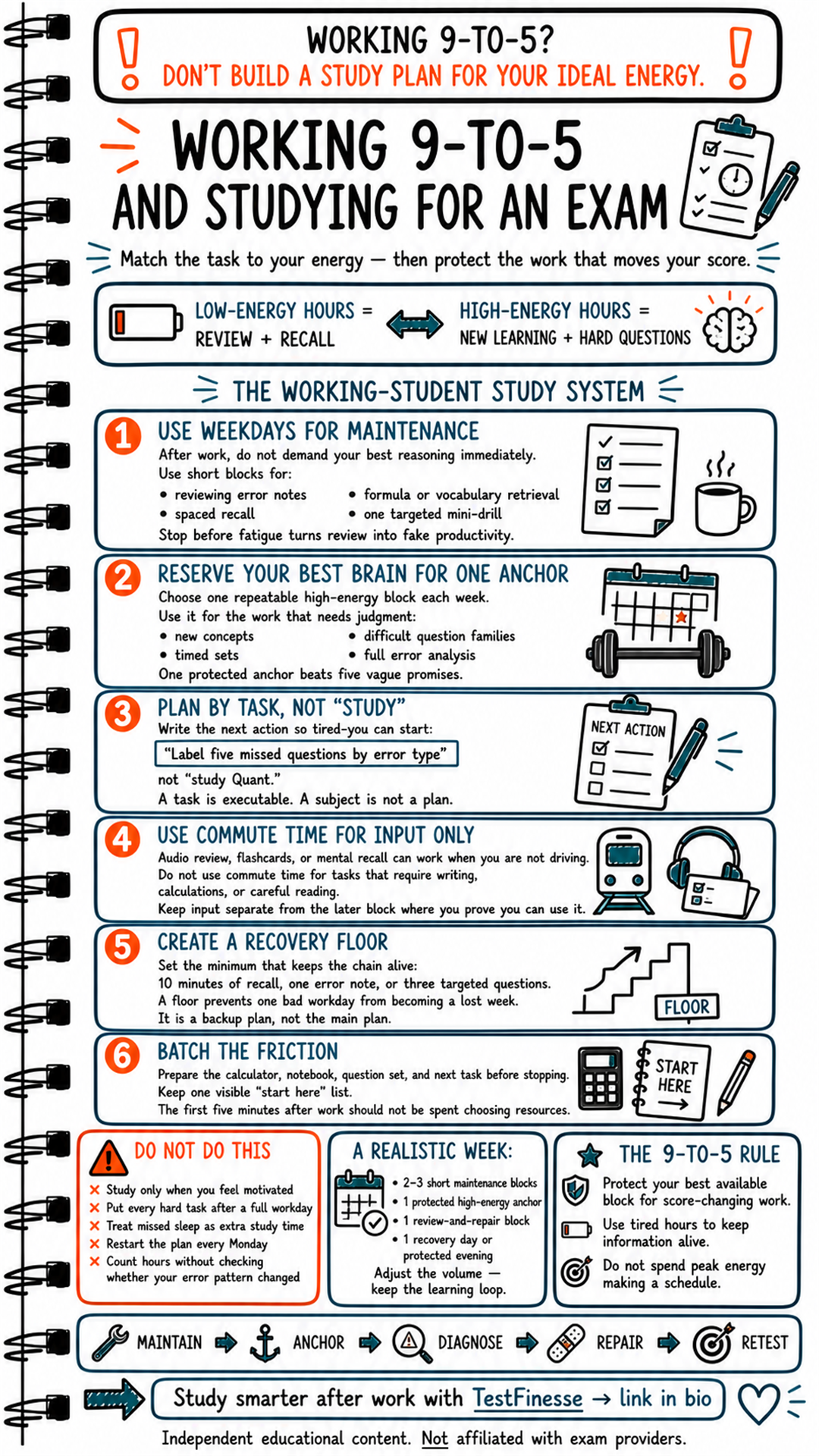
A study plan can look reasonable on paper and still fail by Wednesday.
The problem is often not discipline. It is a mismatch between the work you scheduled and the energy you actually have after a full workday.
Many working students create plans for an ideal version of themselves:
The person who comes home focused
The person who can study for three uninterrupted hours
The person who never has a draining day
The person who always feels motivated
The person who can start difficult work at any time
That person may not exist on most weekdays.
A better plan separates study tasks by energy demand. Use lower-energy hours to maintain what you already know. Reserve your best available focus for work that requires judgment, new learning, difficult questions, or deep error analysis.
The core working-student system is:
Maintain → Anchor → Diagnose → Repair → Retest
Match the Task to Your Energy
Not every study task requires the same level of attention.
Low-energy hours are useful for:
Reviewing error notes
Spaced recall
Formula or vocabulary retrieval
Repeating previously learned concepts
Completing one targeted mini-drill
Organizing the next action
High-energy hours are better for:
Learning a new concept
Solving difficult question families
Completing timed sets
Analyzing a full practice test
Writing explanations for complicated misses
Practicing skills that still feel unstable
This does not mean tired study is worthless. It means tired study should be assigned the right job.
The goal is not to force peak performance every night. The goal is to keep the learning loop alive while protecting the work that needs your best reasoning.
1. Use Weekdays for Maintenance
After work, your brain may not be ready for the most demanding task of the week.
That does not mean the evening is lost. It means the session should be short, specific, and easy to begin.
A weekday maintenance block might include:
Reviewing five error-log entries
Recalling ten formulas without notes
Explaining three missed questions
Completing five targeted questions
Reviewing vocabulary or definitions
Retesting one rule from an earlier session
Choose an endpoint before you begin. A short block that ends cleanly is more useful than an oversized plan that turns into passive rereading.
Example weekday session
10 minutes: recall formulas from memory
15 minutes: review three missed questions
10 minutes: answer three near-twin questions
5 minutes: write tomorrow’s next task
The exact duration can vary. The important feature is that the task is defined before you are tired.
Maintenance keeps information available. It does not need to be the hardest work in your plan.
2. Reserve Your Best Brain for One Anchor
A working student may not have several high-energy blocks available each week. That is why one protected anchor can matter more than five vague promises.
An anchor is a repeatable block reserved for work that requires judgment.
Use it for:
New concepts
Difficult question families
Timed practice
Full error analysis
A targeted review of a major score leak
Retesting a skill after repair
Your anchor might be early Saturday morning, a consistent weekend afternoon, or another time when your energy is reliably higher.
The goal is not to fill every open space on the calendar. The goal is to defend one block that you can realistically repeat.
A strong anchor has:
A defined start and end time
One primary purpose
Materials prepared in advance
A short question set
A review step
A planned retest
One protected anchor is more useful than five vague promises to “study more.”
3. Plan by Task, Not by Subject
“Study Quant” or “Review biology” describes a subject, not an executable action.
When you are tired, a broad subject label creates too many decisions. You still have to decide which chapter, which resource, which questions, and which goal.
A task removes that ambiguity.
Compare:
Vague: Study reading
Executable: Label five missed inference questions by trap type
Vague: Review math
Executable: Solve six percent-change questions and check the original-value setup
Vague: Study pharmacology
Executable: Recall ten medication classes, then explain three missed priority questions
Write the next action so tired-you can start it without planning.
A subject is a category. A task is a plan.
4. Use Commute Time for Input Only
Commute time can support studying, but it is not the right environment for every task.
If you are driving, do not read, write, calculate, or interact with study materials. Safety comes first.
If you are a passenger or using public transportation, audio review, flashcards, and mental recall may be practical. Use that time for input and retrieval, not for work that requires a quiet desk.
Save these tasks for a later block:
Writing explanations
Completing calculations
Reading dense passages
Reviewing detailed rationales
Building an error log
Solving complex multi-step problems
The commute can expose you to a rule. The later study block should test whether you can use it.
Input is not the same as application. Keep a separate block where you prove that you can use what you reviewed.
5. Create a Recovery Floor
Some workdays will go badly. A realistic plan includes a minimum action that keeps the chain alive without pretending you have full energy.
A recovery floor might be:
Ten minutes of recall
One error note
Three targeted questions
One formula explanation
Reviewing one missed question and writing its repair rule
This is a backup plan, not the main plan.
The purpose is to prevent one difficult workday from becoming a lost week. You are not trying to compensate for exhaustion with more exhaustion. You are creating a small, repeatable action that keeps tomorrow easier.
If you are consistently sleeping too little or feeling unable to recover, the answer may be to reduce the study load, adjust the schedule, or seek appropriate support. A study plan should fit inside a sustainable life rather than requiring constant depletion.
6. Batch the Friction
The first few minutes of a study session should not be spent deciding what to open.
Before stopping, prepare:
The calculator
Notebook
Question set
Error log
Formula sheet
Water
The next task
Keep one visible “start here” list.
For example:
Open the error log.
Review the three entries marked setup.
Complete five targeted questions.
Write one repair rule.
Schedule the retest.
This reduces the number of decisions required at the moment you are most likely to avoid starting.
A Realistic Working-Student Week
A sustainable week might include:
Two or three short maintenance blocks: recall, error notes, and targeted questions
One protected high-energy anchor: new learning, difficult questions, or deep review
One review-and-repair block: analyze misses and write rules
One recovery day or protected evening: maintain the ability to continue
The volume can change based on your work schedule, exam date, and current energy. The system should remain recognizable even when the amount of work changes.
Use the TestFinesse Practice Loop
Apply the TestFinesse loop inside every study block:
Answer: Commit before checking the explanation.
Explain: State the rule, setup, or reasoning.
Reveal: Compare your thinking with the rationale.
Fix the gap: Write one repair rule.
Retest: Use a near-twin question later.
This keeps short sessions meaningful. You are not merely logging hours. You are maintaining knowledge, diagnosing leaks, repairing the exact skill, and checking whether the repair transfers.
Final Takeaway
Working 9-to-5 does not require an idealized study schedule. It requires an energy-aware one.
Use tired hours to maintain. Protect your best available block for score-changing work. Plan by task, reduce friction, and keep a recovery floor for difficult days.
The best working-student plan is not the one with the most hours. It is the one you can repeat while still leaving enough capacity to learn.
Maintain → Anchor → Diagnose → Repair → Retest
Independent educational content. Not affiliated with any exam provider. Adapt study volume to your work schedule, health, sleep, exam timeline, and course requirements.
Keep studying
Practice Exam Skills
Turn this into a better score
Reading about a skill only gets you so far. TestFinesse's AI coach walks you through exam questions, explains exactly where your reasoning breaks down, and adapts to what you actually need to practice next.
Explore All Exams