Where to Start When Studying for an Exam: Build Your First Plan From Evidence
Last updated August 24, 2026
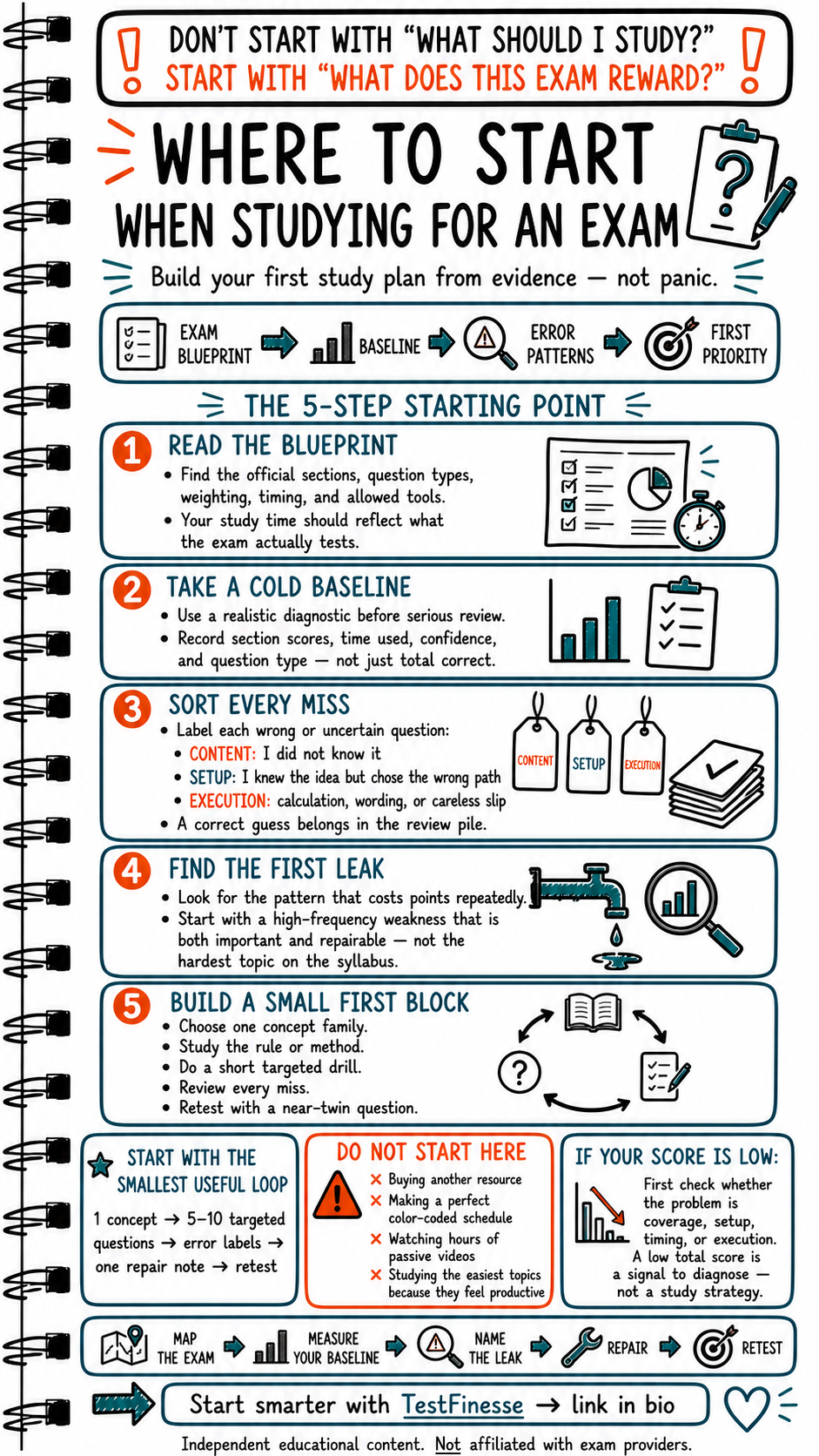
When students begin preparing for an exam, the first question is usually:
“What should I study?”
That question sounds practical, but it is often too broad to create a useful plan. It can send you into a cycle of collecting resources, watching videos, organizing notes, and studying whichever topic feels easiest.
A better starting question is:
“What does this exam reward, and where am I currently losing points?”
That shift changes studying from a vague activity into a diagnostic process.
The first study plan does not need to be perfect. It needs to be based on evidence. Start with the exam blueprint, measure your current performance, identify the first repeated leak, and build one small study block around it.
The process is:
Exam blueprint → baseline → error patterns → first priority → targeted repair
Why Starting With the Blueprint Matters
Before choosing a book, question bank, video course, or study schedule, learn what the exam actually measures.
Look for the official information about:
Sections or domains
Question types
Topic weighting
Timing
Calculator or tool rules
Navigation rules
Scoring information
Any alternate or experimental item formats
Your study time should reflect the real exam rather than the organization of a textbook.
A chapter order is designed for teaching content. An exam blueprint is designed to describe what may be assessed. Those are not always the same thing.
The practical rule
Study the exam’s structure before studying the resource’s structure.
If a topic represents a meaningful portion of the exam, it deserves appropriate attention. If a topic is low-weight but repeatedly causing you to miss questions, it may still deserve targeted repair. The blueprint provides the map, but your baseline tells you where to begin.
1. Read the Blueprint
Treat the official exam outline as the first page of your study plan.
Do not just skim the topic names. Extract the decisions that affect preparation:
What sections appear?
How much time is available?
Which question types are included?
Which tools are allowed?
Which domains carry the most weight?
What skills are being tested: recall, calculation, interpretation, application, or judgment?
This prevents a common mistake: spending most of your time on material that feels familiar while neglecting the format or reasoning style the exam actually rewards.
It also helps you choose realistic practice. If the exam uses data interpretation, timed passages, clinical scenarios, or multi-step calculations, your practice should include those behaviors.
2. Take a Cold Baseline
Before serious review, take a realistic diagnostic.
The goal is not to prove that you are ready. The goal is to measure your starting point.
Record more than your total score:
Section performance
Time used
Confidence level
Question type
Questions answered correctly but guessed
Questions answered incorrectly
Questions that took unusually long
A total score can hide the real problem. Two students may earn the same percentage while having completely different weaknesses. One may have a content gap. Another may know the content but lose time or misread the task.
Use a simple confidence system
High confidence: I knew the rule and applied it.
Medium confidence: I narrowed the choices but was uncertain.
Low confidence: I guessed or relied on partial recognition.
Low-confidence correct answers belong in your review pile. They may represent fragile knowledge that will not transfer reliably to a new question.
3. Sort Every Miss
Do not record every wrong answer as “study this topic.”
Give each miss one primary label:
Content
You did not know the fact, formula, definition, or concept.
Setup
You understood the general idea but chose the wrong path. This may include:
Selecting the wrong formula
Missing the relationship between variables
Misreading what the problem provided
Choosing the wrong question approach
Failing to identify the task
Execution
You knew what to do but made a performance error:
Calculation mistake
Unit error
Misread wording
Careless click
Timing rush
Failure to check the final answer
A correct guess can also belong in the review pile if you could not explain it.
This labeling step matters because each category needs a different repair. A content gap may require instruction. A setup gap may require worked examples and classification practice. An execution gap may require slower checking, timed repetition, or a specific test-day rule.
4. Find the First Leak
Your first priority should not automatically be the hardest topic.
Look for the weakness that is:
Repeated frequently
Costing meaningful points
Important to the exam
Specific enough to repair
Likely to improve through targeted practice
A vague weakness such as “I am bad at math” is difficult to fix. A specific weakness such as “I choose the wrong ratio setup in percentage questions” gives you a clear next action.
Likewise, “I am bad at reading” is too broad. A more useful diagnosis might be:
I miss inference questions
I choose answers that are too broad
I cannot identify the author’s purpose
I lose the main point after focusing on details
I run out of time on the final passage
The first-leak rule
Start with the repeated, important, repairable mistake.
Do not begin with the hardest topic simply because it feels intimidating. Difficulty alone is not a study strategy.
5. Build a Small First Block
Once you identify the first leak, create a small study block.
A strong first block might include:
One concept family
One rule, formula, or decision method
Five to ten targeted questions
An explanation for every miss
One repair note
A near-twin retest later
Keep the block narrow enough that you can tell whether your reasoning improved.
For example:
Weak block
Study all of biology, complete 80 random questions, and review everything.
Strong block
Review fluid-balance cues, complete eight targeted questions, label each miss, write one priority rule, and retest with three new scenarios tomorrow.
The second block produces clearer feedback. You know what skill you trained, what went wrong, and whether the repair transferred.
What Not to Do First
Avoid beginning with:
Buying another preparation resource
Creating a perfect color-coded schedule
Watching hours of passive videos
Studying only the easiest topics
Counting study hours without measuring performance
Reading entire chapters after one missed question
Taking repeated full-length tests without reviewing the misses
These activities are not automatically useless. They are simply poor first moves when you do not yet know what needs repair.
A low baseline score is not a diagnosis. It tells you that something needs investigation. The cause could be coverage, setup, timing, execution, confidence, or a combination.
Use the TestFinesse Practice Loop
Apply the TestFinesse loop to your first targeted study block:
Answer: Commit before checking the explanation.
Explain: State the rule, clue, setup, or question type.
Reveal: Compare your reasoning with the solution.
Fix the gap: Write one trigger rule and retest with a near-twin.
A useful study record looks like this:
Miss: Chose the wrong answer on a priority question.
Label: Question-type and priority gap.
Trigger: The stem asks what must happen first.
Repair rule: Identify immediate safety threats before routine interventions.
Retest: Complete a new priority question tomorrow.
That is more useful than writing, “Review nursing questions.”
Final Takeaway
You do not need to begin with the perfect study resource or the perfect schedule.
Begin with evidence:
Map the exam. Measure your baseline. Name the leak. Repair one skill. Retest it.
A first study plan should create information, not just activity. Every targeted question should help you understand what the exam rewards, what you currently miss, and what specific behavior will improve your next attempt.
Exam blueprint → baseline → error labels → first priority → targeted repair
Independent educational content. Not affiliated with any exam provider. Always confirm current exam rules, content outlines, timing, and allowed tools through the official organization responsible for your exam.
Keep studying
Practice Exam Skills
Turn this into a better score
Reading about a skill only gets you so far. TestFinesse's AI coach walks you through exam questions, explains exactly where your reasoning breaks down, and adapts to what you actually need to practice next.
Explore All Exams