When the Exam Puts You to the Test: How to Keep Showing Up
Last updated August 26, 2026
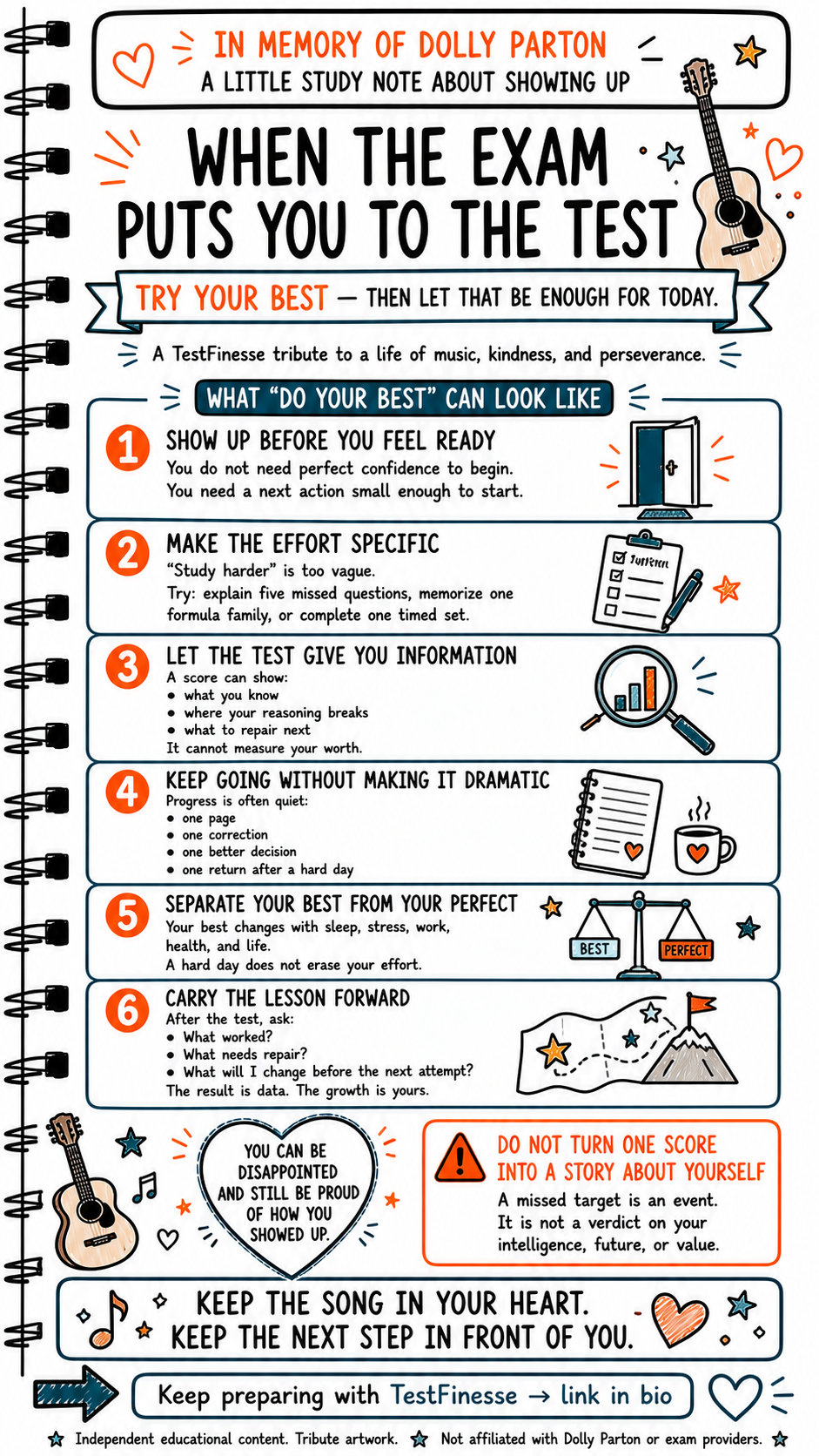
Some study days are productive. Some are frustrating. Some leave you wondering whether all the effort is making a difference.
An exam can test more than your memory. It can test your patience, confidence, schedule, energy, and ability to continue after a disappointing result.
This TestFinesse study note is a tribute to Dolly Parton and to the kind of perseverance that does not require perfection. Dolly Parton died at age 80 on August 25, 2026, according to reporting from the Associated Press. Associated Press report
The lesson for students is not to turn preparation into endless pressure. It is to show up with a specific next action, use results as information, and let a difficult day remain one difficult day.
Your best effort can be real even when the result is disappointing.
1. Show Up Before You Feel Ready
Waiting to feel completely confident can delay preparation indefinitely.
Confidence often develops after repeated action, not before it. You do not need to feel ready to begin a five-question drill, review one missed concept, or complete a short timed set.
Make the first action small enough to start:
Open one practice question.
Review one formula family.
Explain one missed answer.
Write one decision rule.
Complete one short recall session.
The goal is not to create instant motivation. The goal is to create contact with the work.
Once you begin, continuing may become easier. Even when it does not, you have still created useful information about what feels difficult and what needs repair.
Do not wait for perfect confidence. Choose a next action small enough to begin.
2. Make the Effort Specific
“Study harder” is not a study plan. It is a feeling disguised as an instruction.
A useful plan names the behavior:
Explain five missed questions.
Memorize one formula family.
Complete one timed reading passage.
Review ten vocabulary terms using retrieval.
Label each miss as content, setup, wording, timing, or execution.
Retest one weak skill with new questions.
Specific tasks are easier to start and easier to evaluate. At the end of the session, you can tell whether the task was completed and whether it produced useful feedback.
Compare:
“Study math.”
with:
“Complete six percentage-change questions, label every miss, and write one rule about the original value.”
The second plan gives you a clear beginning, middle, and end.
A specific effort creates evidence. A vague effort creates guilt.
3. Let the Test Give You Information
A score is not a complete description of your intelligence, future, or value.
It is one measurement taken under particular conditions. It can still be useful.
A practice test or exam result may show:
What you already know
Where your reasoning breaks
Which question types cause trouble
Where timing changes your accuracy
Which skills need repair next
Whether your preparation is becoming more consistent
Use the score as a diagnostic signal, not a personal verdict.
A disappointing result can become more useful when you ask:
Which misses repeated?
Which errors were avoidable?
Which questions were correct guesses?
Did I misunderstand the task?
Did I know the content but choose the wrong setup?
Did pressure change my decision?
The result is data. The meaning you build from it should be specific and measured.
4. Keep Going Without Making It Dramatic
Progress is often quiet.
It may look like:
One page of corrected notes
One repaired misconception
One better decision
One return after a difficult workday
One question you can now explain clearly
One mistake you no longer repeat
This kind of progress may not feel impressive in the moment, but it compounds.
You do not need to make every study session a major event. A sustainable routine often beats occasional bursts of intense preparation.
A simple weekly rhythm might include:
Short recall sessions
Targeted practice questions
One deeper review block
A scheduled retest
Time to recover and reset
The purpose of consistency is not to perform perfectly every day. It is to make returning easier.
5. Separate Your Best From Your Perfect
Your best effort changes with sleep, stress, work, health, responsibilities, and life circumstances.
A difficult day does not erase the work you completed on better days. It also does not require you to punish yourself with an unrealistic recovery plan.
Separate these ideas:
Best: The strongest effort available under today’s conditions
Perfect: An imaginary standard that never allows normal variation
On a low-capacity day, your best may be ten minutes of recall and one repaired error. On a high-energy day, your best may be a timed set and a detailed review.
Both can belong to a serious preparation plan.
A resilient system adjusts the volume while preserving the learning loop.
Consistency does not mean identical performance. It means continuing to return.
6. Carry the Lesson Forward
After a practice test or official exam, do not stop at the score.
Ask:
What worked?
What needs repair?
What will I change before the next attempt?
Write the answers down while the experience is still clear.
A useful post-test review might include:
The strongest section
The weakest section
The most common miss type
The biggest timing problem
One study behavior to keep
One study behavior to change
One near-term retest or practice goal
The purpose is not to replay the entire test emotionally. It is to convert the experience into a better next move.
A missed target is an event to analyze, not a permanent story about who you are.
Do Not Turn One Score Into a Story About Yourself
A single score can feel larger than it is. It may trigger thoughts such as:
“I am not smart enough.”
“I will never pass.”
“All of my preparation was pointless.”
“Everyone else is ahead of me.”
“I have to start over completely.”
Pause before accepting those conclusions.
Replace identity statements with observable questions:
What specifically happened?
What pattern appeared?
What can I practice?
What information is still missing?
What is the next decision?
This does not minimize disappointment. It gives disappointment a useful place in the process.
Use the TestFinesse Practice Loop
The TestFinesse method turns effort into visible learning:
Answer: Attempt the question before checking the explanation.
Explain: State the rule, clue, formula, or reasoning behind your choice.
Reveal: Compare your thinking with the rationale.
Fix the gap: Write one repair rule and practice it again later.
For example:
“When the question asks for the next action, identify the immediate risk before choosing a routine intervention.”
This process helps you carry the lesson forward instead of carrying only the emotion of the miss.
Final Takeaway
You can be disappointed by a result and still be proud of how you prepared.
You can need more work and still have made real progress. You can have a hard day without turning it into a failed identity. You can continue without pretending that every step feels easy.
Try your best. Learn from the result. Keep the next step in front of you.
Independent educational content and tribute artwork. Not affiliated with Dolly Parton or any exam provider. This post is for study encouragement and educational preparation, not medical or mental-health advice.
Keep studying
Practice Exam Skills
Turn this into a better score
Reading about a skill only gets you so far. TestFinesse's AI coach walks you through exam questions, explains exactly where your reasoning breaks down, and adapts to what you actually need to practice next.
Explore All Exams