The Next-Study Priority Map: Choose the Mistake Most Likely to Become Points
Last updated September 4, 2026
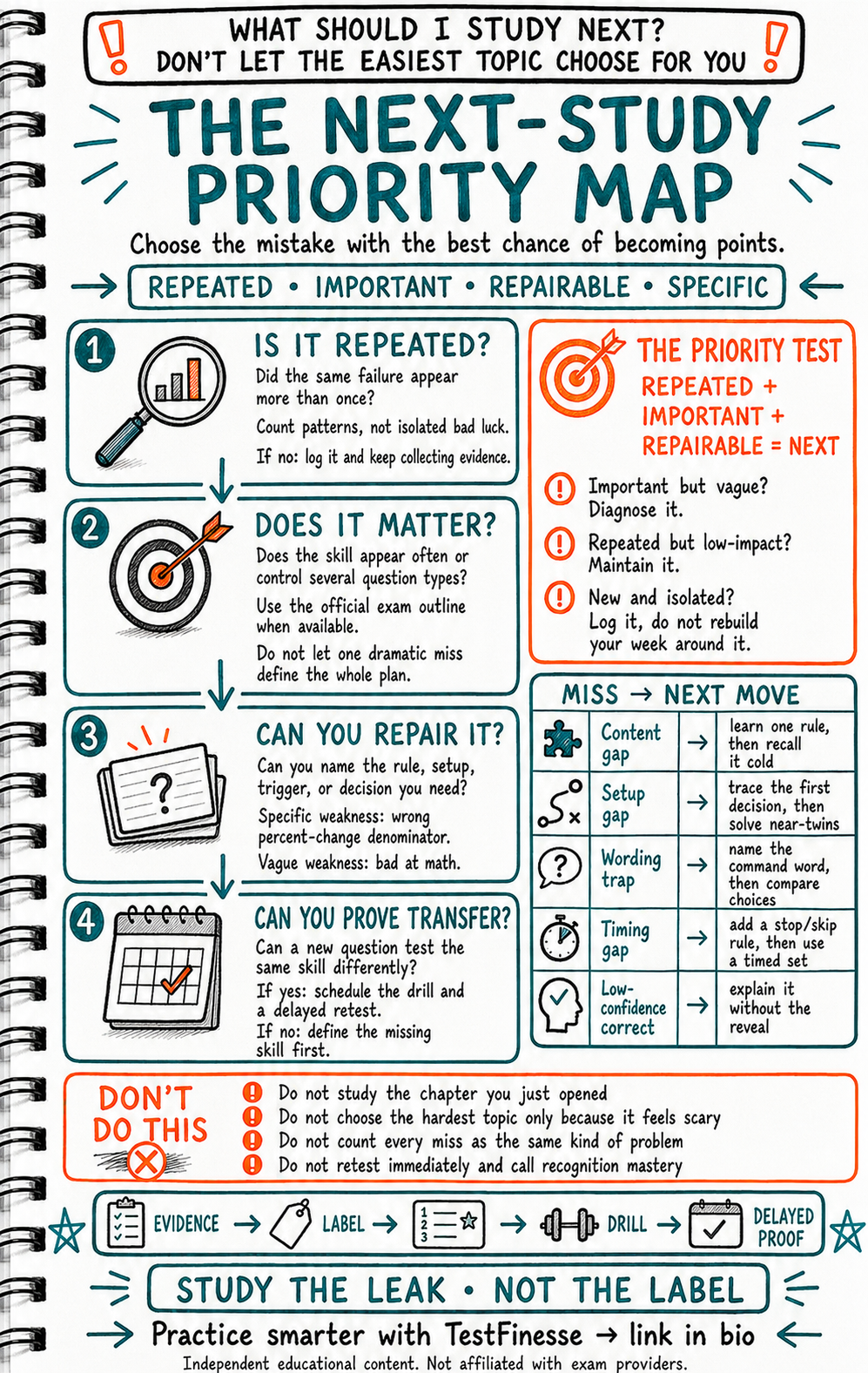
“What should I study next?” sounds like a simple question, but it can create a surprising amount of wasted time.
Many students let the easiest topic choose for them. They review what feels familiar, open the chapter they just studied, or pick the hardest subject because it creates the most anxiety.
Neither approach is necessarily strategic.
A better study decision comes from your performance evidence. Choose the mistake with the strongest chance of becoming a future point.
The next study priority should be:
Repeated → Important → Repairable → Specific
This framework helps you distinguish between a meaningful score leak and a single difficult question that may not deserve your entire week.
1. Is The Problem Repeated?
Start by looking for patterns.
Did the same type of failure appear more than once? Check your recent practice questions, error log, timed sets, and low-confidence correct answers.
Look for repeated behaviors such as:
Reversing the same formula
Missing the same command word
Choosing the wrong denominator
Confusing two similar concepts
Running out of time on the same question type
Guessing correctly without being able to explain why
Ignoring the same clue in a scenario
A single miss may be bad luck, an unfamiliar question, or a momentary lapse in attention. It deserves to be logged, but not necessarily promoted to your top priority.
A repeated miss is different. Repetition suggests that the problem is systematic enough to keep costing points.
Count patterns, not isolated bad luck.
If you do not have enough evidence yet, keep collecting it. Sometimes the correct next move is not a major review block. It is another small mixed set that helps you determine whether a pattern is real.
2. Does The Skill Matter?
A repeated weakness is not automatically the most important weakness.
Next, ask whether the skill appears frequently, affects several question types, or sits near the center of the official exam outline.
A high-value weakness may influence:
Multiple content areas
Several question formats
Both untimed and timed performance
A major exam section
A foundational skill used by harder topics
For example, a setup problem may affect percentage questions, dosage questions, and finance questions. A command-word problem may affect multiple reading or clinical-judgment formats.
Use the official exam outline when available. It can help you distinguish a high-impact skill from a narrow detail that appeared once.
At the same time, do not let one dramatic miss define your entire plan. A difficult question may feel important because it was frustrating, not because it represents a broad weakness.
Ask:
Does repairing this skill have a realistic chance of improving more than one future question?
If yes, it may deserve priority.
3. Can You Repair It?
The strongest study target is specific enough to fix.
Ask whether you can name the missing:
Rule
Setup
Trigger
Decision
Calculation step
Reading behavior
Timing rule
Retrieval cue
Compare these two statements:
“I am bad at math.”
“I use the new value as the denominator in percent-change questions.”
The first statement is vague. The second identifies a repairable behavior.
Specific weaknesses create specific drills:
Wrong percent denominator → complete eight percent-change questions and label original versus new.
Missed priority questions → identify the immediate threat before reading choices.
Unit errors → write the target unit and keep units visible through cancellation.
Wording traps → circle the command word before comparing answers.
Timing problems → use a stop-and-skip rule on a timed set.
Fragile recall → explain the rule without looking at the reveal.
If you can name the broken link, you can design a repair.
If you cannot name the link, diagnose before drilling. “Bad at pharmacology” or “weak in verbal” is not yet a study plan.
4. Can You Prove Transfer?
A repair is not finished because the original question now makes sense.
You need to know whether the skill works when the surface details change.
Ask:
Can a new question test the same skill differently?
Can you solve it without the original explanation?
Can you recognize the trigger in a new scenario?
Can you apply the rule with different numbers or wording?
If yes, schedule a targeted drill and a delayed retest.
Examples:
Change the numbers in a calculation problem.
Use a different patient scenario with the same priority rule.
Switch the passage topic while keeping the same inference structure.
Use a new graph that requires the same comparison.
Rephrase the command so you must identify the task again.
If you cannot design a transfer question, you may not yet understand what the missing skill is. Define the weakness before building your week around it.
Recognition on the original question is not the same as transfer.
The Priority Test
A study target earns priority when it meets all three core conditions:
Repeated + Important + Repairable = Next
A fourth condition makes the plan even stronger:
Specific
Use the following distinctions:
Important But Vague
Diagnose it first.
You may know that a topic matters, but “I need to improve this area” is not specific enough to drill.
Repeated But Low-Impact
Maintain it.
A recurring mistake in a narrow, low-frequency area may deserve periodic review without taking over your entire study plan.
New And Isolated
Log it.
Do not rebuild your week around one unusual miss. Collect more evidence and see whether it repeats.
Repeated And Repairable
Prioritize it.
This is the highest-value combination because you have evidence of a pattern and a clear path to improvement.
Match The Miss To The Next Move
Different errors require different repairs.
Miss typeRepair moveContent gapLearn one rule, then recall it coldSetup gapTrace the first decision, then solve near-twinsWording trapName the command word, then compare choicesTiming gapAdd a stop or skip rule, then use a timed setLow-confidence correctExplain the answer without the reveal
This prevents a common mistake: treating every wrong answer as a content gap.
If you use the wrong formula, rereading the chapter may not help. If you understand the content but misread the task, more memorization may not help. If your answer is correct but slow, additional untimed practice may not address the problem.
Study the leak, not the label.
Avoid These Priority Traps
Do not:
Study the chapter you just opened simply because it is already on your desk.
Choose the hardest topic only because it feels scary.
Count every miss as the same kind of problem.
Treat a correct answer as mastery when you guessed.
Retest immediately and call recognition mastery.
Build a full week around one dramatic miss.
Use broad labels such as “bad at math” or “weak in science.”
Add more content before diagnosing a repeated failure.
Practice without scheduling a delayed proof.
The easiest topic may provide comfort without improvement. The hardest topic may be too broad to repair efficiently. Your best next target is usually the one that is both important and actionable.
Build A Priority Decision In Five Minutes
When choosing your next study block, write:
Repeated? Yes / No
Important? Yes / No
Repairable? Yes / No
Specific? Yes / No
Transfer proof: __________________
Then choose one drill.
For example:
Miss: wrong percentage denominator
Repeated: yes
Important: appears in several calculation sets
Repairable: yes
Specific: original versus new value
Drill: 8 questions with labeled setup
Proof: delayed mixed set on Friday
This is far more useful than writing “study percentages.”
Use The TestFinesse Practice Loop
TestFinesse turns priority selection into an evidence-based practice loop:
Answer: Complete a mixed set without checking the key first.
Explain: Describe your reasoning and confidence level.
Reveal: Compare your work with the rationale.
Fix the gap: Label the first broken step.
Drill: Practice the smallest skill that repairs that step.
Transfer: Solve new questions with changed wording or numbers.
Retest: Return later and use the rule cold.
Track repeated labels rather than only total wrong answers. Your next study priority should come from the pattern that is most likely to become a point after focused repair.
Final Takeaway
You do not need to study the easiest topic next, the topic you just opened, or the topic that feels most intimidating.
Choose the mistake that is:
Repeated. Important. Repairable. Specific.
Then build a small drill, schedule a transfer question, and test the skill again after a delay.
Evidence → label → drill → transfer → delayed proof.
Study the leak, not the label. That is how your next study decision becomes a score-changing decision.
Independent educational content. Not affiliated with any exam provider.
Keep studying
Practice Exam Skills
Turn this into a better score
Reading about a skill only gets you so far. TestFinesse's AI coach walks you through exam questions, explains exactly where your reasoning breaks down, and adapts to what you actually need to practice next.
Explore All Exams