Turn Every Class Into an NCLEX Rule
Last updated August 20, 2026
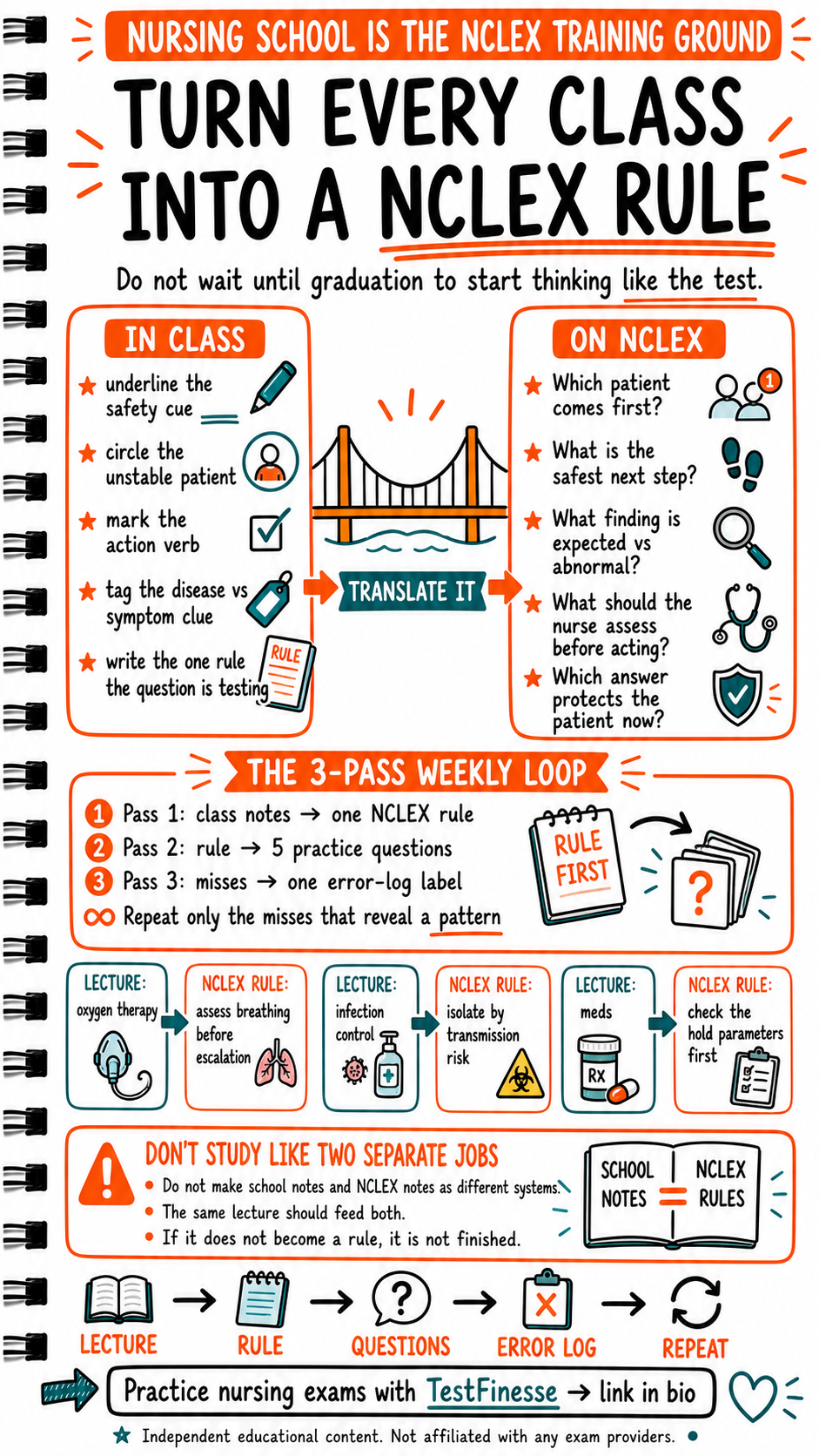
Nursing school is not separate from NCLEX prep.
That is the core idea behind this infographic. Every lecture, case study, lab, and care plan can become a test-ready rule if you train yourself to translate the material the way the exam asks it. The students who do this well do not wait until graduation to “start NCLEX studying.” They build NCLEX thinking into the class they are already taking.
That matters because NCLEX is not a trivia test. NCSBN’s current test plan centers entry-level nursing practice and clinical judgment. In other words, the exam is built to see whether you can recognize what matters, decide what comes first, and choose the safest correct action. Nursing school is the training ground for that work.
The smartest study move is to stop treating lecture notes and NCLEX notes like two different systems.
One lecture should feed both.
The Main Translation Rule
The infographic gives the right framework:
In class: mark the clue
On NCLEX: name the decision the question is really asking
Between the two: translate the material into one rule
That is the skill.
A lecture might give you oxygen therapy, infection control, medications, or patient symptoms. The NCLEX version of that same material usually changes the format:
Which patient comes first?
What is the safest next step?
What is expected vs abnormal?
What should the nurse assess before acting?
Which answer protects the patient now?
If you can translate class content into those question patterns, you are not just memorizing facts. You are building the decision-making pattern the exam wants.
1. In Class: Find the Clue
The first box in the infographic is the part most students skip.
When you are in class, do not just underline everything. Underline the safety cue, circle the unstable patient, mark the action verb, and tag the disease vs symptom clue.
That works because nursing content is full of signal words. The lecture may sound broad, but the test usually narrows the focus:
A symptom may point to a priority problem
A medication line may point to a hold parameter
A diagnosis may point to an isolation rule
A lab value may point to escalation
If you train your eye to catch the clue while you are learning it, you save yourself from rebuilding the whole topic later.
2. On NCLEX: Translate the Prompt
The second box is where the student stops sounding like a student and starts thinking like the test.
When you see a question stem, do not just think, “I know this topic.”
Translate it:
Who is at risk right now?
What action comes first?
What is the safest next step?
What finding is abnormal enough to matter?
What should the nurse assess before acting?
That translation step is the difference between knowing the lecture and answering the question.
NCLEX rewards the nurse who can make the next safe clinical move. It does not reward the person who can list ten facts about the disease but cannot choose the first action.
3. Use the 3-Pass Weekly Loop
The infographic’s weekly loop is practical because it keeps your study tied to the real exam.
Pass 1: Class notes → one NCLEX rule
After a lecture, write one rule from it.
Not a paragraph. Not a summary.
One rule.
Examples:
“Assess breathing before escalation.”
“Isolation depends on transmission risk.”
“Hold parameters come before giving the medication.”
“Safety cues outrank routine tasks.”
That is how lecture notes become exam notes.
Pass 2: Rule → 5 practice questions
Do not wait until you have “finished the chapter.”
Turn the rule into practice immediately. Five questions is enough to expose whether the rule is real or just familiar.
Pass 3: Misses → one error-log label
Every miss needs a label:
safety
assessment
delegation
infection control
meds
expected vs abnormal
timing
priority
That label becomes your next drill target.
The key is repetition with purpose, not repetition with no diagnosis.
4. Make School Notes and NCLEX Notes the Same File
This is one of the most useful ideas in the graphic.
Do not create a school notebook and a separate NCLEX notebook as if they belong to different worlds.
They should feed each other.
A good system looks like this:
Lecture note: oxygen therapy basics
NCLEX rule: assess breathing before escalation
Lecture note: infection control
NCLEX rule: isolate by transmission risk
Lecture note: meds
NCLEX rule: check hold parameters first
That turns class content into a rule bank.
And when you review, you are not rereading an entire unit. You are rehearsing the exact action the exam wants.
5. Study the Question Style, Not Just the Topic
NCLEX style is often the real challenge.
A topic like oxygen therapy can appear as:
priority
teaching
expected finding
abnormal finding
intervention
delegation
assessment
That means the content alone is not enough. You also need to know what job the question is doing.
The infographic’s repeated question types are the right reminder:
Which patient comes first?
What is the safest next step?
What finding is expected vs abnormal?
What should the nurse assess before acting?
Which answer protects the patient now?
If you study only topic names, you miss the exam’s actual job.
If you study the question style, you start seeing the rule behind the topic.
6. Do Not Study Like Two Separate Jobs
This is the trap the infographic warns against.
A lot of students think:
school notes are for class
NCLEX notes are for later
That split slows you down.
Instead, make every class do double duty:
learn the content
convert the content into a rule
test the rule
log the miss
repeat the pattern
That is the faster path because every learning moment becomes test preparation.
7. Build a Rule-First Review Habit
A good NCLEX review session should sound like this:
What was the lecture about?
What is the NCLEX rule hidden inside it?
What would the question ask if it tested this topic?
What error would I likely make under pressure?
What one sentence fixes that miss?
That is the review habit that actually changes performance.
You are not trying to remember every line of the textbook.
You are trying to convert knowledge into action.
Use The TestFinesse Practice Loop
The TestFinesse method here is:
Answer
Explain
Reveal
Fix the gap
For nursing school and NCLEX prep, that means:
Answer: take a lecture-based quiz or NCLEX-style set
Explain: say why the correct action is safest or first
Reveal: identify whether the miss was safety, assessment, meds, infection control, or delegation
Fix the gap: write the rule in one sentence and drill it again
That loop works because it forces visible thinking. It also keeps you from mistaking highlight color for actual understanding.
Final Takeaway
Nursing school is the NCLEX training ground when you use it that way on purpose.
Translate every lecture into one rule.
Translate every rule into a question type.
Translate every miss into an error-log label.
That is how you stop studying class and NCLEX as separate jobs.
The short version:
Lecture
Rule
Questions
Error log
Repeat
If it never becomes a rule, it is not finished.
Educational content only. Not medical or legal advice. Independent educational content. Not affiliated with NCSBN.
Accuracy sources checked: 2026 NCLEX Candidate Bulletin, 2026 NCLEX-RN Test Plan, NCLEX Practice Analyses
Keep studying
Practice Exam Skills
Turn this into a better score
Reading about a skill only gets you so far. TestFinesse's AI coach walks you through exam questions, explains exactly where your reasoning breaks down, and adapts to what you actually need to practice next.