Medication Math Setup Map: How to Stop Losing NCLEX Points to Unit Misses
Last updated August 11, 2026
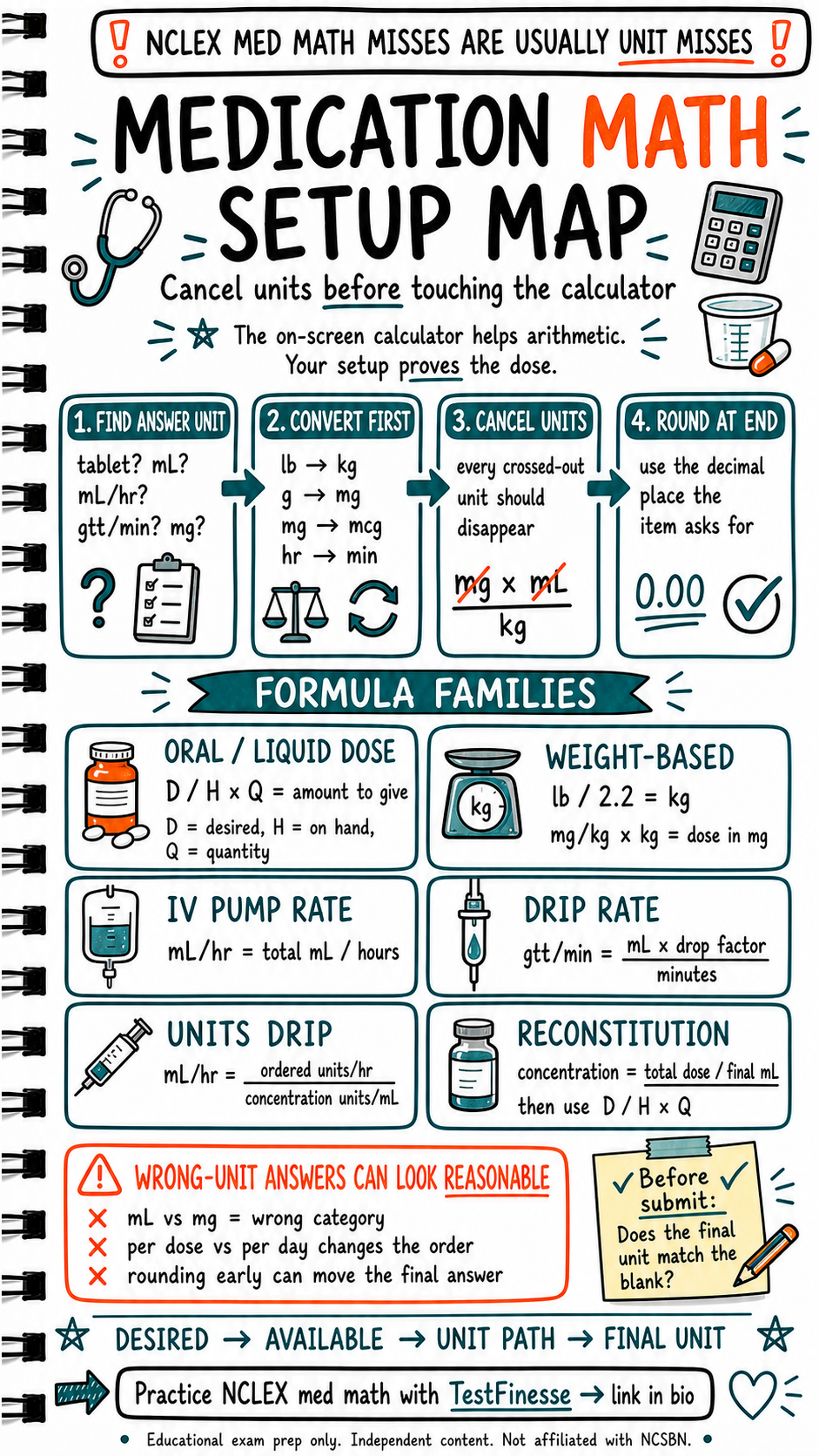
NCLEX medication math is rarely about whether you can do hard arithmetic. Most misses happen earlier: the student grabs the calculator before the setup is clean.
That is why this study note focuses on one core rule:
Cancel units before touching the calculator.
The NCLEX provides an on-screen calculator and erasable note board on exam day, but those tools do not decide whether the answer should be in mL, mg, tablets, gtt/min, units/hr, or mL/hr. The calculator can help with arithmetic. Your setup proves the dose.
Why Medication Math Feels Hard Under Pressure
Medication math combines three things at once:
Nursing language: ordered dose, available dose, quantity, concentration, infusion time
Unit movement: lb to kg, g to mg, mg to mcg, hours to minutes
Final-answer rules: decimal places, rounding, and the unit requested by the item
When students rush, they usually make one of these score leaks:
Solving for mg when the blank asks for mL
Using per day when the item asks for per dose
Forgetting to convert lb to kg
Setting up mL/hr as if it were gtt/min
Rounding too early and moving the final answer
The fix is not “do more random med math.” The fix is building a repeatable setup map.
The 4-Step Medication Math Setup
Before you calculate, move through this sequence.
1. Find the Answer Unit
Start with the blank.
Ask:
Does the item want tablets?
Does it want mL?
Does it want mL/hr?
Does it want gtt/min?
Does it want mg, mcg, or units?
This matters because the answer unit controls the entire setup. If the item asks for mL, your setup should end with mL. If the item asks for gtt/min, both drops and minutes must survive the unit-canceling process.
TestFinesse rule: The final unit is your target. Everything else is a path.
2. Convert First
Do not wait until the middle of the problem to convert.
Common NCLEX medication math conversions include:
lb to kg: lb ÷ 2.2 = kg
g to mg: 1 g = 1,000 mg
mg to mcg: 1 mg = 1,000 mcg
hr to min: 1 hr = 60 min
Conversion misses are dangerous because the arithmetic can still look clean. A student may divide correctly, multiply correctly, and still land in the wrong answer category because the unit path was wrong.
That is why the infographic’s “convert first” step is so important. It forces the question into the right measurement language before you start solving.
3. Cancel Units
This is the heart of medication math.
A clean dimensional-analysis setup should make unwanted units disappear. If mg appears in the numerator and denominator, it cancels. If kg appears above and below the line, it cancels. The only unit left should match the answer blank.
Before solving, ask:
Did every crossed-out unit truly cancel?
Is the remaining unit the one the item asks for?
Did I accidentally leave a hidden “per hour,” “per day,” or “per dose” behind?
If the final unit does not match the blank, the setup is not ready.
This is also why memorizing formulas without understanding units can backfire. A formula is useful only when the units prove that it belongs.
4. Round at the End
For NCLEX calculation items, the safe habit is simple:
Do not round until the final answer.
If the item asks for a whole number, one decimal place, or two decimal places, follow that instruction exactly. If you round halfway through a multi-step dosage problem, you may move the final answer enough to miss the item.
A good final check is:
Did I keep extra decimals during the work?
Did I round only after the setup was complete?
Did I use the decimal place the item requested?
Did I enter the answer in the format the blank expects?
Formula Families To Know
Medication math gets easier when you stop treating every question as brand new. Most problems fall into predictable formula families.
Oral Or Liquid Dose
The common setup is:
Desired ÷ Have × Quantity = amount to give
Use this when the order and available medication are stated in matching dose units, and you need the amount to administer.
Example logic:
Ordered: 250 mg
Available: 125 mg per 5 mL
Needed unit: mL
The setup should move from ordered mg through the available concentration until the answer ends in mL.
Trap: Do not treat “125 mg” as the amount to give. It is the available strength.
Weight-Based Dose
Weight-based problems often begin with:
lb ÷ 2.2 = kg
Then:
mg/kg × kg = dose in mg
The unit path matters. If the order is in mg/kg and the weight is in pounds, you cannot safely solve until pounds become kilograms.
Trap: The item may ask for the dose in mg, or it may ask for the amount to administer in mL after using the medication concentration. Read the final blank first.
IV Pump Rate
For pump problems:
mL/hr = total mL ÷ hours
If the time is given in minutes, convert minutes to hours or build the conversion into your dimensional-analysis setup.
Example:
500 mL over 4 hours
500 ÷ 4 = 125 mL/hr
Trap: A pump rate is usually mL/hr, not drops per minute.
Gravity Drip Rate
For gravity tubing:
gtt/min = mL × drop factor ÷ minutes
The drop factor tells you how many drops are in each mL for that tubing. This is not optional information; it is part of the unit path.
Trap: If the answer asks for gtt/min and your setup never includes the drop factor, the setup is incomplete.
Units Drip
Some infusions are ordered in units per hour and supplied as units per mL. The setup often becomes:
mL/hr = ordered units/hr ÷ concentration units/mL
This is a classic place where students get the right numbers in the wrong order. Let the units decide. If you need mL/hr, the units must cancel until mL is on top and hr is on bottom.
Reconstitution
Reconstitution problems add one extra step: the concentration may exist only after the diluent is added.
A clean process is:
Identify the final concentration after reconstitution.
Confirm the final volume.
Use the ordered dose against the available concentration.
End with the requested unit.
Trap: Do not use the dry vial amount alone if the question gives a final concentration or final volume after mixing.
Wrong-Unit Answers Can Look Reasonable
This is why medication math is stressful. A wrong-unit answer is not always obviously absurd.
Three common traps:
mL vs mg: One is volume; one is mass. They are not interchangeable.
Per dose vs per day: Frequency changes the total amount.
Early rounding: A small change early can shift the final answer.
Before submitting, ask:
Does the final unit match the blank?
That one question catches more errors than reworking the arithmetic from scratch.
Use The TestFinesse Practice Loop
The TestFinesse method is:
Answer
Explain
Reveal
Fix the gap
For NCLEX medication math, use the loop like this:
Answer: Solve without peeking.
Explain: Say the unit path out loud: “I need mL, so mg must cancel.”
Reveal: Check the correct answer and setup.
Fix the gap: Label the miss as a content gap, wording trap, conversion miss, rounding miss, or unit-path miss.
Do not just write “missed med math.” That is too vague. Write the specific fix:
“Forgot lb to kg before mg/kg”
“Used mL/hr formula for gtt/min”
“Rounded before final step”
“Solved per day, item asked per dose”
“Final unit did not match blank”
That turns a missed question into a rule you can use next time.
Final Takeaway
NCLEX medication math is not calculator-first. It is setup-first.
Use this order:
Desired → Available → Unit Path → Final Unit
Then calculate.
The best med math students are not the ones who memorize the most formulas. They are the ones who can look at a problem and say, “What unit am I solving for, and what has to cancel before I get there?”
Educational exam prep only. Always follow your nursing program, supervisor, facility policy, and scope of practice. Independent content. Not affiliated with NCSBN.
Accuracy sources checked: NCLEX Exam Day, NCLEX FAQs, NCLEX Test Plans, NCBI Bookshelf: Nursing Math Calculations, ISMP Error-Prone Abbreviations.
Keep studying
Practice Exam Skills
Turn this into a better score
Reading about a skill only gets you so far. TestFinesse's AI coach walks you through exam questions, explains exactly where your reasoning breaks down, and adapts to what you actually need to practice next.
Explore All Exams