Nursing Exam Prep Pain-Point Decoder: Find the Hidden Leak Behind Every Miss
Last updated August 23, 2026
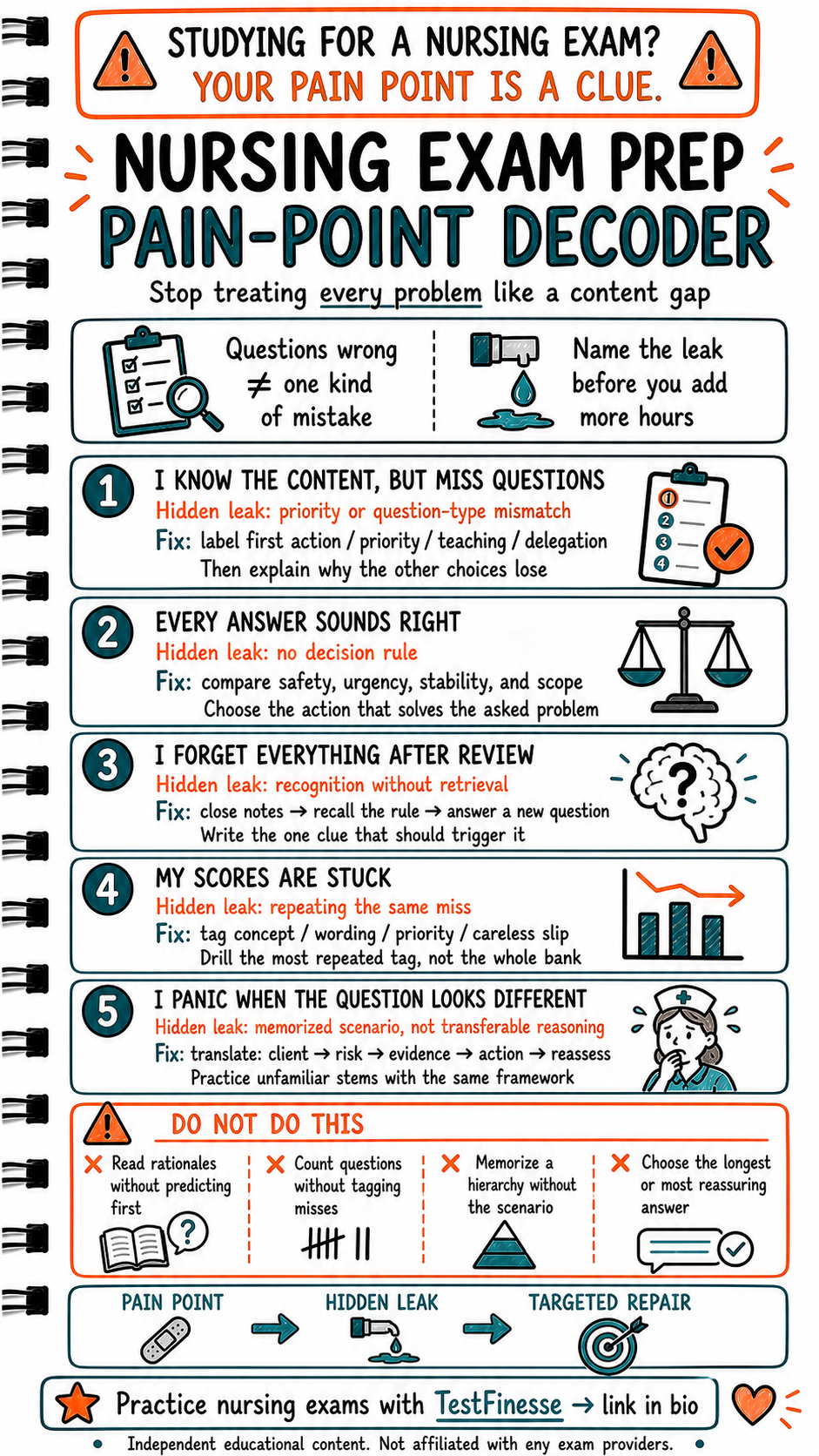
When nursing exam scores stop improving, the problem is not always a lack of content knowledge.
You may understand the disease process and still miss the priority question. You may read every rationale and still forget the rule the next day. You may complete hundreds of practice questions without improving because you are counting questions instead of diagnosing the reason behind each miss.
The better question is not simply, “How many questions did I get wrong?”
It is:
“What kind of thinking failure caused the wrong answer?”
The Nursing Exam Prep Pain-Point Decoder turns common frustrations into specific study diagnoses. Instead of treating every miss as a content gap, you identify the hidden leak and apply the smallest repair that addresses it.
Why Pain Points Are Useful
A study pain point is a signal. It tells you where your current method is breaking down.
For example:
“I know the content, but I still miss questions” may indicate a priority or question-type problem.
“Every answer sounds right” may indicate that you lack a decision rule.
“I forget everything after review” may indicate recognition without retrieval.
“My scores are stuck” may indicate that you are repeating the same error pattern.
“I panic when the question looks different” may indicate memorized scenarios instead of transferable reasoning.
This distinction matters because each problem requires a different repair. More reading will not automatically fix a prioritization problem. More practice questions will not automatically fix weak retrieval. A longer study session may simply give the same mistake more opportunities to repeat.
1. “I Know the Content, But I Still Miss Questions”
This pain point often signals a priority or question-type mismatch.
You may know the medication, diagnosis, or intervention, but fail to identify whether the question is asking for:
The first action
The priority client
The best response
Patient teaching
Delegation
An expected finding
The next step
Targeted repair
Before reviewing the rationale, label the question type. Then explain:
What was the question asking?
What clue controlled the priority?
Why did the correct answer fit the task?
Why did the other choices lose?
This turns a vague mistake into a usable rule.
For instance, write:
“When the question asks for the first action, identify the immediate safety risk before choosing a routine intervention.”
The goal is not merely to memorize the answer. It is to recognize the decision structure when the names, diagnosis, or setting change.
2. “Every Answer Sounds Right”
This usually means you need a decision rule, not another page of notes.
Many nursing questions contain multiple actions that could eventually help the client. The test is often asking which action is most appropriate now, given the client’s stability, urgency, risk, and scope.
Compare answer choices using four filters:
Safety: Which choice prevents the most immediate harm?
Urgency: Which problem cannot wait?
Stability: Is the client stable or experiencing a new change?
Scope: Is the action appropriate for the role and situation described?
The National Council of State Boards of Nursing’s clinical-judgment model emphasizes recognizing cues, analyzing them, prioritizing hypotheses, generating solutions, taking action, and evaluating outcomes. That sequence explains why a technically correct intervention can still be the wrong answer if it addresses a lower-priority concern. NCSBN Clinical Judgment Model
Targeted repair
Do not ask, “Which answer sounds nicest?”
Ask:
“Which answer solves the problem the question actually asked?”
Then explain why each tempting alternative is less safe, less urgent, outside the task, or aimed at a different problem.
3. “I Forget Everything After Review”
This is often a recognition-without-retrieval problem.
Reading a rationale can create a strong feeling of familiarity. The explanation looks clear, so it feels as if you understand it. But when the notes disappear and a new question appears, the rule may not be accessible.
Targeted repair
Use a closed-notes sequence:
Close the rationale.
Recall the decision rule from memory.
Answer a fresh question.
Write the one clue that should trigger the rule.
For example:
Clue: sudden change in client status
Rule: identify immediate safety risk and reassess the affected system
New question: apply the same reasoning to a different client and setting
The new question is important. Re-reading the same explanation tests recognition. A fresh question tests retrieval and transfer.
4. “My Scores Are Stuck”
A plateau often reflects repeating the same miss, not a lack of effort.
If every practice set produces the same priority error, wording error, or careless mistake, continuing to complete mixed questions without tagging the pattern can hide the real problem.
Create a simple error log with categories such as:
Concept
Wording
Priority
Question type
Calculation or setup
Careless slip
Confidence
After each practice set, count the repeated labels. Then drill the most common one first.
Targeted repair
Do not review the entire question bank equally. Choose a small set of targeted questions that test the repeated skill. After the drill, write a rule and retest with unfamiliar questions.
A score plateau becomes useful when it tells you what to repair next.
5. “I Panic When the Question Looks Different”
This pain point often signals memorized scenarios instead of transferable reasoning.
If you only recognize a question because it resembles a practice item, an unfamiliar stem can feel impossible. The solution is to practice the reasoning framework, not the exact story.
Translate each scenario into:
Client → risk → evidence → action → reassess
Ask:
What changed?
Which finding matters most?
What evidence supports concern?
What action addresses the priority?
What should happen after that action?
This method is consistent with the NCSBN view that clinical judgment depends on context. The same diagnosis or intervention may require different decisions depending on the client’s findings, risks, time pressure, resources, and setting. NCSBN Clinical Judgment Measurement Model
What Not to Do
Avoid study habits that create the appearance of progress without repairing the leak:
Reading rationales without predicting first
Counting questions without labeling misses
Memorizing a hierarchy without understanding the scenario
Choosing the longest or most reassuring answer
Rereading entire chapters after one missed question
Treating every wrong answer as a content gap
A rationale is most useful after you have committed to an answer and explained your reasoning. That makes the correction visible.
Use the TestFinesse Practice Loop
Apply the TestFinesse method to every missed nursing exam question:
Answer: Choose an option without looking at the explanation.
Explain: State the question type, priority risk, and evidence.
Reveal: Compare your reasoning with the rationale.
Fix the gap: Write one trigger-and-rule statement, then answer a new question testing the same skill.
Example:
“If the client has a sudden status change, I will identify the immediate safety threat before choosing a routine intervention.”
For delegation questions, remember that the correct answer depends on the client’s condition, the task, the delegatee’s competence, jurisdictional rules, and facility policy. NCSBN guidance states that activities requiring clinical reasoning, nursing judgment, or critical decision-making cannot simply be delegated, while accountability and oversight remain important parts of the process. NCSBN Delegation Guidelines
Final Takeaway
Your study pain point is not a verdict about your ability. It is a diagnostic clue.
Pain point → hidden leak → targeted repair
When you stop treating every miss like a content gap, your review becomes more precise. You can train priority separately from retrieval, retrieval separately from transfer, and repeated errors separately from careless slips.
The goal is not to complete more questions without a plan.
It is to make every miss produce a rule you can use on the next unfamiliar question.
Educational exam-prep content only. Always follow your nursing program, instructor, supervisor, facility policy, and applicable scope-of-practice requirements. Not affiliated with any exam provider.
Accuracy sources checked: NCSBN Clinical Judgment Model, NCSBN Clinical Judgment Measurement Model, NCSBN Delegation Guidelines
Keep studying
Practice Exam Skills
Turn this into a better score
Reading about a skill only gets you so far. TestFinesse's AI coach walks you through exam questions, explains exactly where your reasoning breaks down, and adapts to what you actually need to practice next.
Explore All Exams