10 TEAS Must-Knows to Pass the ATI TEAS
Last updated August 19, 2026
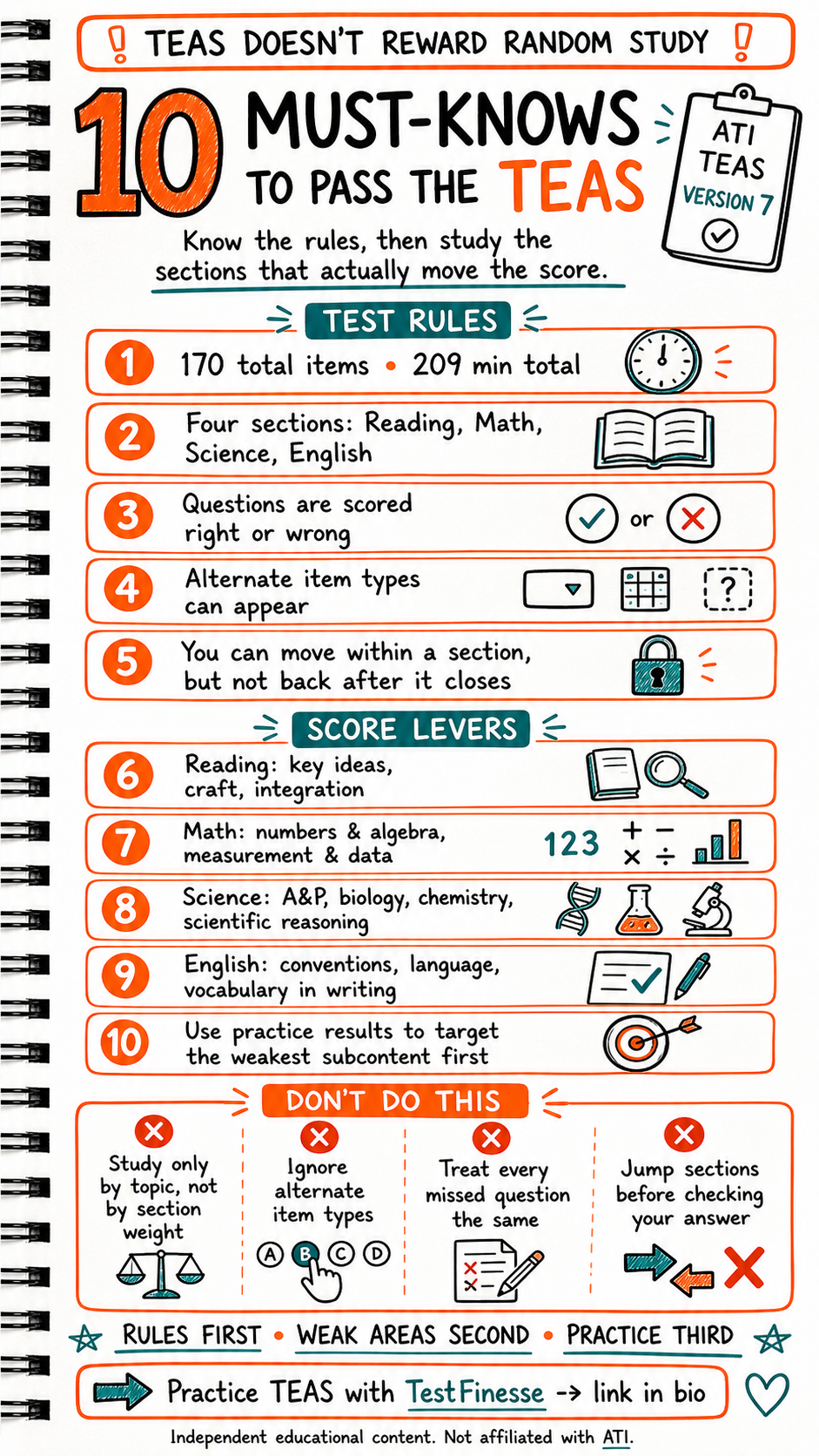
The TEAS is not a test where random studying pays off.
It rewards students who know the rules, understand the section weights, and target the areas that actually move the score. That is the point of this infographic: do not study everything evenly. Study the parts that matter most, and study them in the right order.
The official ATI TEAS Version 7 format is simple once you see it clearly: 170 total questions, 209 total minutes, four timed sections, and no penalty for guessing. The exam includes multiple-choice and alternate item types such as multiple select, fill in the blank, ordered response, and hot spot items. Within a section, you can move around as long as time remains. Once you close a section, you cannot return to it.
That means TEAS prep should be built around two things:
Know the test rules
Use practice results to attack the weakest subcontent first
That is how you avoid score leaks.
1. Know the Test Rules
Before you study content, learn the structure.
For TEAS Version 7, ATI reports:
Reading: 45 questions, 55 minutes
Math: 38 questions, 57 minutes
Science: 50 questions, 60 minutes
English and Language Usage: 37 questions, 37 minutes
The total is 170 items and 209 minutes of allocated testing time. ATI also notes that the exam includes 150 scored items and 20 unscored items.
Why does this matter? Because students often study like the exam is one giant blended quiz. It is not. Each section has its own time budget, its own content emphasis, and its own pressure points.
2. Understand What Is Actually Scored
The infographic is right to stress that TEAS questions are scored right or wrong.
That means:
There is no partial credit
There is no guessing penalty
You should still answer every question
This matters for pacing. A student who freezes on a hard item and leaves it blank is giving away a point opportunity. A student who makes a reasonable elimination and moves on usually has the better outcome.
Your goal is not perfection. Your goal is to keep the score moving.
3. Expect Alternate Item Types
TEAS Version 7 includes more than standard multiple choice.
ATI lists these question types:
Multiple choice
Multiple select
Fill in the blank
Ordered response
Hot spot
That means the test is not just checking whether you recognize a term. It is checking whether you can apply it. Alternate item types punish surface-level memorization, because they force you to show the process, not just the label.
For practice, that means you should train with more than flashcards:
Do multi-step math
Practice selecting all that apply
Practice sequencing steps
Practice interpreting charts, diagrams, and visuals
Practice reading the question stem first, then finding the answer
4. Use the Section Order as a Time Tool
ATI presents the TEAS in four timed sections. You can move within an active section, but once you close it, you cannot go back.
That creates a useful rule:
Do not waste time “saving” hard questions for a later section
Use the current section’s time while it is still open
Review only within the section you are in
The math section also includes a 10-minute break after math in ATI’s current guidance. That is not extra study time. It is a reset window. Use it to clear your head, not to restart your anxiety.
5. Study by Section Weight, Not by Topic Pride
The infographic’s “score levers” are the right way to think about TEAS prep.
The strongest prep plan starts with the areas that are most likely to move the total score:
Reading: key ideas, craft, integration
Math: numbers/algebra and measurement/data
Science: A&P, biology, chemistry, scientific reasoning
English: conventions, language, vocabulary in writing
That does not mean you ignore weaker topics. It means you stop treating all topics as equal.
Study the heaviest and weakest subcontent first.
If you keep missing grammar rules, punctuation, or reading craft questions, those are score leaks. If math is the weakest section, fix the setup and unit habits before you try to grind more random problems.
6. Reading Is About Evidence, Not Vibes
Reading questions on TEAS often look easy because the passage is short and the answer choices sound reasonable.
That is the trap.
Good TEAS reading strategy is:
Find the main idea
Track key details
Notice craft and structure
Use text evidence, not instinct
If two answers seem close, choose the one that is more directly supported by the passage. Do not pick the one that sounds more polished.
7. Math Is Setup First, Calculation Second
TEAS math rewards clean setup.
Before you calculate, ask:
What is the question asking?
What unit should the answer be in?
What operation family fits?
Are the choices telling me the likely range?
That is why the infographic tells you to use practice results to target the weakest subcontent first. If a student keeps missing conversions, proportions, or measurement questions, the fix is not “do more math.” The fix is name the setup before you calculate.
8. Science Is a Content Map, Not a Memory Dump
Science is where many students overread and under-classify.
The TEAS science section is built around:
A&P
Biology
Chemistry
Scientific reasoning
That means your study should be organized by category, not by random notes.
Use this filter:
What body system is being tested?
What process is being described?
What variable changed?
What is the most likely explanation?
If the question is about a graph, experiment, or process, do not read it like a fact sheet. Read it like a reasoning problem.
9. English Is a Rule Section
English and Language Usage is not about whether a sentence sounds fine.
It is about whether the sentence follows the rule.
Focus on:
Conventions of standard English
Knowledge of language
Vocabulary in writing
For close answer choices, use this order:
Find the sentence job
Name the rule
Eliminate the choices that break it
Confirm the choice that fits the sentence
If you trust your ear too early, you will miss the trap.
10. Use Practice Results to Build the Plan
The biggest mistake in TEAS prep is treating every missed question the same.
That is not how score improvement works.
After every practice set, sort misses into buckets:
Content gap
Setup gap
Reading error
Time pressure
Trap answer
Misread question
Then fix the biggest bucket first.
That is the TestFinesse version of the plan:
Rules first
Weak areas second
Practice third
If you keep doing that, your study stops being random. It starts becoming targeted.
Use The TestFinesse Practice Loop
The TestFinesse method here is:
Answer
Explain
Reveal
Fix the gap
For TEAS, that looks like this:
Answer: Take a timed section or question set
Explain: Say why the right answer is right
Reveal: Check what type of miss it was
Fix the gap: Drill the exact weak subcontent
That loop is better than rereading notes because it forces visible thinking. It also keeps you from confusing familiarity with mastery.
Final Takeaway
TEAS prep works best when you study the exam like a system.
Know the rules. Study by section weight. Practice the official question types. Fix the weakest subcontent first. That is how you turn prep time into score movement instead of busywork.
The short version is:
Rules first
Weak spots second
Practice third
Random study last
That is how you pass smarter.
Accuracy sources checked: ATI TEAS Exam Details, ATI TEAS 7 Sections and Timing, ATI TEAS Question Types
Keep studying
Practice Exam Skills
Turn this into a better score
Reading about a skill only gets you so far. TestFinesse's AI coach walks you through exam questions, explains exactly where your reasoning breaks down, and adapts to what you actually need to practice next.
Explore All Exams