10 TEAS Exam Tips: Stop Studying Randomly and Build a Smarter Score Plan
Last updated August 9, 2026
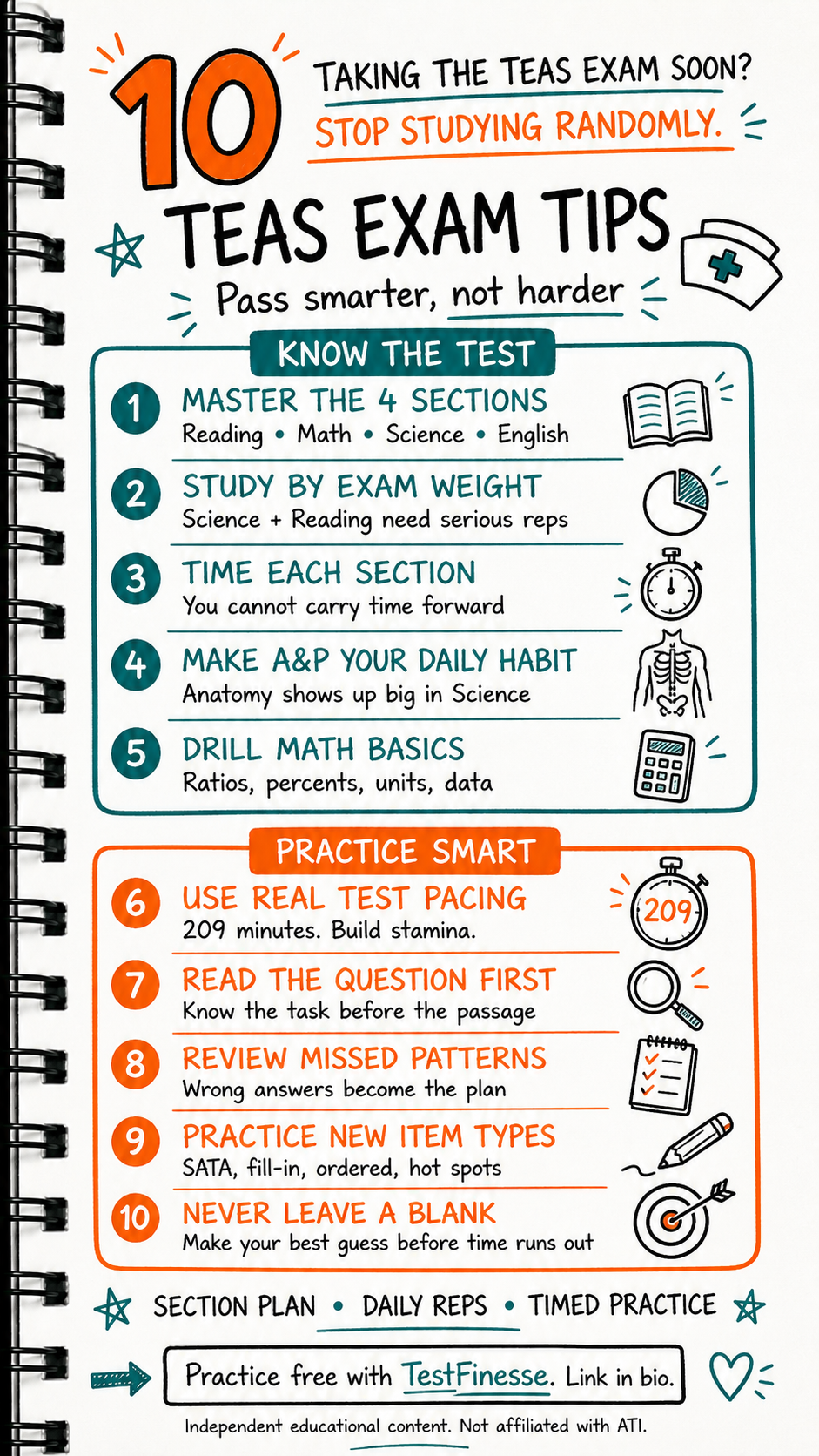
If you are taking the TEAS exam soon, stop studying randomly.
The TEAS is not a test you should prepare for by doing a little bit of everything whenever you feel behind. It has a clear structure, specific section timing, and predictable skill areas.
That means your prep should have a plan.
The ATI TEAS Version 7 includes Reading, Mathematics, Science, and English and Language Usage. The exam has 170 total questions, including scored and unscored pretest questions, with 209 minutes of total testing time.
A smarter TEAS plan is not about studying harder every day.
It is about knowing:
Which sections matter
Where your score is leaking
How each section is timed
Which question types you need to practice
How to review missed questions correctly
The goal is simple:
Pass smarter, not harder.
Know The Test Before You Study
Many students start TEAS prep by buying a book, watching random videos, or answering practice questions with no section plan.
That creates motion, but not always progress.
Before you study, know the structure:
Reading: 45 questions, 55 minutes
Mathematics: 38 questions, 57 minutes
Science: 50 questions, 60 minutes
English and Language Usage: 37 questions, 37 minutes
You can move back and forth within the active section while time remains. But once you close a section and move on, you cannot return to that closed section.
That matters for pacing.
You cannot treat the TEAS like one long pool of time. Each section needs its own timing plan.
1. Master The 4 Sections
The TEAS covers four major areas:
Reading
Math
Science
English and Language Usage
Each section tests a different kind of thinking.
Reading asks whether you can understand passages, find key ideas, interpret structure, and use evidence.
Math focuses on numbers, algebra, measurement, and data.
Science includes anatomy and physiology, biology, chemistry, and scientific reasoning.
English and Language Usage tests grammar, sentence structure, vocabulary, clarity, and standard English conventions.
Do not study for “the TEAS” in general.
Study by section.
A good weekly plan should include time for each area, but not necessarily equal time for each area. Your weakest sections and the highest-weight areas need more reps.
2. Study By Exam Weight
Not every section carries the same amount of content.
According to ATI’s TEAS Version 7 content specifications, Science and Reading are especially important areas to prepare seriously for. Science has the largest scored content share, and Reading is also heavily represented.
That does not mean you should ignore Math or English. It means your study time should match both:
Exam weight
Your personal weakness
Ask:
Which section has the most questions?
Which section has my lowest practice score?
Which section feels hardest under time pressure?
Which section do my target programs care about most?
Some nursing or allied health programs may look closely at individual section scores, not just the overall score. Always check the requirements for the schools where you are applying.
A smarter plan targets the score areas that matter most.
3. Time Each Section
The TEAS is section-timed.
That means pacing has to be practiced section by section.
Approximate pacing:
Reading: about 1.2 minutes per question
Math: about 1.5 minutes per question
Science: about 1.2 minutes per question
English: about 1 minute per question
These are averages, not rigid rules. Some questions will be quick. Others will take longer.
The mistake is spending too much time on one difficult item and losing easier points later.
Use a simple pacing rule:
If a question is stealing too much time, make your best answer, flag it if possible, and move.
You can review within the active section if time remains. But you cannot carry unused section time forward into later sections.
Each section needs its own complete attempt.
4. Make A&P Your Daily Habit
Anatomy and physiology is a major part of TEAS Science.
That means A&P should not be something you cram once a week.
Make it a daily habit.
Focus on:
Body systems
Organ functions
Homeostasis
Anatomical terms
Basic physiology
Cause and effect relationships
How systems interact
Do not only memorize isolated facts.
Ask:
What does this structure do?
What happens if it stops working?
Which system is involved?
How does this process maintain balance?
What clue in the question points to this system?
A&P questions often reward students who understand function, not just names.
A useful habit is to take one body system per day and write:
Main organs
Main job
Key vocabulary
Common question traps
One practice question
Small daily reps beat last-minute cramming.
5. Drill Math Basics
TEAS Math is not about advanced calculus.
It is about clean, accurate use of core math skills.
Drill:
Ratios
Percentages
Fractions
Decimals
Unit conversions
Proportions
Basic algebra
Measurement
Data interpretation
Many TEAS Math mistakes happen because students rush the setup.
Before solving, ask:
What is the question asking for?
What units do I need?
Is this a ratio, percent, or proportion problem?
Do I need to convert first?
Does the answer need to be rounded?
The TEAS provides an on-screen calculator for the Mathematics section, but a calculator does not fix a bad setup.
Your best math habit is:
Write the setup before calculating.
Practice Smart
Once you know the test, your practice should become more targeted.
Do not just answer questions and count right or wrong.
Use practice to build stamina, expose weak spots, and learn how the exam asks questions.
6. Use Real Test Pacing
The TEAS has 209 minutes of total testing time.
That does not mean every practice session has to be a full-length exam. But you do need some real pacing practice before test day.
Use three levels of timing:
Short drills: 5 to 10 questions for one skill
Section practice: one timed section under realistic pacing
Full-length practice: all sections to build stamina
Full-length practice matters because fatigue changes performance.
You may know the content, but still lose points when your focus drops in the later sections.
After a timed practice set, review:
Where did I slow down?
Which questions stole time?
Did I rush near the end?
Did I leave anything blank?
Did timing change my accuracy?
Timed practice teaches more than speed. It teaches decision-making.
7. Read The Question First
For many TEAS passage, chart, and data questions, reading the question first can save time.
This does not mean ignoring the passage.
It means knowing the task before reading deeply.
Ask:
Am I looking for the main idea?
Am I finding a detail?
Am I comparing data?
Am I identifying a conclusion?
Am I solving for a number?
Am I choosing the best revision?
When you know the task, your reading becomes more focused.
For Reading, this helps you look for evidence.
For Science, it helps you know which figure or data point matters.
For English, it helps you identify whether the question is testing grammar, clarity, organization, or vocabulary.
The rule is:
Know the task before you chase the text.
8. Review Missed Patterns
Wrong answers should become the plan.
After practice, do not only write down the correct answer. Label the pattern.
Common TEAS miss types include:
Content gap: I did not know the concept.
Wording trap: I misunderstood what the question asked.
Careless slip: I knew it but rushed.
Formula/setup error: I used the wrong method.
Evidence error: I picked an answer without support.
Unit error: I forgot to convert.
Timing error: I spent too long or guessed too fast.
Then write one rule for next time.
Examples:
Next time, convert units before setting up the proportion.
Next time, find passage evidence before choosing a Reading answer.
Next time, identify the body system before answering an A&P question.
Next time, check whether the English question asks for clarity, grammar, or organization.
Review is where score improvement happens.
Practice shows the gap. Review fixes it.
9. Practice New Item Types
TEAS Version 7 includes more than standard multiple-choice questions.
ATI lists item types such as:
Multiple choice
Multiple select
Fill in the blank
Ordered response
Hot spot
These require different habits.
For multiple select, also known as SATA, do not stop after finding one correct answer. Check each option independently.
For fill-in-the-blank, be careful with spelling, number format, units, and rounding instructions.
For ordered response, think through the sequence before dragging answers.
For hot spot questions, read exactly what area the question asks you to identify.
Alternate item types can feel stressful if you only practice standard multiple choice.
Make them part of your prep before test day.
10. Never Leave A Blank
ATI states that TEAS questions are scored right or wrong and there is no penalty for guessing.
That means a blank is a lost opportunity.
If time is running out, make your best guess.
Use elimination first:
Remove answers that are clearly wrong.
Watch for extreme wording.
Match units in math.
Choose the answer supported by the passage.
Use the chart, figure, or clue provided.
A guess after eliminating two options is much stronger than a random guess.
Your test-day rule should be:
Every question gets an answer before time runs out.
Use The TestFinesse Practice Loop
The TestFinesse method is:
Answer
Explain
Reveal
Fix the gap
For TEAS prep, this means you should explain your answer before checking it.
Ask:
Why did I choose this answer?
What skill was being tested?
What clue mattered most?
What made the wrong answer tempting?
What rule will help me next time?
This turns practice into learning.
You are not just collecting completed questions. You are building a score plan.
Final Takeaway
The TEAS is manageable when your prep is organized.
Focus on these 10 moves:
Master the four sections
Study by exam weight
Time each section
Make anatomy and physiology a daily habit
Drill math basics
Use real test pacing
Read the question first
Review missed patterns
Practice new item types
Never leave a blank
Do not study randomly.
Build a section plan.
Do daily reps.
Practice under timed conditions.
Then use every missed question to sharpen the next one.
Accuracy sources checked: ATI TEAS Exam Details, ATI TEAS Version 7 Content Specifications, ATI TEAS Question Types, and ATI TEAS Section Timing.
Keep studying
Practice Exam Skills
Turn this into a better score
Reading about a skill only gets you so far. TestFinesse's AI coach walks you through exam questions, explains exactly where your reasoning breaks down, and adapts to what you actually need to practice next.
Explore All Exams