HESI A2 Critical Thinking: How to Decode the Scenario Before Choosing an Answer
Last updated August 22, 2026
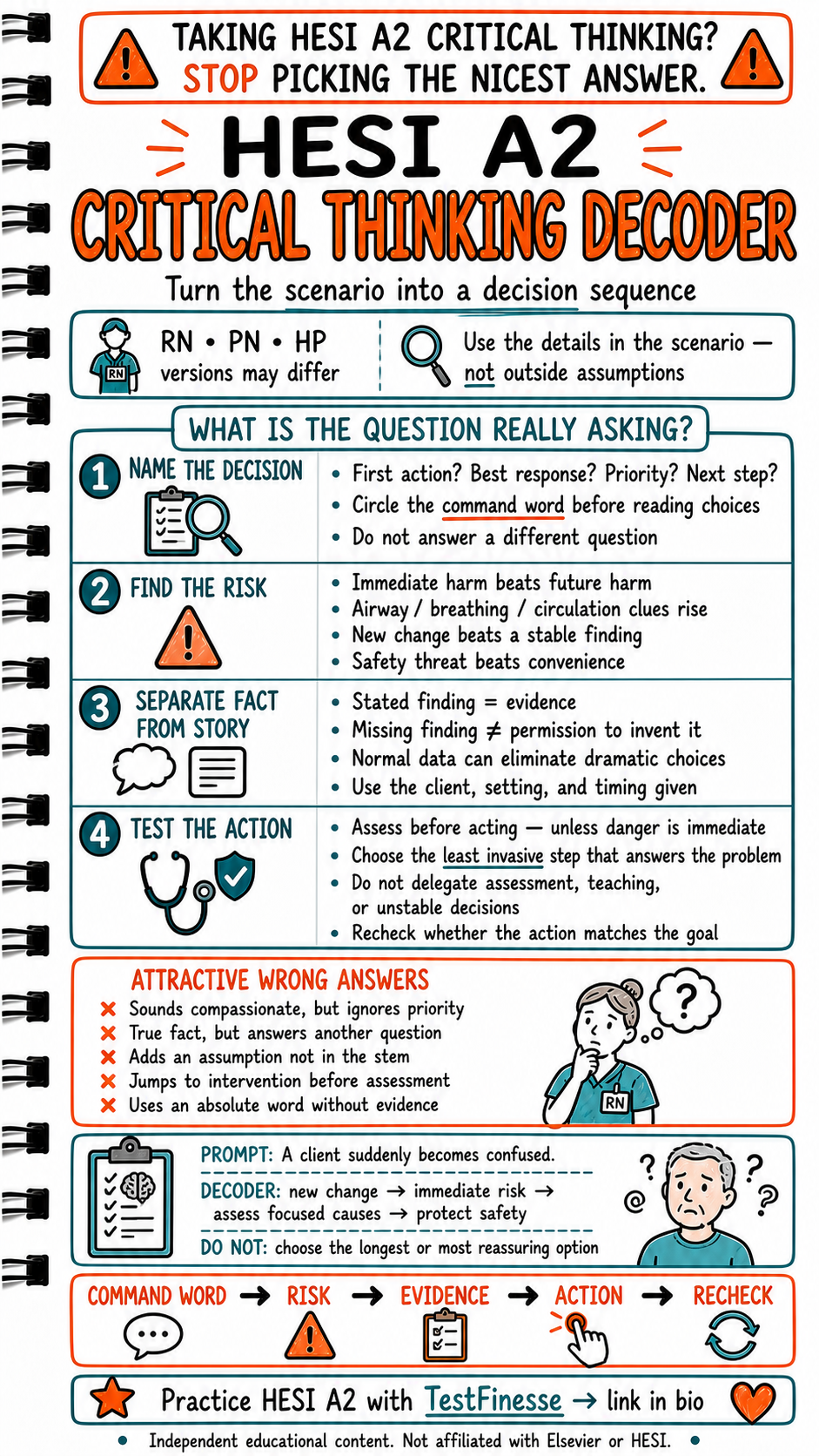
Many nursing exam questions are difficult because several answer choices sound reasonable. One may be compassionate. Another may be technically correct. A third may describe a complete long-term plan.
But the question may only be asking:
What should happen first?
What is the safest next step?
Which finding is most concerning?
What should the nurse assess?
What can be delegated?
The key is to answer the question that was actually asked.
The HESI A2 Critical Thinking Decoder turns each scenario into a short decision sequence:
Command word → risk → evidence → action → recheck
This approach helps prevent a common mistake: choosing the most impressive answer instead of the answer that best matches the client’s immediate needs, the evidence provided, and the nurse’s role.
Important: HESI assessments and nursing-program requirements can vary. Use this framework as educational exam preparation, but always follow your program’s official instructions, current course materials, and scope-of-practice guidance.
The Core Method: Decode Before You Decide
Before reading the answer choices, pause and identify the structure of the question. This reduces the chance that a dramatic detail or familiar nursing intervention will pull you toward the wrong option.
Ask:
What decision is the question asking me to make?
What risk is present right now?
Which facts are explicitly stated?
Which action addresses the problem with the least unnecessary risk?
What result should I reassess afterward?
This is closely related to the clinical-judgment process used in modern nursing education: recognize relevant cues, analyze them, prioritize concerns, generate a safe solution, take action, and evaluate the outcome. The National Council of State Boards of Nursing describes these as distinct steps because knowing facts alone does not guarantee good clinical judgment. NCSBN Clinical Judgment Model
1. Name the Decision
The first step is to identify the command word.
Words such as first, priority, best, most appropriate, next, assess, and teach create different tasks.
If the question asks for the first action
Look for the action that addresses the most immediate threat. Do not automatically choose the longest intervention or the most advanced treatment.
If the question asks for the best response
Consider the communication goal. Is the client asking for information, expressing fear, reporting a symptom, or demonstrating a change in condition?
If the question asks for priority
Rank the findings by urgency and potential harm. A new airway, breathing, circulation, or neurological concern generally deserves more attention than a routine comfort need.
If the question asks what to assess
Do not jump directly to an intervention unless the scenario indicates an immediate danger that requires action.
The rule: Circle the command word mentally before comparing answer choices.
2. Find the Risk
Once you know the task, identify what could cause harm if ignored.
A useful priority filter is:
Immediate harm beats possible future harm.
A new change beats a stable finding.
A safety threat beats convenience.
Airway, breathing, and circulation concerns rise quickly.
Unstable findings take priority over routine care.
This does not mean every question can be solved by memorizing one hierarchy. The scenario still controls the decision. A client’s baseline, diagnosis, timing, symptoms, and vital signs matter.
For example, a slightly abnormal value may be less urgent than a sudden change from baseline. Conversely, a seemingly ordinary complaint may become high priority when paired with confusion, respiratory distress, bleeding, or a rapid decline.
3. Separate Facts From Story
Nursing questions often include details that make the scenario feel realistic. Realism is not the same as relevance.
Sort the stem into three categories:
Stated facts: What the scenario directly tells you.
Clinical clues: Findings that change urgency, risk, or the likely next step.
Your assumptions: Information you are imagining but the question never provided.
The third category is where many attractive wrong answers begin.
Do not invent:
A diagnosis that was not stated.
A medication order that does not exist.
A change in vital signs that was not reported.
Permission to perform an intervention outside the described role.
A client preference that the stem never mentions.
Missing information is not permission to assume it.
Use the client, setting, timing, and objective findings given in the question. If a choice depends on information that is absent, it may be answering a different scenario.
4. Test the Action
Now evaluate each answer choice against the actual problem.
Ask:
Does this action address the command word?
Does it protect the client from the most immediate risk?
Is assessment needed before intervention?
Is the action proportionate to the evidence?
Is it within the role and scope described by the question?
Does it add unnecessary steps?
A strong answer is often the least invasive safe action that directly addresses the problem.
That does not mean “always assess first.” When danger is immediate, action may be required before a complete assessment. The correct sequence depends on the facts presented.
For delegation questions, be careful with blanket rules. Assessment, nursing judgment, evaluation, and care of an unstable client generally require appropriate licensed judgment, while specific tasks may be delegated only when the person is qualified and the situation is stable. Delegation rules vary by jurisdiction, institution, and role, so use your program’s official guidance.
Attractive Wrong Answers
The infographic highlights several common traps:
Compassionate but low priority: Sounds caring but ignores the immediate risk.
True but unrelated: Factually correct, but does not answer the question.
Assumption-based: Depends on information not included in the stem.
Intervention too early: Jumps to treatment before gathering necessary information.
Absolute language: Uses words such as always or never without enough evidence.
Overly complex: Includes multiple steps when the question asks for the next step.
When two answers seem close, ask which one is better supported by the exact scenario and question wording.
A Mini Example
Suppose the prompt says:
A client suddenly becomes confused. What should the nurse do next?
Use the decoder:
Command word: “What should the nurse do next?”
Risk: Sudden confusion is a new change that may signal an acute problem.
Evidence: The change is sudden; do not assume the cause.
Action: Choose a focused assessment or safety action that matches the choices and protects the client.
Recheck: Determine whether the client’s status improves, worsens, or requires escalation.
The strongest answer is not automatically the most reassuring option or the longest intervention. It is the option that fits the evidence and the immediate decision.
Use the TestFinesse Practice Loop
Turn each missed HESI A2 question into visible reasoning:
Answer: Choose the best option without looking at the rationale.
Explain: State the command word, immediate risk, and evidence supporting your choice.
Reveal: Review the rationale and identify the step where your reasoning diverged.
Fix the gap: Write one rule, such as: “When a client has a sudden status change, identify the immediate safety risk before choosing a routine intervention.”
Then practice a fresh question testing the same skill. Do not only reread the explanation. The goal is to make the decision sequence usable under pressure.
Final Takeaway
HESI A2 critical-thinking questions are not invitations to choose the nicest, longest, or most advanced answer. They are exercises in matching the question, the risk, the evidence, and the next safe action.
Before selecting an answer, ask:
What is being asked? What could harm the client now? What facts do I actually have? What is the safest action within the scenario?
That is how you turn a complicated stem into a clear decision sequence.
Educational exam-prep content only. Always follow your nursing program, instructor, supervisor, facility policy, and applicable scope-of-practice requirements. Not affiliated with Elsevier or HESI.
Accuracy sources checked: NCSBN Clinical Judgment Model transcript, NCSBN Clinical Judgment Model overview, Elsevier HESI Exam Solutions
Keep studying
- HESI Family Nursing Clinical Judgment: Assess the Patient, Support the Family
- Nursing Exam Prep Pain-Point Decoder: Find the Hidden Leak Behind Every Miss
- HESI Vocab Is a Translation Test: Split the Word, Then Read the Sentence
- HESI A2 Prep Map: Build Your Study Plan From Your School’s Required Sections
Practice Exam Skills
Turn this into a better score
Reading about a skill only gets you so far. TestFinesse's AI coach walks you through exam questions, explains exactly where your reasoning breaks down, and adapts to what you actually need to practice next.
Explore All Exams