HESI Vocab Is a Translation Test: Split the Word, Then Read the Sentence
Last updated August 18, 2026
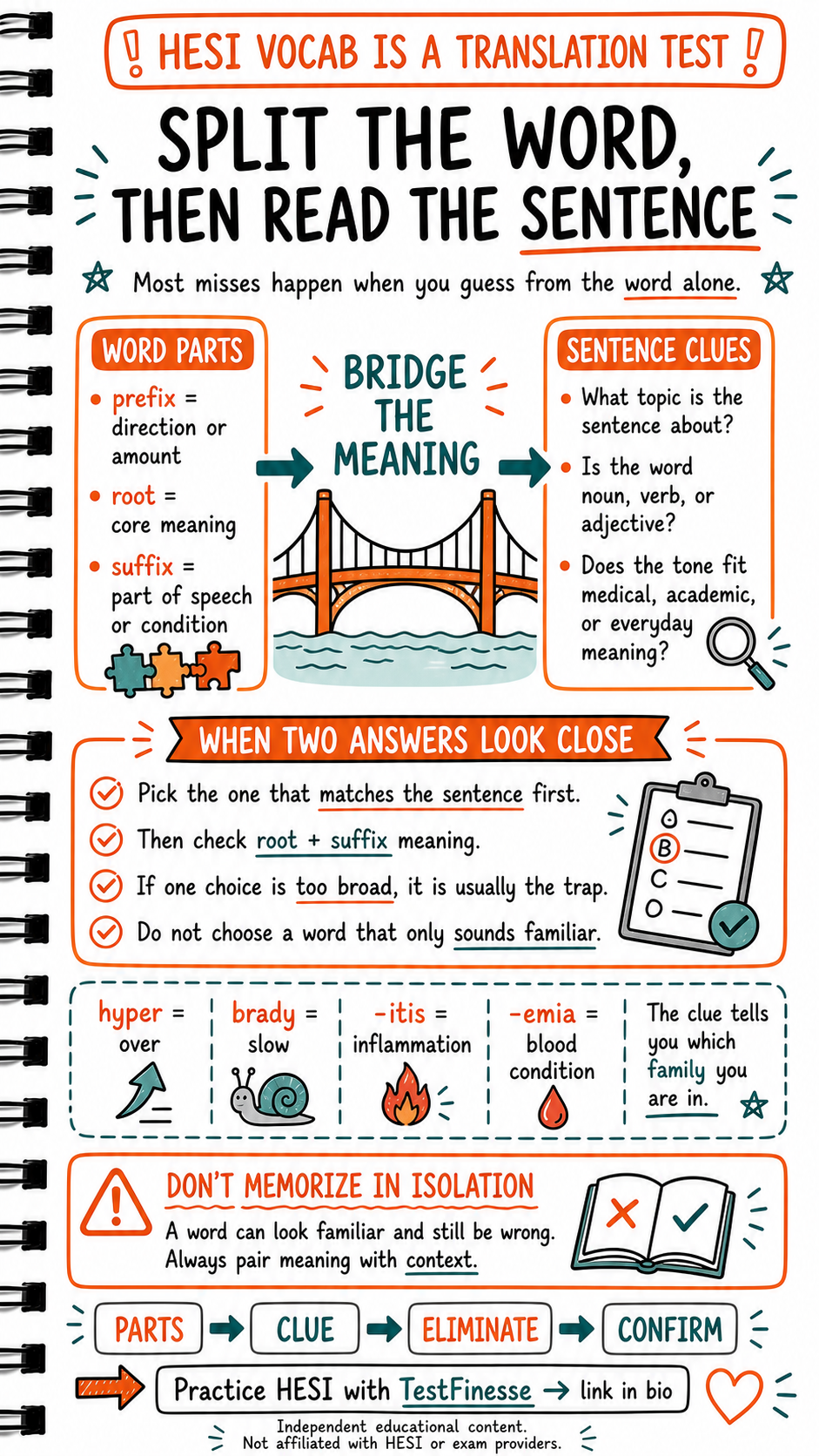
HESI vocabulary is not a memorization contest.
It is a translation test.
That distinction matters because a lot of students study vocab the wrong way. They build long word lists, stare at isolated terms, and hope familiarity will turn into accuracy. But HESI vocab questions usually reward a different skill: can you break the word apart, use the sentence for context, and choose the meaning that actually fits?
Elsevier’s HESI Admission Assessment review materials include vocabulary as one of the core A2 subjects, alongside reading comprehension, grammar, math, biology, chemistry, and A&P. That means vocab is not a side topic. It is a real part of the prep stack, and it deserves a strategy instead of random memorization.
The TestFinesse rule is simple:
Split the word, then read the sentence.
Why HESI Vocab Feels Hard
Vocabulary questions feel slippery because the wrong answer can sound familiar.
That is the trap.
A word may look medical, academic, or technical enough to feel correct, even when it does not match the sentence. Another choice may be a closer fit even if it does not sound as impressive. That is why isolated memorization is not enough. You need a method that uses both the word parts and the sentence clue.
A strong HESI vocab answer is not the one that looks smartest.
It is the one that matches meaning, context, and word family.
1. Use Word Parts First
Start by breaking the word into its parts:
prefix
root
suffix
The image’s framework is right: word parts tell you the family the word belongs to.
Prefix
The prefix often points to direction or amount.
Examples:
hyper = over
brady = slow
The prefix can shift the meaning enough to eliminate a tempting wrong answer right away.
Root
The root usually carries the core meaning.
If you know the root, you know what the word is fundamentally about.
Suffix
The suffix often points to part of speech or condition.
Examples:
-itis = inflammation
-emia = blood condition
That is useful because the suffix can tell you whether you are looking at a condition, process, or descriptor.
TestFinesse rule: Word parts tell you the family before context fills in the meaning.
2. Then Read The Sentence
Word parts alone are not enough.
You still need the sentence clue.
Ask:
What topic is the sentence about?
Is the word a noun, verb, or adjective?
Does the tone fit medical, academic, or everyday meaning?
Is the sentence asking for a literal meaning or a contextual meaning?
This is where a lot of students go wrong. They guess from the word alone and skip the sentence. But the sentence usually tells you which meaning the test wants.
A word can look familiar and still be wrong if it does not fit the sentence.
Sentence rule: Context decides which meaning wins.
3. Bridge The Meaning
The best HESI vocab answers usually come from combining the parts and the sentence.
That is why the image uses the phrase bridge the meaning.
You are not choosing between “word list answer” and “sentence answer.” You are building one full meaning from both clues.
For example:
If the prefix suggests “over,” the root suggests a body process, and the sentence is medical, that narrows the family.
If the suffix suggests a condition, the sentence talks about symptoms, and one choice is a noun while another is an adjective, that helps you eliminate.
If the sentence sounds everyday but one answer is overly technical, the overly technical option may be a trap.
Bridge rule: Word parts and sentence clues should point to the same answer.
4. When Two Answers Look Close
This is where HESI vocab becomes a decision test.
If two answers are close, use this order:
Pick the one that matches the sentence first.
Then check root and suffix meaning.
If one choice is too broad, it is usually the trap.
Do not choose a word that only sounds familiar.
That sequence matters because the sentence is your strongest context clue. If the sentence matches one choice better, that choice usually deserves priority over a more general “maybe.”
A too-broad answer often sounds attractive because it covers more ground. But vocab questions usually want precision, not vagueness.
Close-choice rule: Match the sentence first, then verify the word family.
5. Don’t Memorize In Isolation
This is one of the biggest mistakes on vocab prep.
A word can look familiar and still be wrong.
That is why you should never memorize a term without:
a sentence
a root
a prefix or suffix
a meaning family
an example of use
The image’s warning is accurate: always pair meaning with context.
If you only memorize word lists, you may recognize the word but miss the actual meaning the question is testing.
That leads to false confidence.
Isolation rule: Familiar is not the same as correct.
6. Use Families, Not Single Words
A better way to study HESI vocab is by word family.
The image gives a few examples:
hyper = over
brady = slow
-itis = inflammation
-emia = blood condition
That is the right idea because families are easier to remember than isolated vocabulary.
A family gives you:
a clue about meaning
a clue about tone
a clue about medical context
a clue about related terms
This is especially useful on HESI because the exam often leans toward healthcare language. If you can recognize the word family, you can often eliminate several answer choices quickly.
7. Parts -> Clue -> Eliminate -> Confirm
A clean HESI vocab process looks like this:
Parts → Clue → Eliminate → Confirm
Parts
Break the word into prefix, root, and suffix.
Clue
Read the sentence and identify the sentence’s topic and tone.
Eliminate
Remove choices that are too broad, wrong in part of speech, or mismatched in meaning.
Confirm
Make sure the winning choice fits both the sentence and the word family.
That is a good exam process because it is fast and repeatable. You are not randomly remembering. You are decoding.
What Not To Do
Do not study HESI vocab like this:
memorize long word lists in isolation
guess from the word alone
ignore the sentence
choose the word that sounds most familiar
skip the root and suffix
trust a broad answer when the sentence wants precision
That approach creates recognition without translation.
HESI vocab wants translation.
Use The TestFinesse Practice Loop
The TestFinesse method is:
Answer
Explain
Reveal
Fix the gap
For HESI vocab, your explanation should include:
What were the word parts?
What sentence clue mattered most?
Which answer matched the context?
Which choice was too broad or too familiar?
Did I confirm the meaning, or just recognize the word?
That turns each miss into a better decoding rule.
Final Takeaway
HESI vocab is a translation test.
Split the word, then read the sentence.
When two answers look close, match the sentence first, then confirm the root and suffix meaning. Do not memorize in isolation. Pair meaning with context.
Parts -> Clue -> Eliminate -> Confirm
Educational content only. Rules and subject coverage can vary by program; check your school’s current HESI A2 requirements. Independent content. Not affiliated with Elsevier or exam providers.
Accuracy sources checked: Elsevier Admission Assessment Exam Review, 6th Edition, Elsevier Evolve Product Page: Admission Assessment Exam Review, 6th Edition, Elsevier Evolve Product Page: Admission Assessment Exam Review, 6th Edition - Faculty.
Keep studying
- HESI Family Nursing Clinical Judgment: Assess the Patient, Support the Family
- Nursing Exam Prep Pain-Point Decoder: Find the Hidden Leak Behind Every Miss
- HESI A2 Critical Thinking: How to Decode the Scenario Before Choosing an Answer
- HESI A2 Prep Map: Build Your Study Plan From Your School’s Required Sections
Practice Exam Skills
Turn this into a better score
Reading about a skill only gets you so far. TestFinesse's AI coach walks you through exam questions, explains exactly where your reasoning breaks down, and adapts to what you actually need to practice next.
Explore All Exams