HESI Family Nursing Clinical Judgment: Assess the Patient, Support the Family
Last updated August 26, 2026
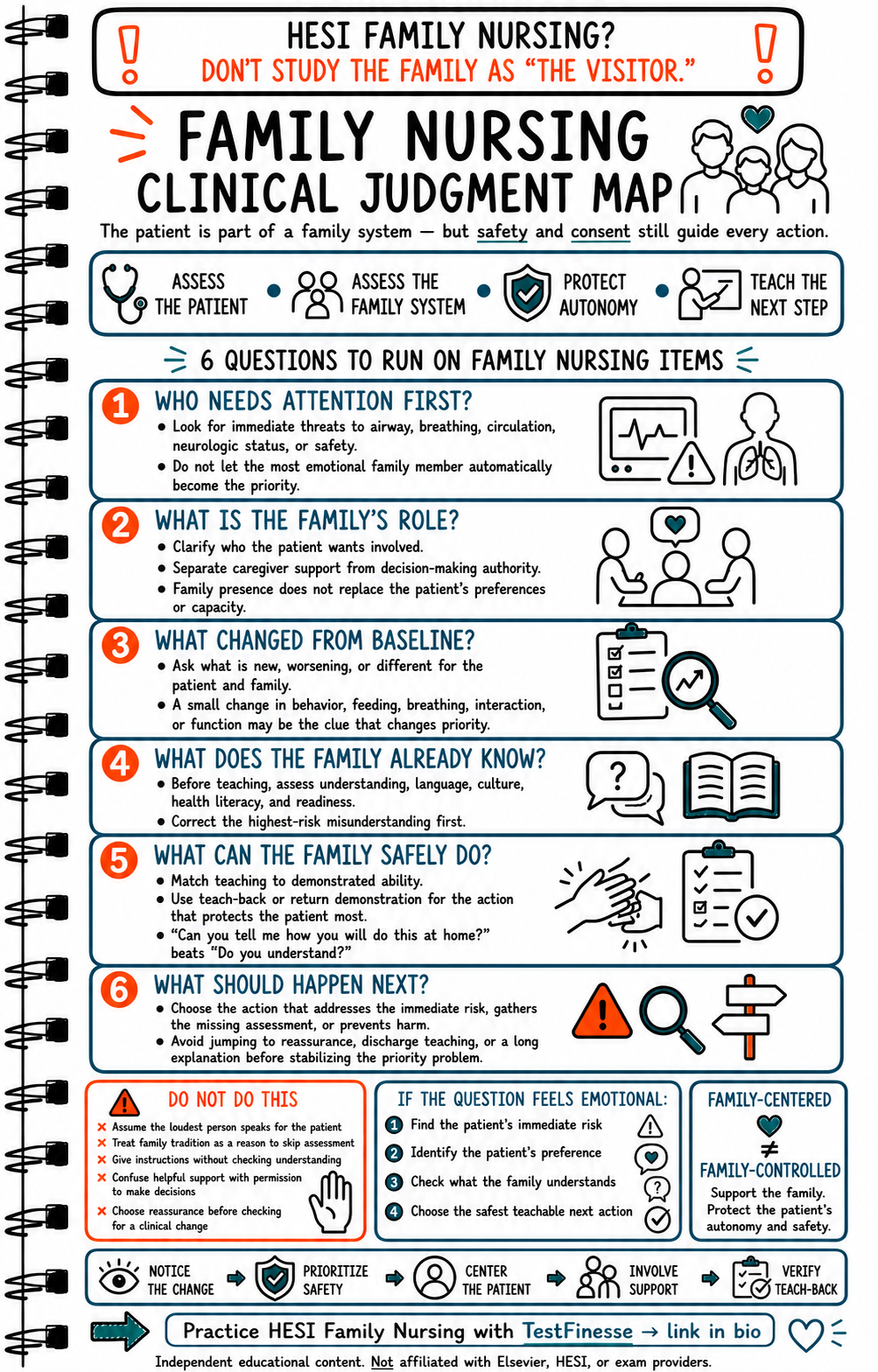
Family nursing questions can feel emotionally complicated because more than one person matters in the scenario.
A parent may be frightened. A partner may be speaking loudly. A caregiver may know important details. A child may depend on an adult for care. Several people may need education, reassurance, or support.
But family-centered care does not mean the family automatically controls the decision.
The central HESI Family Nursing principle is:
The patient is part of a family system, but safety, consent, autonomy, and clinical judgment still guide the next action.
That means you must hold two ideas at the same time:
The family can provide valuable information and support.
The patient’s preferences, capacity, safety, and rights remain central.
When a question feels emotional, do not let the loudest voice or most distressed family member automatically become the priority. Return to the clinical sequence:
Notice the change → prioritize safety → center the patient → involve support → verify understanding
Why Family Questions Are Easy to Misread
Family nursing questions often include relational details that create urgency without necessarily creating clinical priority.
A worried family member may be emotionally intense but medically stable. A quiet patient may be experiencing the most important change. A caregiver may be helpful but may not have authority to make decisions for a capable patient.
Before selecting an answer, separate:
Emotional urgency: Someone is frightened, angry, or distressed.
Clinical urgency: Someone has a new, worsening, or potentially dangerous finding.
Decision authority: Who has the right and capacity to make the decision?
Support role: Who can assist with care, communication, or teaching?
The most emotional person is not automatically the person who needs attention first.
1. Who Needs Attention First?
Start with immediate threats to:
Airway
Breathing
Circulation
Neurologic status
Physical safety
Rapidly changing condition
Look for what is new, worsening, or potentially dangerous.
Do not allow the most expressive family member to automatically become the priority. A family member may be crying or demanding answers while the patient is developing respiratory distress, confusion, bleeding, or another acute change.
Use this question
“Who has the most urgent unmet safety need right now?”
Then compare that answer with the wording of the stem. If the question asks about the patient’s next action, do not allow the family’s emotional response to replace the clinical task.
2. What Is the Family’s Role?
Family members may contribute:
Baseline information
Symptom history
Medication details
Cultural context
Emotional support
Assistance with home care
Observations the patient cannot communicate
But family presence does not automatically replace the patient’s preferences or decision-making authority.
Clarify:
Who does the patient want involved?
What information can be shared?
Is the patient able to participate in decisions?
Does the family member have a legally recognized decision-making role?
Is the family offering support or attempting to control the plan?
In an exam question, avoid assuming that family tradition, age, relationship, or confidence gives someone permission to speak for the patient.
Support the family without allowing helpful support to become unauthorized control.
Consent and privacy details can vary by patient capacity, legal status, setting, and jurisdiction, so students should follow their program’s official instruction and applicable policy.
3. What Changed From Baseline?
Family members can be especially valuable when they know what is normal for the patient.
Ask what is:
New
Worsening
Different
Less functional
Less interactive
Unusual for this patient
Small changes may be significant:
A patient who is suddenly less responsive
A child who stops feeding normally
An older adult who becomes newly confused
A person who develops a different breathing pattern
A patient who stops participating in usual activities
A caregiver who reports a new inability to manage care at home
The important comparison is often not “normal versus abnormal” in the abstract. It is:
“What is different from this patient’s baseline?”
Use family observations as clinical clues, then connect them to assessment and safety.
4. What Does the Family Already Know?
Before teaching, determine the family’s:
Understanding
Language needs
Cultural context
Health literacy
Readiness
Emotional state
Ability to participate
Do not give a long explanation before identifying the highest-risk misunderstanding.
For example, if a caregiver misunderstands a medication schedule, a safety warning, or a symptom that requires follow-up, address that misunderstanding before offering general reassurance.
Teaching should be matched to the actual need. A family that already understands the diagnosis may need a home-care demonstration rather than another definition.
5. What Can the Family Safely Do?
Family involvement should be matched to demonstrated ability, not assumed willingness.
Ask:
Can the caregiver physically perform the task?
Do they understand the instructions?
Can they identify when to seek help?
Do they have the necessary supplies?
Is the plan realistic in the home setting?
Does the patient agree with the involvement?
Use teach-back or return demonstration rather than asking only, “Do you understand?”
The Agency for Healthcare Research and Quality describes teach-back as asking patients or caregivers to explain, in their own words, what they need to know or do. It is a check on how clearly the information was communicated, not a quiz for the patient. AHRQ Teach-Back Tool
Better prompts include:
“Can you tell me how you will do this at home?”
“What will you do if that symptom appears?”
“Can you show me how you will use the device?”
“What is the first step after you get home?”
If the explanation is incorrect, reteach using a different approach and check again.
6. What Should Happen Next?
Once you identify the patient’s risk, family role, baseline change, and understanding, choose the next action that best fits the situation.
A strong answer generally:
Addresses the immediate risk
Gathers a missing assessment
Protects safety
Respects patient autonomy
Matches the family’s demonstrated ability
Avoids unnecessary escalation
Creates a clear next step
Avoid jumping to:
Reassurance before assessing a change
Discharge teaching before stabilizing the priority concern
A long explanation before confirming understanding
Family instructions without checking capacity and willingness
A plan based only on what the loudest person requests
The “best” answer is not always the most complete answer. It is the next safe, appropriate, evidence-based action.
Common Family Nursing Traps
Watch for these attractive wrong answers:
Assuming the loudest family member speaks for the patient
Treating family tradition as a reason to skip assessment
Giving instructions without checking understanding
Confusing emotional support with decision-making authority
Choosing reassurance before investigating a clinical change
Allowing family preference to override a capable patient’s preference
Using teach-back as a memory test instead of a communication check
Family-centered does not mean family-controlled.
Use the TestFinesse Practice Loop
Apply the TestFinesse method to every missed family nursing question:
Answer: Choose the option before reading the rationale.
Explain: Identify the patient risk, family role, baseline change, and question type.
Reveal: Compare your reasoning with the explanation.
Fix the gap: Write one trigger rule and practice a new family scenario.
Example:
“When family members disagree or become emotional, identify the patient’s immediate safety risk and decision-making preference before responding to the family.”
This makes the reasoning transferable. The names, diagnosis, and relationship may change, but the framework remains available.
Final Takeaway
Family nursing questions are not asking you to ignore the family. They are asking you to involve the family safely and appropriately.
Notice the change. Prioritize safety. Center the patient. Involve support. Verify teach-back.
The strongest answer protects both the patient’s clinical needs and the patient’s autonomy while using the family as a source of support, history, and partnership.
Educational exam-prep content only. Always follow your nursing program, instructor, supervisor, facility policy, applicable consent requirements, and scope-of-practice rules. Not affiliated with Elsevier, HESI, or any exam provider.
Accuracy sources checked: AHRQ Teach-Back Tool, AHRQ Patient and Family Engagement Guide, NCSBN Scope of Practice Decision-Making Framework
Keep studying
- Nursing Exam Prep Pain-Point Decoder: Find the Hidden Leak Behind Every Miss
- HESI A2 Critical Thinking: How to Decode the Scenario Before Choosing an Answer
- HESI Vocab Is a Translation Test: Split the Word, Then Read the Sentence
- HESI A2 Prep Map: Build Your Study Plan From Your School’s Required Sections
Practice Exam Skills
Turn this into a better score
Reading about a skill only gets you so far. TestFinesse's AI coach walks you through exam questions, explains exactly where your reasoning breaks down, and adapts to what you actually need to practice next.
Explore All Exams