Nursing Exams Ask Your Next Move: Decode the Stem Before You Choose
Last updated August 17, 2026
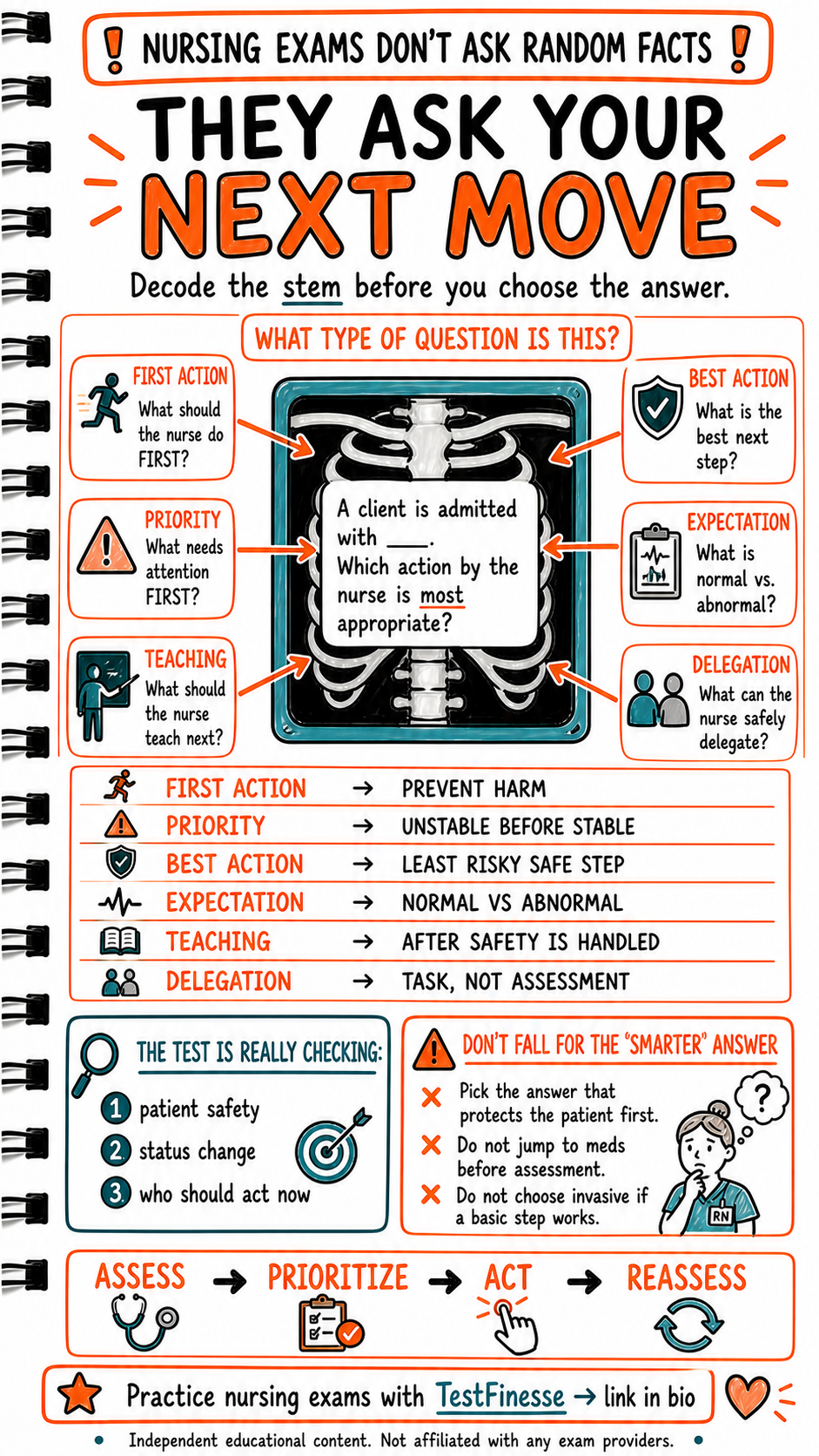
Nursing exams do not ask random facts.
They ask your next move.
That is the key shift most students need. The stem is not just testing whether you remember a symptom, a medication class, or a nursing skill. It is testing whether you can decide what comes next for this client, at this moment, in this situation.
That lines up with how modern nursing licensure is built. NCSBN says the Next Generation NCLEX emphasizes clinical judgment and decision making in the context of safe client care. In other words, the exam is looking for the safest reasonable step, not the flashiest answer.
The TestFinesse rule is simple:
Decode the stem before you choose the answer.
Why “Next Move” Thinking Matters
A lot of students miss nursing questions because they jump straight to content.
They see a stem and immediately think:
“What disease is this?”
“What medication is this?”
“What is the normal lab value?”
“What intervention have I memorized?”
That is too early.
The better question is:
What type of decision is the test asking me to make?
That matters because the same client scenario can be framed as different kinds of questions:
first action
priority
best action
expectation
teaching
delegation
Each one uses a different mental move.
If you do not identify the question type, you can know the content and still miss the answer.
1. First Action
Ask:
What should the nurse do first?
This is a prevent-harm question. The exam is looking for the earliest safe step, not the most complete one.
That often means:
assess first when needed
stabilize before teaching
gather data before acting
protect the client before documenting
stop an unsafe move before continuing
The “first action” is not always the most dramatic. It is the move that prevents harm or clarifies what is happening.
TestFinesse rule: First action means the first safe step, not the final solution.
2. Priority
Ask:
What needs attention first?
Priority questions are usually about instability.
Look for clues like:
airway, breathing, circulation
sudden change
worsening symptoms
abnormal findings
urgent safety risk
bleeding, chest pain, confusion, respiratory distress
NCSBN’s clinical judgment framework emphasizes recognizing cues, prioritizing hypotheses, and taking the best possible evidence-based action for safe care. That is the logic behind priority items.
A stable client almost never outranks an unstable one.
Priority rule: Unstable before stable.
3. Best Action
Ask:
What is the best next step?
This is usually the least risky safe option that actually fits the situation.
The “best” choice is not always the most aggressive one. It is the one that:
protects the client
fits the current stage
stays inside the nurse’s role
matches the data you have
avoids unnecessary escalation or delay
Students often fall for the “smarter” answer here. They pick the option that sounds advanced, technical, or impressive. But the exam usually wants the simplest safe step that fits the stem.
Best action rule: Choose the least risky safe step.
4. Expectation
Ask:
What is normal vs. abnormal?
Expectation questions are pattern checks.
The exam may be testing whether you can tell:
what should happen after a procedure
what finding is expected for this condition
what finding is outside the normal pattern
what symptom is a warning sign
what baseline trend is changing
These questions reward context, not isolated memory.
A number can look “normal-ish” and still be wrong if it is abnormal for that client, that stage, or that pattern of care. This is why expectation questions should never be answered by one fact alone.
Expectation rule: Compare to baseline and trend, not a number by itself.
5. Teaching
Ask:
What should the nurse teach next?
Teaching questions are usually about safety sequencing.
If the client is unstable or an urgent issue is present, teaching usually waits. If safety is handled, then education can move forward.
That means you should not choose teaching just because it sounds helpful. Teaching is important, but it is not always first.
The exam often tests whether you understand the order:
safety first
then teaching
then reinforcement
then follow-up
Teaching rule: Teaching comes after safety is handled.
6. Delegation
Ask:
What can the nurse safely delegate?
Delegation questions are task questions, not assessment questions.
The important distinction is:
assessment and judgment stay with the nurse
routine tasks may be delegated if appropriate
unstable clients should not be delegated
teaching and evaluation usually stay with the nurse
A delegation trap often looks attractive because it saves time. But if the answer sends the wrong task to the wrong person, it fails the question.
Delegation rule: Delegate tasks, not assessment.
What The Test Is Really Checking
The image gets the core idea right. Nursing exams are really checking:
Patient safety
Status change
Who should act now
That is the heart of clinical judgment.
NCSBN says the NCJMM measures clinical judgment and decision making within the context of safe nursing care. So when you see a stem, do not just ask what the condition is. Ask what the patient needs next.
That “next move” lens is how you stop turning nursing questions into trivia questions.
Don’t Fall For The “Smarter” Answer
One of the biggest traps on nursing exams is choosing the answer that sounds more advanced than the one the stem actually needs.
That usually shows up when students:
jump to medications before assessment
choose invasive action when a basic step works
pick teaching before safety
choose documentation before intervention
select a task that is too aggressive for the current finding
The more impressive answer is not always the correct answer.
Safe beats flashy.
Use The TestFinesse Pattern
A clean nursing exam process looks like this:
Assess → Prioritize → Act → Reassess
That sequence fits the way the exam wants you to think.
Assess what is happening
Prioritize who or what needs attention first
Act with the safest next step
Reassess for status change
This works because it mirrors how real nursing judgment unfolds. You do not solve everything at once. You make the next correct move, then check whether the situation changed.
Use The TestFinesse Practice Loop
The TestFinesse method is:
Answer
Explain
Reveal
Fix the gap
For nursing questions, make the explanation explicit:
What kind of question was this?
Was it first action, priority, best action, expectation, teaching, or delegation?
What clue in the stem told me that?
Was the correct move about safety, status change, or task assignment?
Did I choose the safest next step, or just the most familiar one?
Then tag the miss:
first-action miss
priority miss
teaching trap
delegation trap
expectation miss
status-change miss
That turns a wrong answer into a repeatable rule.
Final Takeaway
Nursing exams do not ask random facts.
They ask your next move.
Decode the stem first, identify the question type, and then choose the safest action.
Assess → Prioritize → Act → Reassess
If you can do that, you stop chasing trivia and start answering like a nurse.
Educational exam prep only. Always follow your program, supervisor, facility policy, and scope of practice. Independent content. Not affiliated with any exam providers.
Accuracy sources checked: NCSBN Launches Next Generation NCLEX Exam, NCSBN Resources on Next Generation NCLEX, NCSBN Clinical Judgment Model / NGN resources, NCSBN Clinical Judgment Item Writing Method.
Keep studying
Practice Exam Skills
Turn this into a better score
Reading about a skill only gets you so far. TestFinesse's AI coach walks you through exam questions, explains exactly where your reasoning breaks down, and adapts to what you actually need to practice next.