TEAS Math Rescue Map: Classify the Setup Before You Calculate
Last updated August 12, 2026
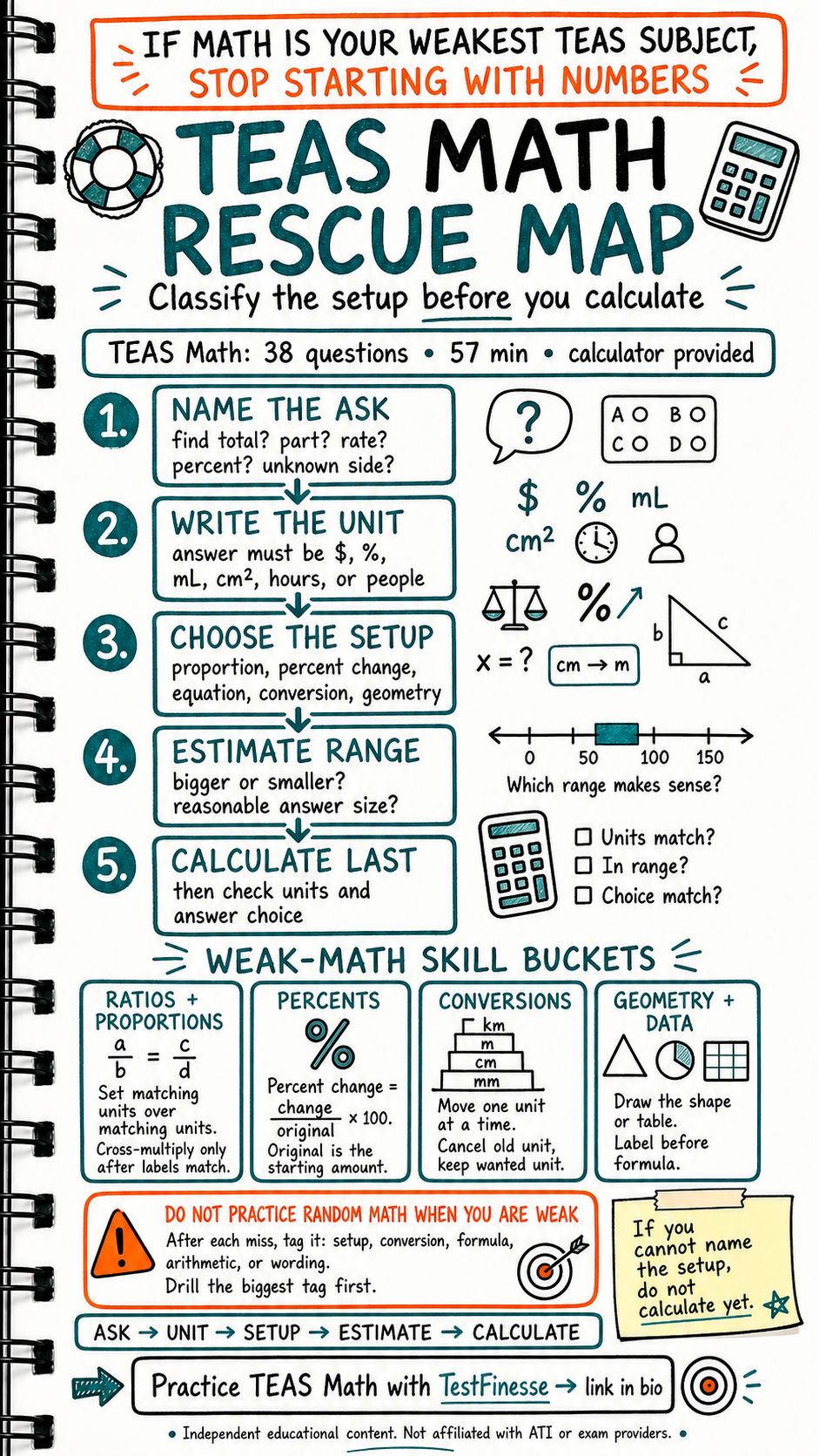
If Math is your weakest TEAS subject, the fix is not always “do more math.”
The better fix is often:
Stop starting with numbers.
Many TEAS Math misses happen before the calculation begins. Students see numbers in the question, grab the calculator, and start combining them before they have identified the task, the unit, or the setup. That creates avoidable errors in proportions, percents, conversions, geometry, and data questions.
The ATI TEAS Math section currently includes 38 questions in 57 minutes, covering Numbers and Algebra plus Measurement and Data. ATI also notes that the TEAS includes multiple item types and that sections are timed separately. So your math plan needs to be fast, but it also needs to be organized.
The TestFinesse rule is:
Ask → Unit → Setup → Estimate → Calculate
Calculator last. Setup first.
Why TEAS Math Feels Harder Than It Is
TEAS Math is not just arithmetic. It is math language under time pressure.
The question may ask for:
A total
A part
A rate
A percent
A missing side
A conversion
A reasonable estimate
A data comparison
Those are different jobs. If you treat them all the same, you end up doing random operations and hoping the answer choice appears.
That is why the first move is not calculation. The first move is classification.
1. Name The Ask
Before solving, ask:
What am I trying to find?
Common TEAS Math asks include:
Find the total
Find the part
Find the rate
Find the percent
Find the unknown side
Find the converted unit
Find the best estimate
Find the value from a table, graph, or chart
This step protects you from solving the wrong question.
For example, a word problem may give a starting amount, a change, and a final amount. If the question asks for the percent change, you should not stop after finding the difference. The difference is only the numerator of the setup.
Score move: Rewrite the ask in plain words before touching the calculator.
2. Write The Unit
The unit tells you what kind of answer is allowed.
Before solving, write the final unit:
Dollars
Percent
mL
cm²
Hours
People
Feet
Meters
Cups
Degrees
Square units
Cubic units
This matters because wrong-unit answers can look reasonable. A number may be close to an answer choice but still belong to the wrong category.
For example:
cm measures length.
cm² measures area.
cm³ measures volume.
Those are not interchangeable.
If the answer must be in hours, do not leave it in minutes. If the answer must be a percent, do not leave it as a decimal unless the item asks for that format.
TestFinesse rule: If you cannot name the final unit, do not calculate yet.
3. Choose The Setup
Once you know the ask and unit, choose the setup.
Common TEAS Math setups include:
Proportion
Percent change
Equation
Conversion
Geometry formula
Data table or graph
Rate
Mean or average
Part-whole relationship
The setup is the bridge between the words and the math.
Do not ask, “What numbers do I have?” first. Ask:
What relationship is being tested?
If the problem compares two equivalent rates, use a proportion.
If the problem asks how much something increased or decreased, use percent change.
If the problem changes units, use a conversion path.
If the problem shows a shape, label the shape before choosing a formula.
The setup decides what the numbers mean.
4. Estimate The Range
Before calculating, estimate the answer size.
Ask:
Should the answer be bigger or smaller?
Is it around 10, 100, or 1,000?
Should the percent be less than 100% or greater than 100%?
Is the length reasonable for the shape?
Does the unit make sense?
Which answer choices are obviously too large or too small?
Estimation is not guessing. It is a safety check.
If your calculation gives a value that is wildly outside the expected range, inspect the setup before you trust the calculator.
A calculator can confirm arithmetic. It cannot confirm judgment.
5. Calculate Last
Now calculate.
After calculating, check three things:
Units match: Does the final unit match the blank?
Answer is in range: Does the size make sense?
Choice matches: Is the answer in the format the choices use?
This final check catches the most common TEAS Math traps:
Choosing the right number in the wrong unit
Forgetting to convert
Rounding too early
Solving for the part instead of the total
Using the wrong geometry formula
Misreading a graph or table label
Weak-Math Skill Buckets
If TEAS Math is your weak section, do not practice random math forever. Sort your misses into buckets and drill the biggest one first.
Ratios And Proportions
For proportions, set matching units over matching units.
A clean proportion looks like:
a / b = c / d
But the labels matter more than the letters.
Before cross-multiplying, check:
Are both numerators the same type of unit?
Are both denominators the same type of unit?
Did I match part to part and whole to whole?
Did I place the unknown in the correct position?
Do not cross-multiply until the labels match.
Percents
Percent questions often test part-whole thinking.
For percent change, use:
change ÷ original × 100
The key word is original.
The original is the starting amount, not the ending amount. If a value increases from 80 to 100, the change is 20, but the original is 80.
Common percent traps include:
Dividing by the new amount instead of the original
Confusing percent with percentage points
Forgetting to multiply by 100
Treating a discount like an increase
Stopping at the decimal before converting to percent
Percent rule: Name the original before calculating.
Conversions
Conversions are unit paths.
Move one unit at a time, and cancel the old unit until the wanted unit remains.
For example:
km to m
m to cm
cm to mm
minutes to hours
cups to ounces
pounds to kilograms
The order matters. A conversion problem is not asking you to remember a random number; it is asking whether you can move cleanly from one unit to another.
Conversion rule: Cancel the old unit. Keep the wanted unit.
Geometry And Data
For geometry, draw or label before using a formula.
Ask:
Is this length, area, or volume?
Is the shape a triangle, rectangle, circle, or composite figure?
Which side is the base?
Which measurement is the height?
Are the units squared or cubed?
For data questions, read the table or graph first:
Axis labels
Units
Categories
Trends
Scale
Key or legend
Do not bring a formula to a graph before understanding what the graph is showing.
Geometry and data rule: Label before formula.
Do Not Practice Random Math When You Are Weak
Random practice can feel productive, but it often hides the real problem.
After each miss, tag it:
Setup miss
Conversion miss
Formula miss
Arithmetic miss
Wording miss
Unit miss
Estimation miss
Then drill the biggest tag first.
If most of your misses are setup misses, more calculator practice will not fix the problem. If most are conversion misses, random algebra will not help. If most are wording misses, you need to slow down at the ask.
A better review question is:
What kind of miss was this?
That answer becomes your next drill.
Use The TestFinesse Practice Loop
The TestFinesse method is:
Answer
Explain
Reveal
Fix the gap
For TEAS Math, your explanation should include:
What was the ask?
What was the final unit?
What setup did I choose?
What estimate range made sense?
What did I calculate last?
What miss type goes in my trap bank?
This makes your reasoning visible. Once your reasoning is visible, you can fix it.
Final Takeaway
If TEAS Math feels like your weakest subject, do not start by doing more random calculations.
Start by naming the setup.
Use this path every time:
Ask → Unit → Setup → Estimate → Calculate
If you cannot name the setup, do not calculate yet.
Independent educational content. Not affiliated with ATI or exam providers.
Accuracy sources checked: ATI TEAS Exam Details, ATI: What is the ATI TEAS Exam?, ATI: TEAS Sections and Navigation, ATI: TEAS Time Limits.
Practice Exam Skills
Turn this into a better score
Reading about a skill only gets you so far. TestFinesse's AI coach walks you through exam questions, explains exactly where your reasoning breaks down, and adapts to what you actually need to practice next.