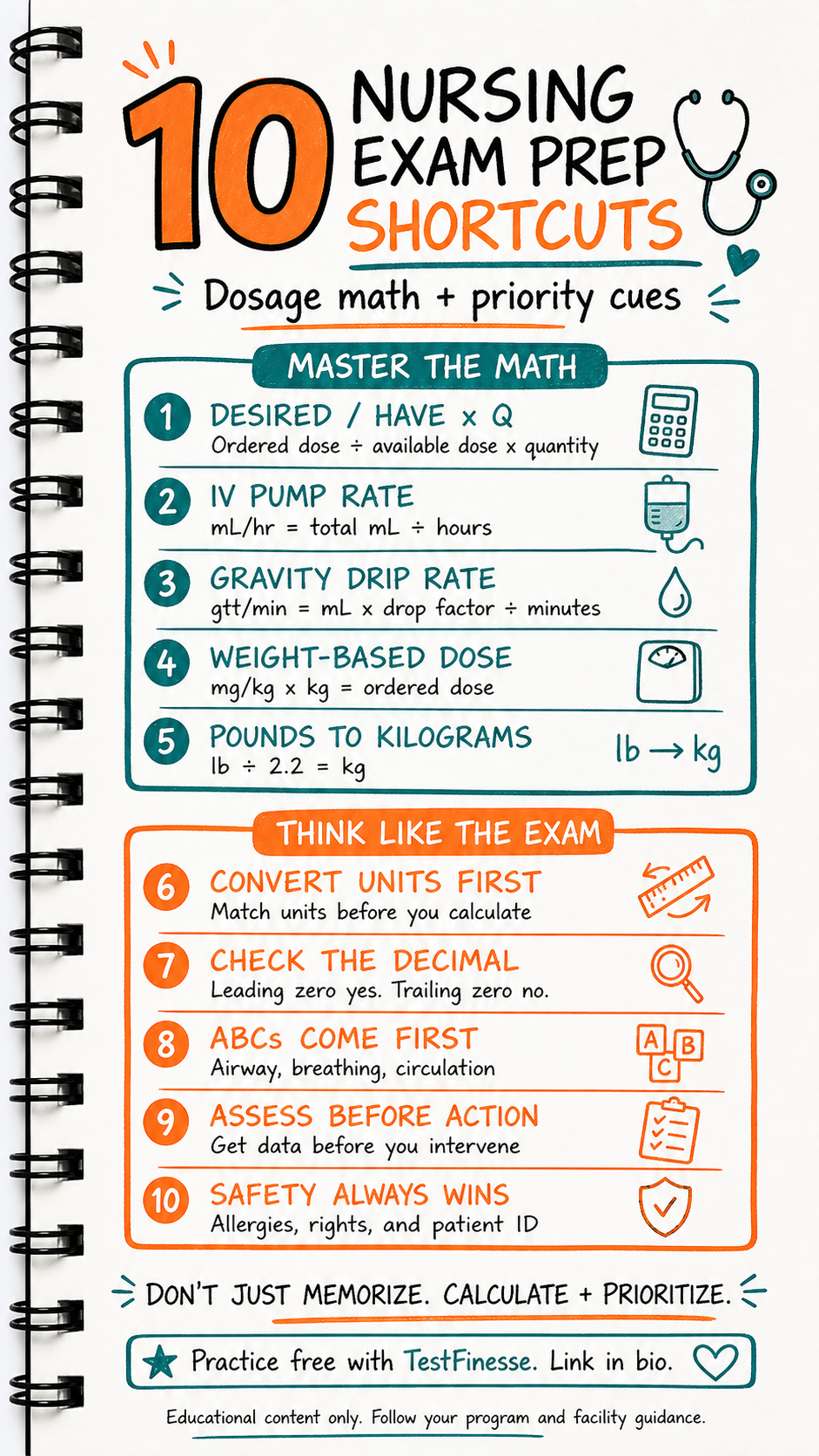
10 Nursing Exam Prep Shortcuts: Dosage Math and Priority Cues
Last updated August 9, 2026
Nursing exams do not only test what you memorized.
They test whether you can calculate safely and prioritize correctly under pressure.
That is why dosage math and priority questions feel stressful for so many students. You may know the content, but one missed unit, decimal, patient clue, or priority word can change the answer.
The good news is that many nursing exam mistakes follow predictable patterns.
If you learn the shortcuts, you can slow the question down and think like the exam.
The goal is not to memorize random tricks.
The goal is to build a safe decision system:
Calculate carefully. Prioritize clinically. Protect the patient.
Master The Math
Dosage math questions reward clean setup.
Before calculating, always ask:
What is ordered?
What is available?
What unit do I need in the final answer?
Do I need to convert first?
Does the answer make sense for the patient?
Most medication math errors happen because students calculate too soon.
Do not rush the numbers. Set up the problem first.
1. Desired / Have × Quantity
One of the most common dosage formulas is:
Desired ÷ Have × Quantity = Amount to give
This is often called the desired over have method.
Use it when the question gives:
Ordered dose
Available dose
Quantity or volume available
Example:
The order is 500 mg.
The medication available is 250 mg per tablet.
500 ÷ 250 × 1 tablet = 2 tablets
The key rule:
Desired and have must be in the same unit before you calculate.
If the order is in milligrams and the supply is in grams, convert first.
2. IV Pump Rate
For an IV pump rate, use:
mL/hr = total mL ÷ hours
Example:
Infuse 1,000 mL over 8 hours.
1,000 ÷ 8 = 125 mL/hr
This formula is simple, but students still miss it when the time is given in minutes.
If the question gives minutes, convert to hours first or use a consistent setup.
For example:
30 minutes = 0.5 hours
The exam trap is usually not the division. It is the time unit.
3. Gravity Drip Rate
For gravity tubing, use:
gtt/min = mL × drop factor ÷ minutes
Where:
gtt/min = drops per minute
mL = total volume to infuse
Drop factor = drops per mL from the tubing package
Minutes = total infusion time in minutes
Example:
Infuse 100 mL over 30 minutes with tubing that delivers 15 gtt/mL.
100 × 15 ÷ 30 = 50 gtt/min
The shortcut is:
Volume times drop factor, then divide by minutes.
Always check whether the question asks for mL/hr or gtt/min. Those are different answers.
4. Weight-Based Dose
Weight-based dosing often uses:
mg/kg × kg = ordered dose
Example:
A medication is ordered at 10 mg/kg for a patient who weighs 70 kg.
10 × 70 = 700 mg
The most common trap is using pounds instead of kilograms.
If the dose is written as mg/kg, the patient weight must be in kg before calculating.
For pediatric, emergency, and medication safety questions, weight-based dosing is especially important because small errors can become large dose problems.
5. Pounds To Kilograms
A common nursing exam conversion is:
lb ÷ 2.2 = kg
Example:
A patient weighs 154 lb.
154 ÷ 2.2 = 70 kg
You may also see:
kg × 2.2 = lb
For medication math, convert pounds to kilograms before using any mg/kg formula.
A safe habit:
If the formula says kg, do not use lb.
Think Like The Exam
The second half of nursing exam prep is not just math.
It is clinical judgment.
The exam wants to know whether you can notice the safest priority, identify missing assessment data, and avoid risky actions.
6. Convert Units First
Before you calculate anything, match the units.
Watch for:
mg vs. g
mcg vs. mg
mL vs. L
minutes vs. hours
lb vs. kg
tablets vs. mL
units per mL
mg per dose vs. mg per day
A correct formula with mismatched units can still produce a dangerous answer.
Use this order:
Identify the final unit
Convert the given values
Set up the formula
Calculate
Check whether the answer is reasonable
Do not let the calculator do the thinking for you.
7. Check The Decimal
Decimal safety is a major medication safety issue.
The rule is:
Leading zero: yes. Trailing zero: no.
Use a leading zero before a decimal dose less than one:
Correct: 0.5 mg
Unsafe: .5 mg
Do not use a trailing zero after a whole number:
Correct: 5 mg
Unsafe: 5.0 mg
Why?
Because .5 mg can be misread as 5 mg, and 5.0 mg can be misread as 50 mg.
The Joint Commission lists both trailing zero and lack of leading zero as prohibited medication-related dose designations.
For exam purposes, this is a high-value safety rule.
8. ABCs Come First
ABCs means:
Airway
Breathing
Circulation
In priority questions, ABCs are often the first screen.
If one patient has an airway or breathing problem and another has a stable, nonurgent issue, the airway or breathing problem usually takes priority.
Examples of high-priority clues include:
Difficulty breathing
Absent or compromised airway
Low oxygen saturation
New cyanosis
Severe bleeding
Signs of shock
Acute change in level of consciousness
But use judgment.
ABCs are not a magic answer for every question. The exam may also test safety, unstable vs. stable, acute vs. chronic, expected vs. unexpected, or assessment vs. intervention.
A better rule is:
Check ABCs first when the patient appears unstable.
9. Assess Before Action
Many nursing exam questions test whether you gather data before intervening.
If the patient is not in immediate danger, assessment often comes before action.
Examples:
Check vital signs before giving certain medications.
Assess pain before choosing an intervention.
Ask follow-up questions before assuming the cause.
Review allergies before medication administration.
Gather relevant cues before deciding what to do next.
This fits the clinical judgment process: recognize cues, analyze cues, prioritize hypotheses, generate solutions, take action, and evaluate outcomes.
The exam trap is jumping to an intervention before you have enough data.
However, if the patient is in immediate danger, you may need to act quickly.
So the real shortcut is:
Assess first unless the question shows an immediate safety threat.
10. Safety Always Wins
Patient safety is one of the strongest nursing exam themes.
Before choosing an answer, check for safety issues:
Allergies
Right patient
Right medication
Right dose
Right route
Right time
Patient identification
Fall risk
Infection control
Unsafe environment
Contraindications
Unexpected change in condition
The Joint Commission emphasizes correct patient identification and safe medication management. Nursing exams reflect that same safety mindset.
For medication questions, verify:
Patient identity
Medication order
Allergies
Dose
Route
Timing
Relevant assessment data
If an answer protects the patient from a serious, immediate risk, pay attention.
Safety is often the clue that separates two tempting choices.
How To Review Nursing Exam Misses
When you miss a nursing question, do not just write down the correct answer.
Label the miss.
Was it:
Dosage formula error
Unit conversion error
Decimal safety error
Priority error
Assessment-before-action error
ABCs mistake
Medication safety miss
Question wording trap
Careless calculation slip
Then write one fix rule.
Examples:
Next time, convert lb to kg before mg/kg.
Next time, check whether the answer should be mL/hr or gtt/min.
Next time, use a leading zero for doses less than 1.
Next time, assess before acting unless the patient is unstable.
Next time, check airway and breathing before choosing a lower-priority intervention.
This turns every miss into a safer next answer.
Use The TestFinesse Practice Loop
The TestFinesse method is:
Answer
Explain
Reveal
Fix the gap
For nursing exam prep, explain before you reveal.
Ask:
What formula am I using?
What units need to match?
What is the priority clue?
Is this asking for assessment or intervention?
Is there a patient safety risk?
What makes the tempting wrong answer unsafe or incomplete?
Then reveal the answer and diagnose the gap.
This helps you build both math accuracy and clinical judgment.
Final Takeaway
Nursing exam prep is not just about memorizing facts.
You need to calculate and prioritize.
Focus on these 10 shortcuts:
Desired ÷ Have × Quantity
IV pump rate: total mL ÷ hours
Gravity drip rate: mL × drop factor ÷ minutes
Weight-based dose: mg/kg × kg
Pounds to kilograms: lb ÷ 2.2
Convert units first
Use leading zeros, avoid trailing zeros
Check ABCs for unstable patients
Assess before action unless immediate danger is present
Let safety guide the final choice
Do not just memorize.
Calculate and prioritize.
Educational note: This is test prep content, not clinical guidance. Always follow your nursing program, instructor, facility policy, medication administration standards, and scope of practice.
Accuracy sources checked: OpenStax Dosage Calculations, StatPearls Pharmacy Calculations, Joint Commission prohibited dose designations, Joint Commission patient identification and safety, OpenStax Rights of Medication Administration, and NCSBN NCLEX-RN Test Plan.