TEAS Calculation Playbook: Formulas and Conversions That Turn Word Problems Into Points
Last updated August 10, 2026
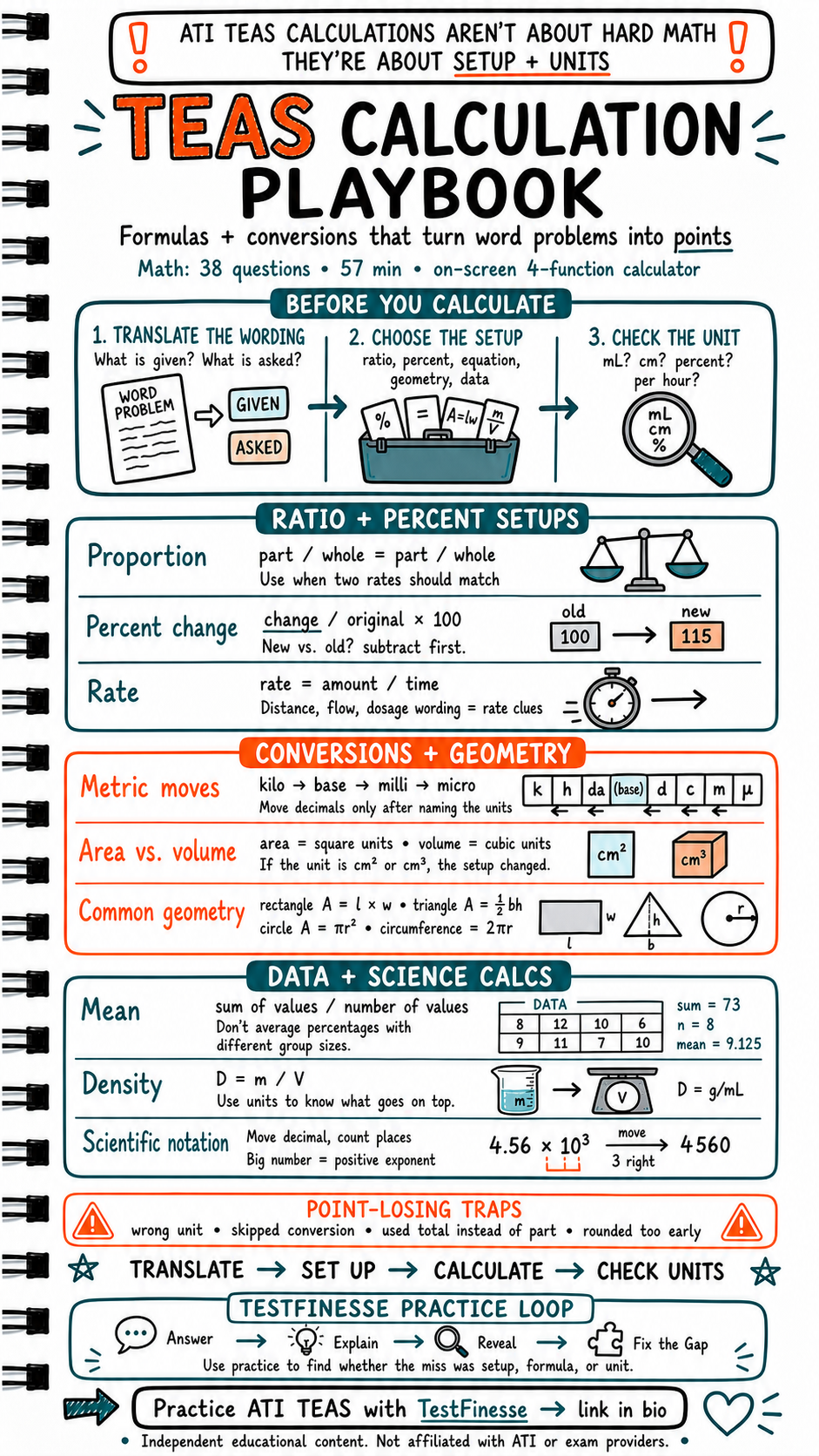
ATI TEAS calculations are not about hard math.
They are about setup and units.
The TEAS Math section has 38 questions in 57 minutes, and it covers two main areas: Numbers and Algebra and Measurement and Data. A four-function calculator is provided, but the calculator cannot decide which formula to use. It cannot tell you whether the answer should be in mL, cm², percent, dollars per hour, or cubic units.
That part is your job.
The best TEAS math strategy is simple:
Translate. Set up. Calculate. Check units.
Before You Calculate
Most TEAS math mistakes happen before the arithmetic starts.
Students often know how to multiply, divide, or convert, but they lose points because they:
Misread what was given
Missed what was being asked
Used the wrong unit
Skipped a conversion
Used total instead of part
Rounded too early
Before touching the calculator, slow down and follow three steps.
1. Translate The Wording
First, identify:
What is given?
What is asked?
Underline or write down the key numbers and labels.
For example, if a word problem gives total cost, number of items, and time, decide which numbers matter for the question. Do not assume every number must be used.
Ask:
“What answer unit do I need?”
That question keeps the setup focused.
2. Choose The Setup
Next, decide what kind of problem it is.
Common TEAS math setups include:
Ratio
Percent
Proportion
Equation
Geometry
Rate
Data interpretation
Unit conversion
This matters because the same numbers can lead to different answers depending on the setup.
A percent problem is not solved the same way as a rate problem. A square-unit area problem is not the same as a cubic-unit volume problem.
3. Check The Unit
Before calculating, check the final unit.
Look for:
mL
cm
cm²
cm³
percent
per hour
per minute
grams
kilograms
dollars
degrees
Units tell you what the math should do.
If the question asks for area, your answer should be in square units. If it asks for volume, your answer should be in cubic units. If it asks for a rate, your answer should include “per.”
Ratio And Percent Setups
Ratios, percents, and rates are high-value TEAS math skills because they appear in everyday word problems, data questions, and measurement contexts.
Proportion
A proportion compares two equal ratios.
A common setup is:
part / whole = part / whole
Use a proportion when two rates or relationships should match.
Example:
If 3 out of 5 students passed, how many would pass out of 40?
3 / 5 = x / 40
Cross-multiply or solve:
5x = 120
x = 24
The key is keeping matching units in matching positions.
Do not put part over whole on one side and whole over part on the other.
Percent Change
Use:
percent change = change / original × 100
First find the change:
new - original = change
Example:
A value increases from 100 to 115.
Change:
115 - 100 = 15
Percent change:
15 / 100 × 100 = 15%
The trap is using the new value as the denominator. Percent change is based on the original value unless the question says otherwise.
Ask:
“New compared to old? What was the original?”
Rate
Use:
rate = amount / time
Rate clues include:
per hour
per minute
miles per hour
mL per hour
dollars per item
words per minute
flow
speed
dosage wording
Example:
If a person walks 12 miles in 3 hours:
12 / 3 = 4 miles per hour
The unit “per” tells you division is involved.
Conversions And Geometry
TEAS math includes measurement and data, so conversions and geometry deserve steady practice.
Metric Moves
Know the metric direction:
kilo → base → milli → micro
Common examples:
1 kg = 1,000 g
1 g = 1,000 mg
1 mg = 1,000 mcg
1 L = 1,000 mL
1 m = 100 cm
The rule is:
Move decimals only after naming the units.
Do not move a decimal because the number “looks right.” Name the starting unit, name the ending unit, then convert.
Area Vs. Volume
Area uses square units.
Volume uses cubic units.
That means:
Area: cm², in², ft²
Volume: cm³, in³, ft³, mL, L
If the unit changes from cm² to cm³, the setup changed.
Area measures surface.
Volume measures space inside.
A rectangle area problem is not the same as a box volume problem.
Common Geometry
Know the most common formulas:
Rectangle area: A = l × w
Triangle area: A = 1/2 bh
Circle area: A = pi r²
Circumference: C = 2 pi r
Watch for diameter vs. radius.
If the problem gives diameter, divide by 2 to get radius before using circle area or circumference formulas that require r.
Example:
Diameter = 10
Radius = 5
Circle area:
A = pi(5²) = 25pi
Data And Science Calculations
TEAS math and science-style calculations often overlap through data, measurement, and interpretation.
Mean
Mean means average.
Use:
mean = sum of values / number of values
Example:
Data set: 8, 12, 10, 6, 9, 11, 7, 10
Sum:
73
Number of values:
8
Mean:
73 / 8 = 9.125
Important trap:
Do not average percentages from different group sizes unless the groups are the same size.
If group sizes differ, you need a weighted average.
Density
Use:
D = m / V
Density equals mass divided by volume.
Example:
Mass = 30 g
Volume = 10 mL
D = 30 / 10 = 3 g/mL
Use the units to know what goes on top.
If the answer unit is g/mL, grams go on top and mL goes on bottom.
Scientific Notation
Scientific notation writes large or small numbers using powers of 10.
Example:
4.56 × 10³ = 4,560
A positive exponent makes the number bigger.
A negative exponent makes the number smaller.
Quick rule:
Positive exponent: move decimal right
Negative exponent: move decimal left
The exponent tells you how many places to move.
Point-Losing Traps
Watch for these common TEAS calculation traps:
Wrong unit
Skipped conversion
Used total instead of part
Used part instead of whole
Rounded too early
Confused area and volume
Used diameter instead of radius
Averaged percentages incorrectly
Solved for the wrong value
Did not check the final unit
A strong habit is to write the final unit before you calculate.
If the question asks for mL/hr, write:
Answer = ___ mL/hr
Then solve into that unit.
Use The TestFinesse Practice Loop
The TestFinesse method is:
Answer
Explain
Reveal
Fix the gap
For TEAS calculations, ask after every miss:
Was this a setup mistake?
Was this a formula mistake?
Was this a unit mistake?
Did I round too early?
Did I answer the wrong thing?
Then write one rule for next time.
Example:
Next time, identify whether the question asks for area or volume before choosing the formula.
Final Takeaway
TEAS math is not about doing complicated calculations.
It is about setting up simple calculations correctly.
Focus on:
Ratios
Percents
Rates
Metric conversions
Area and volume
Geometry formulas
Mean
Density
Scientific notation
Unit checking
Use the calculator.
But memorize the setup.
Translate → set up → calculate → check units.
Accuracy sources checked: ATI TEAS Exam Details, ATI TEAS Sections and Timing, ATI TEAS Overview and Content Specifications, and ATI Calculator Policy.