PN Clinical Judgment Decoder: How to Pick the Safest NCLEX-PN Answer
Last updated August 12, 2026
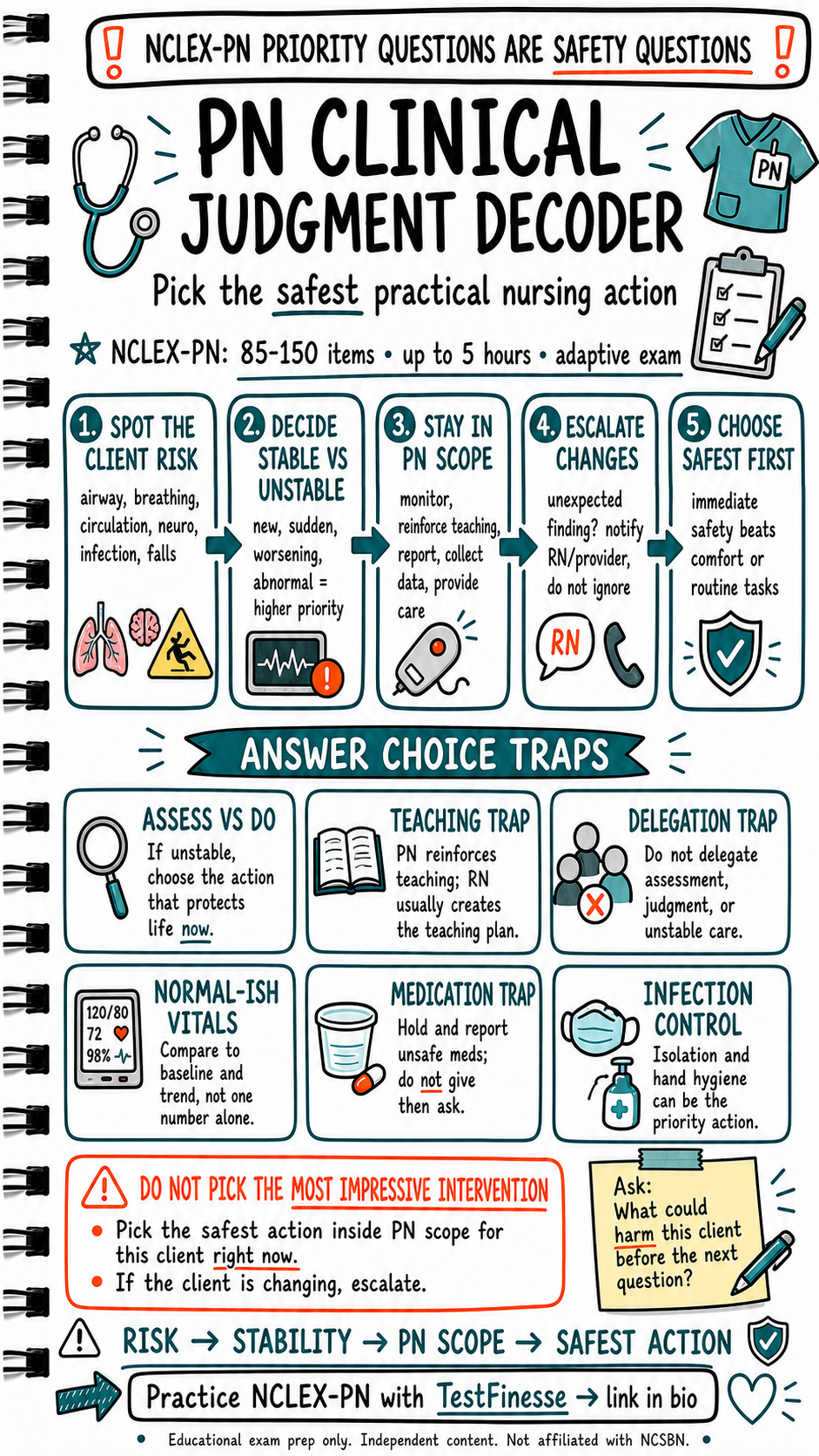
NCLEX-PN priority questions are safety questions.
That does not mean every answer is dramatic. It means the best answer is usually the one that protects the client from the most immediate risk while staying inside the practical/vocational nurse role.
The current NCLEX-PN is a computerized adaptive exam with 85-150 items and a maximum time limit of 5 hours. NCSBN’s 2026 NCLEX-PN Test Plan also makes clinical judgment part of the exam through case studies and stand-alone items. So the question is not only, “Do I know the content?”
It is:
Can I pick the safest practical nursing action for this client right now?
Use this flow:
Risk → Stability → PN Scope → Safest Action
1. Spot The Client Risk
Start with risk before you start with tasks.
Look for threats to:
Airway
Breathing
Circulation
Neurologic status
Infection prevention
Falls and injury
Medication safety
This works because NCLEX-PN questions often place several actions in front of you that are all reasonable in a normal shift. But priority questions are not asking, “What could a nurse do eventually?” They are asking, “What matters first?”
If one client could deteriorate before the next question, that client or action moves up.
2. Decide Stable Vs. Unstable
Next, ask whether the client is stable or changing.
Higher-priority language includes:
New
Sudden
Worsening
Abnormal
Unexpected
Severe
Dropping
Increasing
Change from baseline
A single vital sign is not always enough. Compare the finding to the client’s baseline and trend. A blood pressure, oxygen saturation, pulse, pain report, or mental-status change may matter more when it is new, worsening, or paired with other symptoms.
TestFinesse rule: Stable clients often need planned care. Unstable or changing clients need protection, reassessment, or escalation.
3. Stay In PN Scope
NCLEX-PN answers are written for the practical/vocational nurse role.
That means the best answer should fit the PN role, legal scope, and the situation. Exact scope varies by state, jurisdiction, facility policy, and supervision rules, but for NCLEX-PN thinking, you should notice whether an answer sounds like:
Monitoring
Collecting data
Reinforcing teaching
Reporting findings
Providing assigned care
Following protocol
Escalating abnormal changes
Working within the health care team
Be careful with answer choices that ask the PN to make independent judgments beyond the role, create broad care plans, accept unstable delegation, or ignore a change that should be reported.
Scope is part of safety. An answer can sound impressive and still be wrong if it is not the safest action inside PN practice.
4. Escalate Changes
If the finding is unexpected, worsening, or outside what should be handled independently, escalate.
That may mean notifying the RN, provider, or appropriate member of the health care team, depending on the wording.
Escalation is especially important when the client has:
A new respiratory problem
A sudden neurologic change
Signs of shock or poor perfusion
A possible medication reaction
A significant fall or injury risk
A concerning infection-control issue
A change that does not match the expected course
The key is not to escalate everything. It is to escalate meaningful change.
5. Choose Safest First
Priority questions often include comfort, routine care, documentation, teaching, and safety.
When the client is at risk, safety wins.
A useful question is:
What could harm this client before the next question?
If one answer prevents injury, protects airway, holds an unsafe medication, initiates infection control, or reports deterioration, it may outrank a routine task.
Answer Choice Traps
Assess Vs. Do
“Assess first” is not a magic rule.
If the question already gives enough data to show instability, choose the action that protects life or prevents harm now. If the question does not give enough data, then assessment or data collection may be the right first move.
Rule: If unstable, protect the client. If unclear, collect the missing data.
Teaching Trap
PNs commonly reinforce teaching, but initial teaching plans or broad education planning may belong elsewhere depending on the setting and wording.
Watch the verbs:
Reinforce may fit PN scope.
Review understanding may fit.
Create a teaching plan may be a trap.
Provide complex new teaching independently may be a trap.
Do not choose teaching because it sounds helpful if the client has an immediate safety need.
Delegation Trap
Do not delegate assessment, clinical judgment, unstable care, or anything requiring nursing interpretation.
Delegation-style traps often include an answer that sends an unstable client task to assistive personnel or ignores that the PN must report a change.
Safe delegation starts with stability.
Normal-Ish Vitals
A number can look normal and still be concerning.
Ask:
Is this normal for this client?
Is it trending worse?
Is it paired with symptoms?
Is it expected after the procedure, medication, or diagnosis?
Is there an airway, breathing, circulation, or neurologic clue?
NCLEX-PN priority questions often test trend recognition, not memorized numbers alone.
Medication Trap
If a medication looks unsafe, do not give it and then ask.
Hold and report unsafe medication situations according to the question’s wording and the nurse’s role.
Watch for:
Allergies
Unsafe vital signs
Incorrect dose
Contraindications
Concerning lab values
Unexpected adverse effects
Client identifiers that do not match
Medication safety is client safety.
Infection Control Trap
Isolation, hand hygiene, PPE, and transmission precautions can be priority actions.
If an answer prevents spread of infection or protects a vulnerable client, do not dismiss it as “too basic.” On NCLEX-PN, basic safety actions are often the point.
Do Not Pick The Most Impressive Intervention
A common NCLEX-PN miss is choosing the answer that sounds most advanced.
But priority questions do not reward drama. They reward the safest practical action.
Before choosing, ask:
Is this client stable or changing?
Is this action inside PN scope?
Does this prevent harm now?
Does this ignore a finding that should be escalated?
Is a simpler safety action actually better?
The safest answer is often practical, direct, and role-appropriate.
Use The TestFinesse Practice Loop
The TestFinesse method is:
Answer
Explain
Reveal
Fix the gap
For NCLEX-PN clinical judgment, your explanation should include:
What was the client risk?
Was the client stable or unstable?
Was the action inside PN scope?
Did the finding need escalation?
What made the tempting wrong answer unsafe?
Then tag the miss:
Risk miss
Stability miss
Scope miss
Delegation miss
Teaching trap
Medication trap
Infection-control miss
Final Takeaway
When an NCLEX-PN priority question feels confusing, return to the decoder:
Risk → Stability → PN Scope → Safest Action
Do not pick the most impressive intervention. Pick the safest action inside PN scope for this client right now.
Educational exam prep only. Always follow your nursing program, supervisor, facility policy, jurisdiction, and scope of practice. Independent content. Not affiliated with NCSBN.
Accuracy sources checked: NCSBN NCLEX length FAQ, NCLEX Test Plans, 2026 NCLEX-PN Test Plan.