NCLEX Pharmacological and Parenteral Therapies: Let the Route Change the Priority
Last updated August 31, 2026
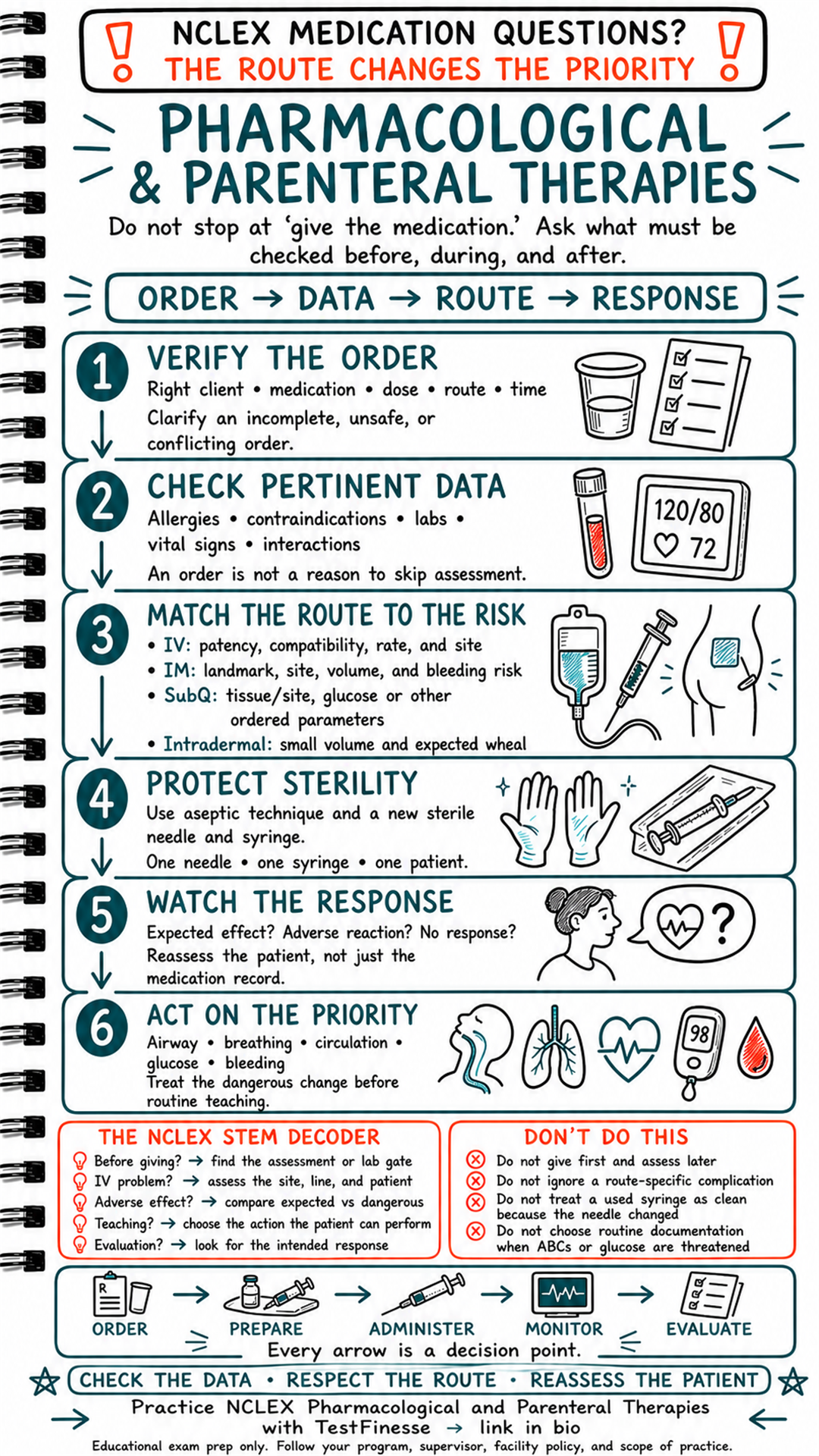
NCLEX medication questions are rarely asking only, “Can the nurse give this medication?”
The stronger question is:
What must the nurse verify, assess, monitor, or respond to before, during, and after administration?
That distinction matters because medication administration is a full clinical process. The nurse must evaluate the order, review relevant patient information, identify route-specific risks, administer safely, monitor the response, and reassess the patient.
The 2026 NCLEX-RN Test Plan includes evaluating medication-order accuracy, using the rights of medication administration, performing medication calculations, monitoring IV therapy, reviewing contraindications and laboratory results, educating clients, evaluating medication response, and handling high-risk medications safely. 2026 NCLEX-RN Test Plan
The practical framework is:
Order → Data → Route → Response
1. Verify The Order
Begin with the medication order, not the syringe.
Check the essential elements:
Correct client
Correct medication
Correct dose
Correct route
Correct time
Required parameters
Allergies and relevant precautions
If the order is incomplete, conflicting, or unsafe, the correct move is clarification through the appropriate clinical process. Do not invent missing information or proceed simply because the medication appears familiar.
The order may be technically written but still require additional assessment before administration. For example, a medication may depend on a heart rate, blood pressure, glucose value, laboratory result, or assessment finding.
An order is permission to assess and administer safely, not permission to skip assessment.
2. Check Pertinent Data
After verifying the order, look for patient-specific information that could change the safety decision.
Pertinent data may include:
Medication allergies
Contraindications
Recent laboratory results
Vital signs
Renal or hepatic function
Drug interactions
Previous response
Current symptoms
Relevant medication history
Do not collect every possible piece of information without purpose. Focus on the data connected to the medication and the patient’s current condition.
For example:
A medication that affects heart rate may require pulse and blood-pressure assessment.
A medication that affects glucose may require glucose data and symptom assessment.
An anticoagulant may make bleeding findings especially important.
An IV medication may require checking the line, site, compatibility, and ordered administration rate.
The question may be testing whether you know which data are the gate before the medication can be safely given.
3. Match The Route To The Risk
The route changes what you must inspect and what complications you should anticipate.
IV Medications
For IV therapy, focus on:
Line patency
Infiltration or extravasation
Site condition
Compatibility
Ordered rate
Pump settings
Patient response
An IV route can produce a rapid systemic effect, so a change in the patient or the site may require prompt attention. Do not ignore pain, swelling, coolness, redness, leaking, resistance, or unexpected changes around the IV site.
IM Medications
For intramuscular medications, consider:
Correct landmark
Appropriate site
Volume
Needle selection according to policy and patient factors
Bleeding risk
Tissue or nerve injury risk
The safest answer is not determined by the medication name alone. The patient’s age, muscle mass, condition, medication volume, and bleeding risk may affect the route-specific decision.
Subcutaneous Medications
For subcutaneous administration, assess:
Appropriate tissue and site
Skin condition
Ordered medication parameters
Glucose or other required monitoring
Rotation or site-specific instructions when relevant
The stem may be testing whether you recognize that the medication requires a specific patient assessment before administration.
Intradermal Medications
Intradermal injections use a small volume and produce a localized response. Questions may focus on technique, the expected wheal, site selection, or interpretation of the response according to the procedure being performed.
Do not treat every injection as interchangeable. The route determines the equipment, location, rate, volume, assessment, and follow-up.
4. Protect Sterility
Parenteral therapy requires careful infection-prevention practice.
The essential safety principle is:
One needle. One syringe. One patient. One time.
A used syringe is not made clean by changing the needle. The CDC states that needles and syringes should not be reused between patients, even if the needle is changed, and that aseptic technique should be used when preparing and administering injections. CDC Injection Safety
For NCLEX questions, eliminate choices that:
Reuse a syringe
Use a used syringe to enter a medication vial
Share medication from a single-dose container
Prepare medication in a contaminated workspace
Treat a changed needle as proof that the syringe is sterile
Delay disposal of used injection equipment
The route and medication may vary, but contamination prevention remains a core safety rule.
5. Watch The Response
Medication administration does not end when the medication enters the patient.
Evaluate:
Was the intended effect produced?
Did an adverse reaction occur?
Is there no response?
Did the patient’s condition worsen?
Does the patient need reassessment?
Is additional action required under the order or protocol?
Reassess the patient, not just the medication record.
A documented administration time does not prove that the therapy worked. The patient’s response is the evidence.
For example, if the medication was intended to improve a symptom, reduce a measurement, or stabilize a physiologic problem, look for the expected clinical change. If the patient develops a dangerous reaction, the priority changes immediately.
Evaluation is an active nursing responsibility, not a documentation checkbox.
6. Act On The Priority
When a medication question includes a dangerous change, use a priority lens.
Look first for threats involving:
Airway
Breathing
Circulation
Altered consciousness
Severe glucose abnormality
Major bleeding
Anaphylaxis
Rapid deterioration
Routine teaching and documentation should not outrank an immediate threat.
The NCLEX often includes attractive answers that sound organized:
Complete the medication record
Teach the patient about side effects
Recheck the prescription later
Document the expected response
Schedule routine follow-up
Those may be appropriate eventually, but they are not the best first action when the patient is unstable.
Ask:
What can harm the patient fastest if ignored?
Then match the action to the scope of the question.
Decode The Question Stem
Use the wording to select the correct lens.
Stem wordingBest lens“Before giving?”Required assessment, lab, vital-sign, or allergy check“IV problem?”Site, line, patency, compatibility, rate, and patient response“Adverse effect?”Expected effect versus dangerous reaction“Teaching?”What the patient can safely perform, monitor, or report“Evaluation?”Whether the intended response occurred“Priority?”Airway, breathing, circulation, glucose, bleeding, or instability
Do not answer a teaching question with an emergency intervention unless the scenario establishes immediate danger. Do not choose routine documentation when the patient’s ABCs or glucose are threatened.
Common NCLEX Medication Traps
Avoid these errors:
Giving first and assessing later.
Ignoring a route-specific complication.
Treating all adverse effects as equally urgent.
Choosing a medication because it sounds familiar.
Skipping the order-verification step.
Confusing an expected effect with an overdose or adverse reaction.
Failing to inspect an IV site when the problem is route-specific.
Reusing a syringe because the needle was changed.
Choosing documentation over an unstable patient.
Answering a teaching question with a vague phrase such as “monitor symptoms.”
The best answer usually identifies the exact priority:
Assess respiratory status
Check the ordered vital sign
Review the relevant laboratory value
Stop and assess the IV site according to policy
Recognize a severe reaction
Reassess the patient’s response
Escalate an unsafe order through the appropriate process
Use The TestFinesse Practice Loop
When practicing pharmacological and parenteral-therapy questions, study the decision sequence instead of memorizing isolated rationales.
Answer: Commit to a choice before looking at the explanation.
Explain: State the order clue, pertinent data, route risk, and patient response.
Reveal: Compare your reasoning with the rationale.
Fix the gap: Write one trigger rule in your own words.
Examples:
“Before giving a medication, find the assessment or lab gate.”
“If the problem is IV-specific, inspect the line, site, and patient.”
“If breathing is threatened, routine teaching waits.”
“If the drug produces an expected effect, look for the dangerous deviation.”
“A new syringe and needle are required for each injection and patient.”
Then solve a near-twin question with a different medication, route, or clinical setting. The purpose is to transfer the framework:
Order → Data → Route → Response
Final Takeaway
NCLEX pharmacology questions are not simply medication-recognition questions.
Verify the order. Check the data. Respect the route. Watch the response. Prioritize the dangerous change.
Every arrow is a decision point. When you slow down long enough to identify the risk, the next action becomes much easier to recognize.
Educational exam-prep content only. This is not medical advice. Always follow your nursing program, clinical instructor, supervisor, facility policy, current scope of practice, and official NCLEX guidance.
Accuracy sources checked: 2026 NCLEX-RN Test Plan, CDC Injection Safety
Keep studying
Practice Exam Skills
Turn this into a better score
Reading about a skill only gets you so far. TestFinesse's AI coach walks you through exam questions, explains exactly where your reasoning breaks down, and adapts to what you actually need to practice next.
Explore All Exams