HESI A2 Prep Map: Build Your Study Plan From Your School’s Required Sections
Last updated August 11, 2026
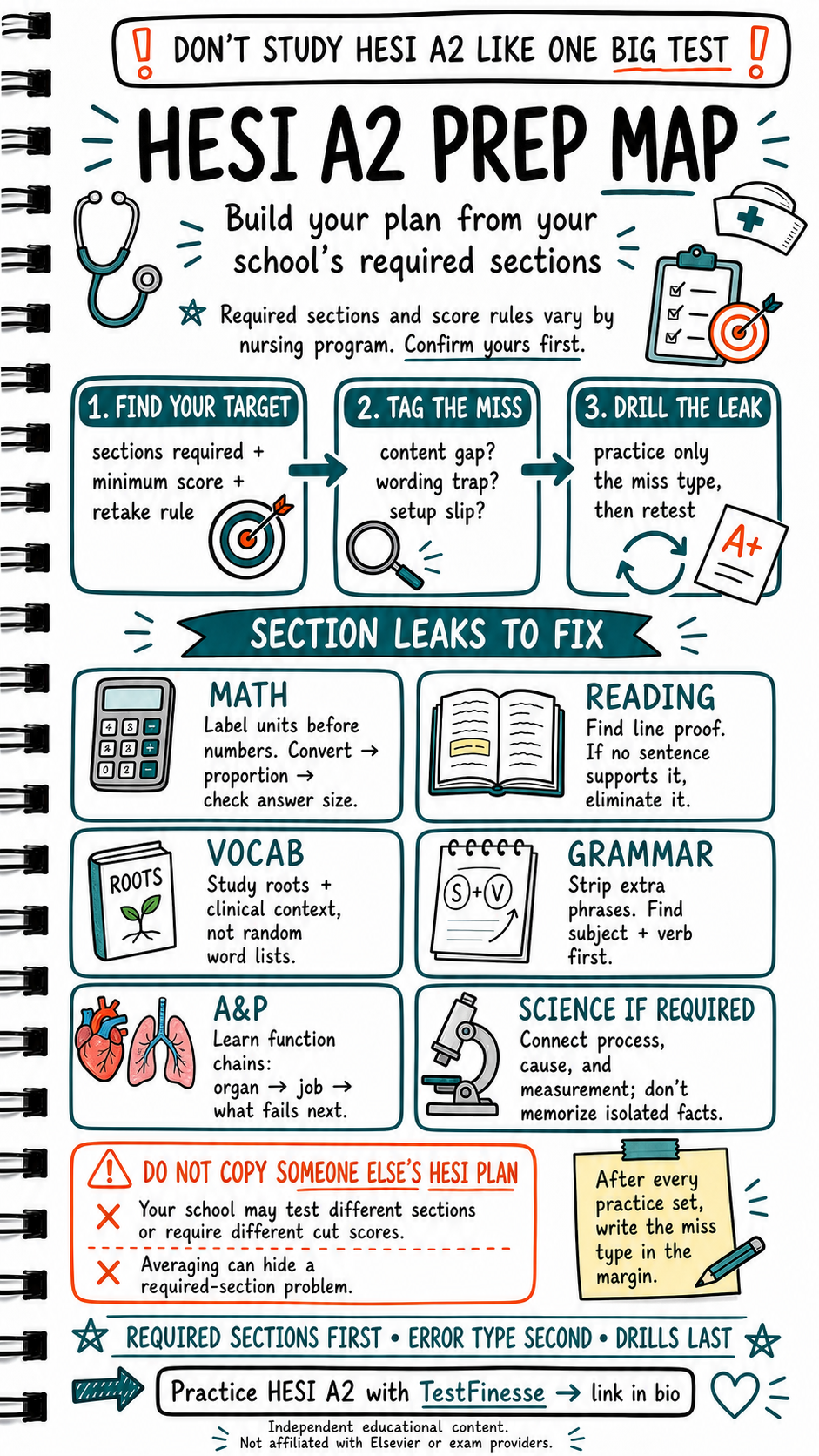
Do not study for the HESI A2 like it is one big test.
That is one of the fastest ways to waste study time.
The HESI Admission Assessment, often called the HESI A2, is used by nursing and health professions programs as part of the admissions process. But here is the detail many students miss:
Your school decides which sections matter.
One program may require Math, Reading, Vocabulary, Grammar, and Anatomy and Physiology. Another may add Biology or Chemistry. Another may have different minimum scores, retake rules, deadlines, or score-use policies.
That means your study plan should not begin with a random online checklist.
It should begin with your program’s requirements.
The best HESI A2 prep rule is:
Required sections first. Error type second. Drills last.
Why You Should Not Copy Someone Else’s HESI Plan
It is tempting to ask another student what they studied and copy their plan.
That can help a little, but it can also mislead you.
HESI A2 requirements vary by nursing program. Schools may choose different required sections, minimum scores, retake policies, testing windows, and score rules. Some programs may focus heavily on A&P. Others may care most about a required minimum in Reading or Math. Some may average section scores, while others may require a minimum score in each section.
That is why two students can both be “studying for HESI” but need very different plans.
Before you study, confirm:
Which sections your school requires
Minimum score for each required section
Whether there is an overall score requirement
Retake rules
How long scores are valid
Testing deadline
Whether science sections are required
Whether your school accepts remote or only approved testing-center scores
Do this before buying resources, building a schedule, or copying a study plan.
1. Find Your Target
Your first step is to find your target.
Not a general target like:
“I want to pass HESI.”
A specific target like:
“My program requires Math, Reading, Vocabulary, Grammar, and A&P, with at least 80% in each required section.”
Your target should include three things:
Sections required
Minimum score
Retake rule
This matters because your study plan should match your admissions goal.
If your school does not require Chemistry, you may not need to spend the same amount of time on Chemistry as a student whose program does require it. If your school requires a minimum in every section, a strong average may not protect you from one weak required area.
Ask your program, testing center, or admissions page:
What sections do I need to take?
What score do I need on each section?
Can I retake the exam?
If I retake it, which score counts?
Is there a waiting period?
When is the deadline?
Your HESI plan starts there.
2. Tag The Miss
After every practice set, tag the miss.
Do not only count how many you got wrong.
Label why each miss happened.
Common HESI miss types include:
Content gap: You did not know the concept, word, rule, or body system.
Wording trap: You misunderstood what the question asked.
Setup slip: You knew the idea but set up the math, grammar, or evidence wrong.
Careless error: You rushed, copied the wrong number, skipped a word, or selected too fast.
Review gap: You recognized the explanation but could not produce the answer on your own.
Timing issue: You spent too long or guessed too quickly.
This step turns practice into information.
A missed Math question because you forgot a percent setup is different from a missed Math question because you forgot to convert units.
A missed Reading question because you lacked line proof is different from a missed Reading question because you ran out of time.
The fix depends on the cause.
3. Drill The Leak
Once you tag the miss, drill the leak.
That means you practice the specific mistake type, not the whole subject randomly.
Examples:
If you miss unit conversions, drill only conversions for a short set.
If you miss Reading evidence, drill line-proof questions.
If you miss subject-verb agreement, drill grammar sentence cores.
If you miss A&P function chains, drill organ → job → what fails next.
If you miss vocabulary roots, drill roots in clinical context.
Then retest.
The goal is not to feel busy.
The goal is to prove the weak spot improved.
A useful loop is:
Find the miss
Name the cause
Drill that cause
Retest with new questions
That is how score leaks close.
Section Leaks To Fix
The infographic breaks HESI prep into common section leaks. Use these as a diagnostic map.
Math: Label Units Before Numbers
HESI Math is often less about advanced math and more about clean setup.
Before calculating, label the units.
Ask:
What is given?
What is being asked?
Do I need to convert first?
Is this a proportion, percent, ratio, or dosage-style setup?
Does the answer size make sense?
A strong Math process is:
Convert → proportion → check answer size.
Common Math leaks include:
Fractions
Ratios
Percentages
Unit conversions
Basic algebra
Word problem setup
Measurement
Dosage-style reasoning
Do not just redo random math questions. Find the setup type that keeps leaking points.
Reading: Find Line Proof
HESI Reading is not about vibes.
The correct answer should be supported by the passage.
Before choosing, ask:
Which sentence proves this?
Is the answer stated or clearly supported?
Is this too broad?
Is this outside information?
Does this answer match the author’s point?
If no sentence supports it, eliminate it.
That one rule can prevent many Reading misses.
A good Reading habit is to answer in your own words first, then match the answer choice to the passage proof.
Vocabulary: Study Roots And Clinical Context
Vocabulary prep should not be random word-list memorization only.
Study word parts and clinical context.
Focus on:
Prefixes
Roots
Suffixes
Common healthcare terms
Words that appear in patient-care contexts
Similar-looking words
Terms that change meaning based on context
For example, a root can help you decode an unfamiliar word even if you have not memorized the full term.
Ask:
What body system does this word point to?
What does the prefix change?
What does the suffix tell me?
How would this word appear in a healthcare sentence?
Roots plus context beat random memorization.
Grammar: Strip Extra Phrases
Grammar questions often become easier when you simplify the sentence.
Strip extra phrases and find the core:
Subject + verb
Then check:
Subject-verb agreement
Pronoun clarity
Verb tense
Punctuation
Sentence structure
Word choice
Unnecessary wording
Many students miss grammar questions because the sentence is cluttered.
Your first move should be:
Find the subject and verb first.
Once the sentence core is clear, the error is easier to see.
A&P: Learn Function Chains
Anatomy and physiology is not just naming parts.
You need to understand what structures do.
Use function chains:
organ → job → what fails next
Example:
Heart → pumps blood → poor perfusion if it fails
Lungs → exchange gases → oxygen problems if exchange fails
Kidneys → filter blood and regulate fluid/electrolytes → imbalance if function fails
This helps you answer questions that test cause and effect, not just recall.
Ask:
What is the organ’s job?
What process is happening?
What happens if that process breaks?
Which symptom or clue matches that failure?
A&P becomes easier when facts connect to function.
Science If Required: Connect Process, Cause, And Measurement
Not every school requires every science section.
If your program requires Biology, Chemistry, or another science area, do not memorize isolated facts only.
Connect:
Process
Cause
Measurement
Result
For Biology, ask what process is happening.
For Chemistry, ask what changes, what stays fixed, and what units matter.
For scientific reasoning, ask what the data shows.
Science questions often reward relationships more than isolated definitions.
Do Not Let Averages Hide A Required-Section Problem
Averaging can hide a weak section.
For example, a student may feel fine because the overall average looks strong, but one required section may still fall below the school’s minimum.
That can matter if the program requires a minimum score per section.
Track each required section separately.
Your tracker should show:
Section
Practice score
Required score
Weakest question type
Miss type
Next drill
Retest result
This keeps your prep aligned with the actual admissions requirement.
Use The TestFinesse Practice Loop
The TestFinesse method is:
Answer
Explain
Reveal
Fix the gap
For HESI A2 prep, add one more step:
Tag the miss.
After every practice set, write the miss type in the margin.
Ask:
Was this a content gap?
Was this a wording trap?
Was this a setup slip?
Was this a careless mistake?
Which required section does this affect?
What drill should I do next?
Then practice only that leak before retesting.
That is how your wrong answers become your plan.
Final Takeaway
HESI A2 prep should not start with someone else’s schedule.
It should start with your school’s requirements.
Use this prep map:
Find your target
Confirm required sections
Know the minimum score rules
Check retake policies
Tag each missed question
Drill the leak
Retest with new questions
For each section, use the right strategy:
Math: label units before numbers
Reading: find line proof
Vocabulary: study roots plus clinical context
Grammar: find subject and verb first
A&P: learn function chains
Science if required: connect process, cause, and measurement
Do not study HESI A2 like one big test.
Required sections first. Error type second. Drills last.
Independent educational content. Not affiliated with Elsevier or exam providers.
Accuracy sources checked: Elsevier Admission Assessment Exam Review, 6th Edition, Evolve Admission Assessment Exam Review, 6th Edition, MTSU HESI Requirements Example, Northwest Florida State College HESI Requirements Example, and Indian River State College HESI A2 FAQ.
Keep studying
- HESI Family Nursing Clinical Judgment: Assess the Patient, Support the Family
- Nursing Exam Prep Pain-Point Decoder: Find the Hidden Leak Behind Every Miss
- HESI A2 Critical Thinking: How to Decode the Scenario Before Choosing an Answer
- HESI Vocab Is a Translation Test: Split the Word, Then Read the Sentence
Practice Exam Skills
Turn this into a better score
Reading about a skill only gets you so far. TestFinesse's AI coach walks you through exam questions, explains exactly where your reasoning breaks down, and adapts to what you actually need to practice next.
Explore All Exams