The LSAT Argument X-Ray: How to Expose the Gap Before Answer Choices
Last updated August 10, 2026
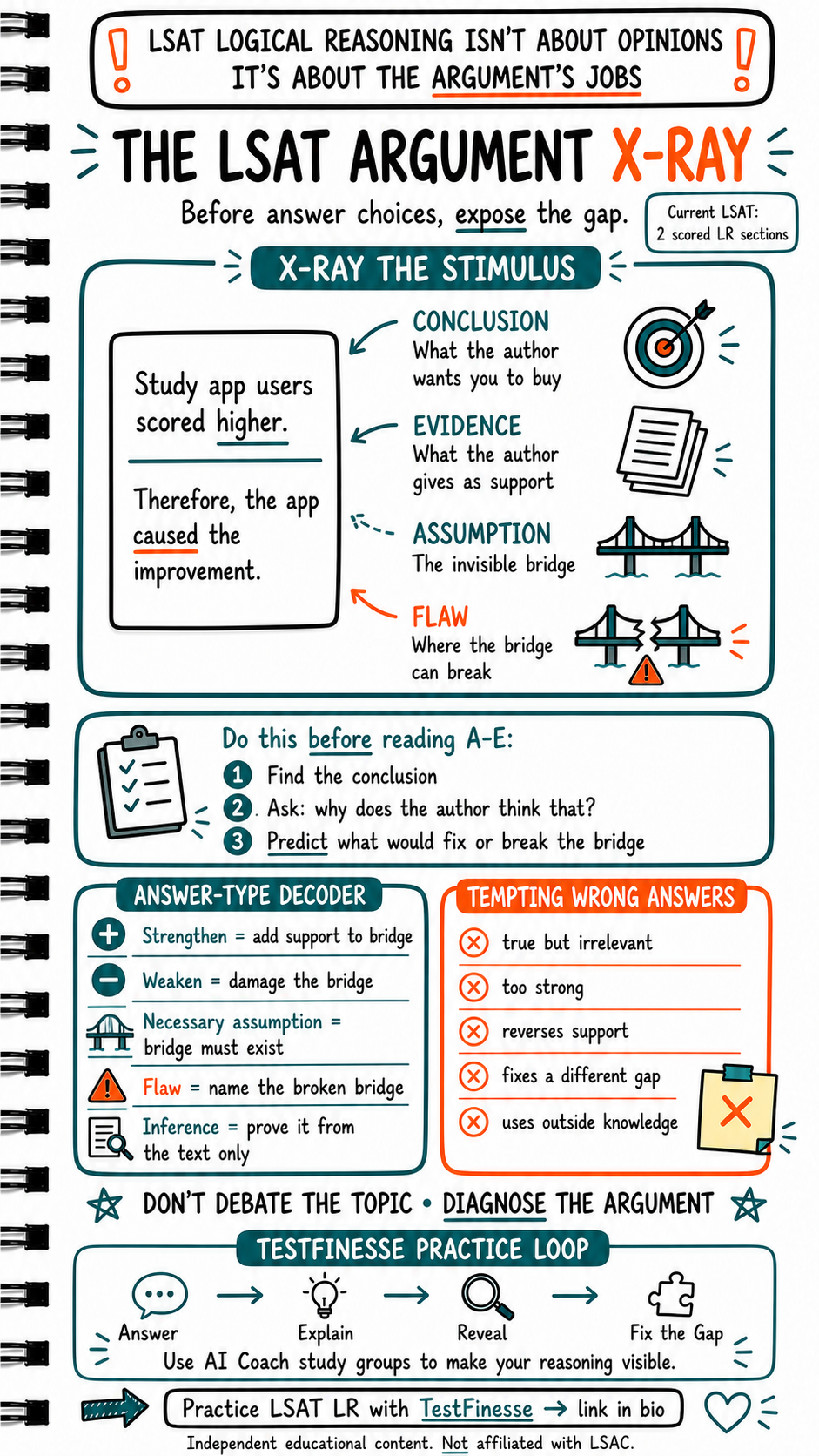
LSAT Logical Reasoning is not about your opinion.
It is about the argument’s job.
That is one of the biggest mindset shifts students need for LR. The test is not asking whether you like the topic, agree with the author, or have outside knowledge about the issue. It is asking whether you can understand how the argument works.
The current LSAT includes two scored Logical Reasoning sections, which means LR is a major part of your score. Each LR question gives you a short passage and asks you to reason about it.
The best move is to slow down before the answer choices.
Do not debate the topic.
Diagnose the argument.
What It Means To X-Ray The Stimulus
To X-ray an LSAT stimulus means to look beneath the topic and expose the structure.
Most LR arguments have four important pieces:
Conclusion: what the author wants you to accept
Evidence: what the author gives as support
Assumption: the invisible bridge between evidence and conclusion
Flaw: where that bridge can break
Once you see those pieces, the answer choices become much easier to judge.
You are no longer asking:
“Which answer sounds good?”
You are asking:
“Which answer does the job this question requires?”
Conclusion: What The Author Wants You To Buy
The conclusion is the author’s main claim.
It is what the argument is trying to prove.
Look for conclusion language like:
therefore
thus
so
clearly
hence
for this reason
it follows that
But do not rely only on keywords. Some conclusions appear without obvious signal words.
Ask:
“What does the author want me to believe?”
Example:
Study app users scored higher. Therefore, the app caused the improvement.
The conclusion is:
The app caused the improvement.
That is the claim the author wants you to accept.
Evidence: What The Author Gives As Support
Evidence is the reason offered for the conclusion.
In the example:
Study app users scored higher. Therefore, the app caused the improvement.
The evidence is:
Study app users scored higher.
That evidence may be relevant, but it does not automatically prove the conclusion. Maybe app users were already stronger students. Maybe they studied more. Maybe the app was one factor but not the cause.
The evidence is what the author gives you.
The conclusion is what the author wants from that evidence.
LSAT LR often tests whether the move from evidence to conclusion is valid, weak, supported, or missing something.
Assumption: The Invisible Bridge
An assumption is something the argument needs but does not directly say.
It is the invisible bridge between evidence and conclusion.
In the study app example, the author assumes something like:
The app caused the higher scores.
App users were not already better prepared.
No other factor explains the score difference.
The comparison between users and non-users is fair.
Assumptions matter because many LR question types are built around them.
If the bridge must exist, you may be dealing with a necessary assumption question.
If the bridge is weak, you may be dealing with a flaw question.
If an answer adds support to the bridge, it may strengthen the argument.
If an answer damages the bridge, it may weaken the argument.
Flaw: Where The Bridge Can Break
A flaw is the weakness in the reasoning.
It is not just something you dislike.
It is the specific place where the evidence fails to prove the conclusion.
Common LSAT flaws include:
Confusing correlation with causation
Ignoring an alternative explanation
Using an unrepresentative sample
Comparing unlike groups
Making a conclusion that is too broad
Mistaking necessary for sufficient
Assuming what the argument tries to prove
Treating absence of evidence as evidence of absence
In the study app example, the flaw is likely causal:
The argument assumes the app caused the higher scores just because app users scored higher.
That is not guaranteed.
A good flaw answer names the broken bridge.
Do This Before Reading A-E
Before reading the answer choices, do three things:
Find the conclusion
Ask why the author thinks that
Predict what would fix or break the bridge
This short process prevents answer-choice confusion.
For example:
Conclusion: The app caused the improvement.
Evidence: App users scored higher.
Gap: Maybe app users were already stronger or studied more.
Prediction: A strengthen answer might show the groups were similar before using the app. A weaken answer might show app users had more outside tutoring.
Now the answer choices have a job.
You are not reading them cold.
Answer-Type Decoder
Different Logical Reasoning question types require different answer behavior.
The same answer can be helpful for one task and wrong for another.
Strengthen: Add Support To The Bridge
A strengthen answer makes the argument more likely.
It does not need to prove the conclusion completely.
It just needs to help.
For the study app example, a strengthen answer might say:
Before using the app, app users and non-users had similar practice-test scores.
That supports the bridge between app use and score improvement.
Ask:
“Does this make the conclusion more believable?”
Weaken: Damage The Bridge
A weaken answer makes the argument less likely.
It attacks the connection between evidence and conclusion.
For the study app example, a weaken answer might say:
Students who used the app also received extra tutoring that non-users did not receive.
That gives another explanation for the higher scores.
Ask:
“Does this make the evidence less able to prove the conclusion?”
Necessary Assumption: The Bridge Must Exist
A necessary assumption is something the argument needs in order to work.
If the assumption is false, the argument weakens or collapses.
For the study app example, a necessary assumption might be:
The app users’ higher scores were not entirely caused by something unrelated to the app.
Necessary assumption answers are often modest.
They do not always sound dramatic. They simply protect the argument from falling apart.
Ask:
“If this were false, would the argument be in trouble?”
Flaw: Name The Broken Bridge
A flaw answer describes the reasoning mistake.
It does not fix the argument.
It names what went wrong.
For the study app example:
The argument takes a correlation between app use and higher scores as evidence that the app caused the higher scores.
That is the flaw.
Ask:
“What did the author assume without enough support?”
Inference: Prove It From The Text Only
Inference questions are different.
They are not asking you to strengthen, weaken, or critique the argument.
They are asking what must be true or is most strongly supported by the text.
For inference questions, do not add your own assumptions.
Stay inside the passage.
Ask:
What is stated?
What must follow?
What is supported without outside knowledge?
Is this answer too strong?
The safest inference answers are often boring, narrow, and carefully worded.
Tempting Wrong Answers
LSAT LR wrong answers are not random.
They are designed to be tempting.
Watch for these common traps.
True But Irrelevant
An answer can be true and still fail the task.
If the question asks you to weaken the app argument, an answer about how popular study apps are may be true but irrelevant.
Ask:
“Does this answer affect the conclusion?”
Too Strong
Extreme language can make an answer wrong.
Be careful with:
always
never
all
none
must
only
proves
If the argument only supports a limited claim, a broad or absolute answer may go too far.
Ask:
“Does the stimulus really support something this strong?”
Reverses Support
Some answers flip the direction of the reasoning.
For example, if the argument says app use may lead to higher scores, a wrong answer may treat higher scores as the reason students used the app.
Ask:
“Which direction does the support actually move?”
Fixes A Different Gap
This is a very common trap.
The answer may fix a real-sounding problem, but not the problem in this argument.
For the study app example, an answer about whether the app is affordable might be interesting. But if the argument is about whether the app caused score improvement, affordability may not matter.
Ask:
“Is this the actual gap?”
Uses Outside Knowledge
LSAT LR does not require specialized outside knowledge.
If an answer depends on facts not in the stimulus, be careful.
You can use common sense, but you should not import your own opinions or expertise.
Ask:
“Can I evaluate this from the stimulus?”
Use The TestFinesse Practice Loop
The TestFinesse practice loop is:
Answer
Explain
Reveal
Fix the gap
For LSAT LR, explain before you reveal.
Ask:
What is the conclusion?
What is the evidence?
What assumption connects them?
What is the flaw or gap?
What job does the question stem require?
Why is the tempting wrong answer wrong?
After revealing, diagnose the miss.
Was it:
Conclusion confusion
Question-type confusion
Assumption miss
Flaw miss
Too-strong answer
Irrelevant answer
Outside knowledge
Wrong bridge
Then write one rule for next time.
Final Takeaway
LSAT Logical Reasoning is not about debating the topic.
It is about diagnosing the argument.
Before answer choices, expose the structure:
Conclusion
Evidence
Assumption
Flaw
Then match the answer to the question type:
Strengthen: add support to the bridge
Weaken: damage the bridge
Necessary assumption: identify what must be true
Flaw: name the broken bridge
Inference: prove it from the text only
Do not debate the topic.
Diagnose the argument.
Accuracy sources checked: LSAC Logical Reasoning, LSAC Logical Reasoning Sample Questions, LSAC Types of LSAT Questions, and LSAC FAQ.