10 LSAT RC Moves Most People Miss: Structure and Proof Over Speed
Last updated August 9, 2026
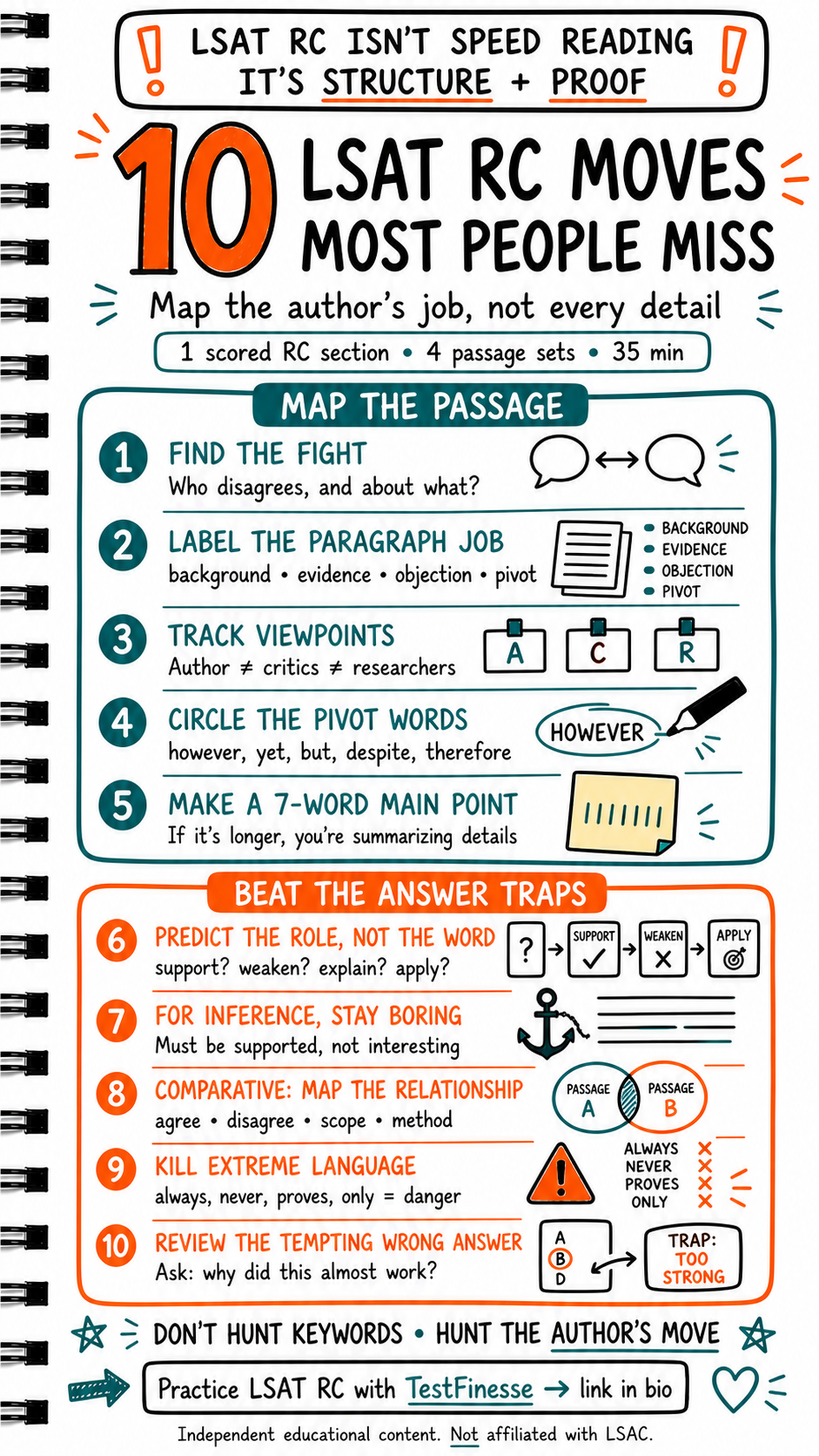
LSAT Reading Comprehension is not speed reading.
It is structure plus proof.
Many students try to improve RC by reading faster, highlighting more, or memorizing every detail. But LSAT RC does not reward you for remembering every sentence. It rewards you for understanding what the author is doing and proving your answers from the passage.
The current LSAT includes one scored Reading Comprehension section. Each LSAT multiple-choice section is 35 minutes, and the test may also include an unscored variable section that could be Reading Comprehension or Logical Reasoning.
That means RC matters. And because you may see an unscored RC section too, your process needs to be repeatable under pressure.
The best rule is simple:
Map the author’s job, not every detail.
Why LSAT RC Feels Hard
LSAT passages are dense on purpose. They often include unfamiliar topics from law, science, humanities, or social science. But the topic is rarely the real problem.
The real problem is losing the structure.
Students often miss RC questions because they:
Treat every detail as equally important
Read for keywords instead of relationships
Miss the author’s attitude
Confuse one viewpoint with another
Pick answers that are interesting but not proven
Fall for answers that are too strong
Forget why a paragraph was included
LSAC describes Reading Comprehension as testing your ability to understand complex, law-school-like materials. The questions are based on what is stated or implied in the passage or passage pair.
That means your job is not to bring outside knowledge.
Your job is to understand the passage’s structure and choose the answer that is best supported.
Map The Passage
The first five moves are about mapping the passage while you read.
You do not need a perfect summary. You need a usable map.
1. Find The Fight
Many LSAT RC passages contain a disagreement, tension, debate, or correction.
Ask:
Who disagrees, and about what?
The “fight” might be obvious:
One group of scholars argues one view.
The author challenges that view.
New evidence complicates an older theory.
Or it might be subtle:
A common assumption is incomplete.
A traditional explanation misses something.
A researcher’s method has limits.
The author agrees partly but adds a qualification.
Finding the fight helps you understand why the passage exists.
A passage is rarely just “about wetlands” or “about legal history.” It is usually about a problem, debate, interpretation, or shift in understanding.
Better notes look like:
Old view vs. new evidence
Critics vs. author
Theory works, but only in limited cases
Method is useful, but flawed
That is much more useful than copying topic details.
2. Label The Paragraph Job
Each paragraph has a job.
Do not ask only, “What did this paragraph say?”
Ask:
“Why is this paragraph here?”
Common paragraph jobs include:
Background
Main claim
Evidence
Example
Objection
Author response
Pivot
Qualification
Implication
For example:
Paragraph 1 may introduce the old theory.
Paragraph 2 may present evidence against it.
Paragraph 3 may explain the author’s revised view.
That map helps when a question asks about main point, organization, function, or the role of a detail.
You do not need long notes. Short labels are better:
P1: old view
P2: problem
P3: author fix
The goal is not to rewrite the passage. The goal is to stay oriented.
3. Track Viewpoints
LSAT RC often includes multiple voices.
The author is not always the same as the critics, researchers, historians, scientists, courts, or theorists mentioned in the passage.
Track who believes what.
Use simple labels:
A = author
C = critics
R = researchers
T = traditional view
N = new evidence
This matters because wrong answers often mix viewpoints.
For example, an answer choice may describe something the critics believe as if the author believes it. Or it may turn a researcher’s limited conclusion into the passage’s main point.
Ask:
Who says this?
Does the author agree?
Is this the old view, new view, or author’s view?
Is the author neutral, supportive, skeptical, or qualified?
On LSAT RC, viewpoint control is score control.
4. Circle The Pivot Words
Pivot words show where the passage changes direction.
Important pivot words include:
however
yet
but
although
despite
nevertheless
therefore
rather
in contrast
on the other hand
These words are small, but they often reveal the structure.
For example:
However may introduce the author’s disagreement.
Although may show a concession.
Therefore may introduce a conclusion.
Despite may show that evidence cuts against expectation.
When you see a pivot word, slow down.
Ask:
“What changed?”
The answer often points to the author’s main move.
5. Make A 7-Word Main Point
After reading the passage, force yourself to make a short main point.
Aim for about seven words.
Examples:
Author revises old theory using new evidence.
Critics underestimate practical value of method.
Legal rule changed because context shifted.
Study supports claim but has limits.
If your main point is too long, you are probably summarizing details instead of structure.
A strong main point should include:
The topic
The author’s position
The passage’s main move
Weak main point:
“This passage is about coral reef studies.”
Better main point:
“New evidence challenges old coral reef theory.”
The second version is useful because it captures the author’s job.
Beat The Answer Traps
The next five moves are about answer choices.
RC wrong answers are often attractive. Your job is to know why they are wrong.
6. Predict The Role, Not The Word
Before looking at the choices, predict what kind of answer you need.
Do not try to guess exact wording.
Predict the role.
Ask:
Do I need support?
Do I need a weakening idea?
Do I need the author’s purpose?
Do I need a detail from one paragraph?
Do I need an inference?
Do I need the relationship between two passages?
This protects you from attractive wrong answers.
For example, if the question asks for the role of a paragraph, do not choose an answer just because it mentions familiar words. Choose the answer that describes what the paragraph does.
Keyword matching is dangerous.
Role matching is stronger.
7. For Inference, Stay Boring
Inference questions are not asking for the most creative answer.
They are asking for the answer that must be supported by the passage.
A good LSAT RC inference is usually:
Modest
Text-based
Carefully worded
Supported by a specific line or relationship
A bad inference answer is often:
Too broad
Too extreme
Too interesting
Only loosely related
Based on outside knowledge
The best rule:
For inference, stay boring.
If an answer feels exciting but you cannot prove it from the passage, it is probably not safe.
Ask:
“Where is the proof?”
If you cannot point to the support, do not pick it.
8. For Comparative Reading, Map The Relationship
Comparative Reading passages are not two separate reading assignments.
They are a relationship task.
You need to understand how Passage A and Passage B connect.
Common relationships include:
Agreement
Disagreement
Different scope
Different method
Same problem, different solution
One passage gives theory, the other gives application
One passage is more optimistic or skeptical
After reading both passages, ask:
What does Passage A say?
What does Passage B say?
Where do they overlap?
Where do they differ?
Would one author agree with the other?
Is the difference about evidence, scope, method, or conclusion?
For comparative questions, the wrong answer may be accurate for one passage but not both.
Always check the relationship.
9. Kill Extreme Language
Extreme language is not always wrong, but it is dangerous.
Be careful with words like:
always
never
proves
only
completely
entirely
must
all
none
LSAT RC passages often use careful, qualified language. If the passage says a method is “often useful,” an answer that says it is “always reliable” is too strong.
The trap is intensity.
Wrong answers often take a limited claim and stretch it too far.
Before choosing an extreme answer, ask:
“Does the passage really go that far?”
If the answer is no, eliminate it.
10. Review The Tempting Wrong Answer
Do not only review the right answer.
Review the wrong answer that almost got you.
Ask:
“Why did this almost work?”
Tempting wrong answers usually have a pattern:
Too strong
Wrong viewpoint
Right topic, wrong role
Supported by one detail, not the main point
True but irrelevant
Opposite relationship
Outside knowledge
Half right, half wrong
This review step is where improvement happens.
If you only say, “The right answer was C,” you may miss the lesson.
Instead, write a rule:
Next time, check whether the answer is too strong.
Next time, separate the author from the critics.
Next time, prove inference answers from the passage.
Next time, map both passages before answering comparative questions.
Every tempting wrong answer should become a future trap warning.
Use The TestFinesse Practice Loop
The TestFinesse practice loop is:
Answer
Explain
Reveal
Fix the gap
For LSAT RC, this means you should explain your answer before checking it.
Ask:
What line or paragraph supports my answer?
What role does this answer play?
Whose viewpoint is being tested?
Is this answer too strong?
Why are the other choices wrong?
Then reveal the answer and diagnose the miss.
Was it:
A structure miss?
A viewpoint mix-up?
An unsupported inference?
A comparative relationship error?
A tempting wrong answer trap?
A timing problem?
The goal is not just to do more RC passages.
The goal is to make your reading process cleaner.
Final Takeaway
LSAT RC is not about reading every word faster.
It is about knowing what matters.
Focus on these 10 moves:
Find the fight
Label the paragraph job
Track viewpoints
Circle pivot words
Make a 7-word main point
Predict the role, not the word
Stay boring on inference questions
Map the relationship in comparative reading
Watch extreme language
Review the tempting wrong answer
Do not hunt keywords.
Hunt the author’s move.
That is how Reading Comprehension becomes less random and more repeatable.
Accuracy sources checked: LSAC FAQ, LSAC Types of LSAT Questions, LSAC Reading Comprehension Sample Questions, and LSAC August 2024 Format Update.
Keep studying
Practice Exam Skills
Turn this into a better score
Reading about a skill only gets you so far. TestFinesse's AI coach walks you through exam questions, explains exactly where your reasoning breaks down, and adapts to what you actually need to practice next.
Explore All Exams