LSAT Inference Question Decoder: Pick What the Passage Guarantees, Not What Feels Likely
Last updated August 13, 2026
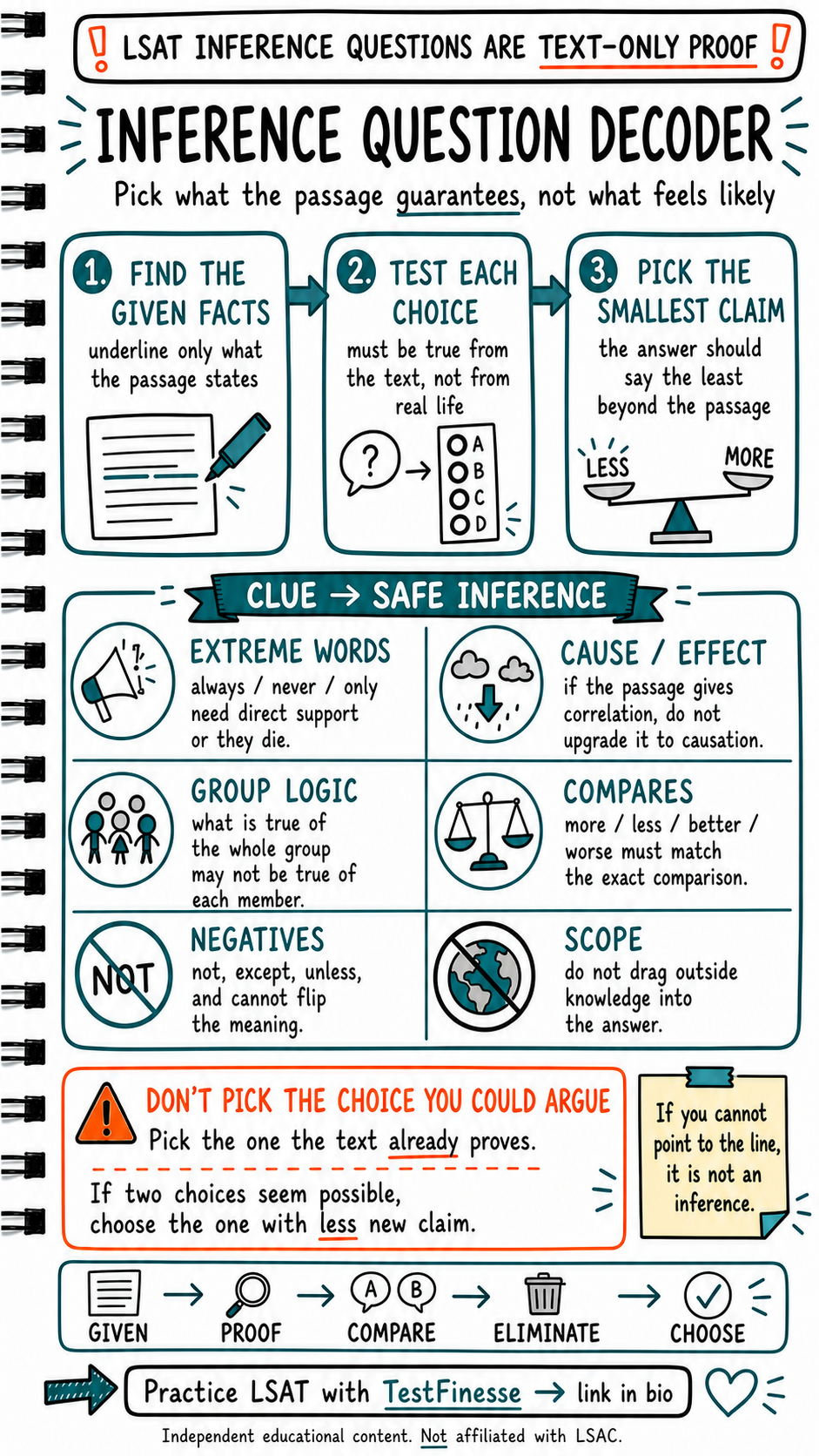
LSAT inference questions are text-only proof.
That is the whole game.
You are not being asked what seems reasonable in real life. You are not being asked what a smart person might believe. You are not being asked to bring in background knowledge. LSAC’s Reading Comprehension materials say these questions must be answered from what is stated or implied in the passage, and LSAC’s approach guidance is even more direct: answer only on the basis of the information provided in the selection.
That means the best inference answer is the one the passage guarantees, not the one that sounds clever.
The TestFinesse rule is simple:
Given facts → Proof → Compare → Eliminate → Choose
Why Inference Questions Feel Slippery
Inference questions are hard because they hide inside ordinary language.
The answer choices are often written to sound:
plausible
sophisticated
obvious
“common sense”
slightly stronger than the passage
That last one is the trap.
A good inference answer is usually modest. It should say the smallest claim the text supports. If two choices both feel possible, the better one is usually the one that says less and adds less.
1. Find The Given Facts
Start by underlining only what the passage actually states.
Do not underline:
your prior knowledge
what the author “must have meant”
what the world usually does
what sounds likely
Underline:
direct statements
definitions
comparisons
qualifiers
contrasts
repeated ideas
explicit conclusions
This step keeps the question inside the passage.
If the passage says “some,” do not convert it to “all.”
If the passage says “may,” do not convert it to “will.”
If the passage says “often,” do not convert it to “always.”
Inference rule: Facts in, assumptions out.
2. Test Each Choice
An inference choice must be true from the text, not from real life.
That means you should test the answer choice against the passage line by line.
Ask:
Can I point to the line that supports this?
Does the passage directly say it or clearly require it?
Is the choice too strong?
Did the answer add new information?
Did it sneak in a cause, motive, or conclusion that the passage never gave?
If you cannot trace the choice to the text, it is not an inference. It is a guess with good grammar.
LSAC’s own guidance on reading comprehension says to respond to the specific question being asked and to answer only on the basis of the information provided in the selection. That is the standard you want.
3. Pick The Smallest Claim
If two choices look possible, choose the one that says the least beyond the passage.
This is one of the most useful LSAT habits you can build.
Smaller claims are safer because they are easier to support. Bigger claims usually introduce:
absolute language
unsupported certainty
extra causation
broader scope
stronger generalizations
The passage may support a narrow relationship, but the tempting wrong answer often upgrades it into a larger conclusion.
TestFinesse rule: The right inference is usually the least dramatic one.
Clue → Safe Inference
Extreme Words
Words like:
always
never
only
completely
must
all
none
impossible
need direct support.
If the passage is softer than the answer choice, eliminate it.
A passage that says “some,” “often,” or “likely” usually does not support an answer that says “all” or “never.”
Extreme words need extreme proof.
Cause / Effect
Do not upgrade correlation into causation.
If the passage shows two things happening together, that is not the same as proving one caused the other.
Ask:
Did the passage actually say “because”?
Did it only show relationship or timing?
Is the answer choice adding an invisible mechanism?
If the passage gives correlation, do not promote it to cause.
Group Logic
What is true of the whole group may not be true of each member.
This trap shows up when a passage talks about:
a group
a category
a population
a set of cases
a general pattern
Do not assume the passage proved the strongest claim about every individual item in the group.
If the text supports a group-level statement, a choice about every member may go too far.
Compares
Words like:
more
less
better
worse
larger
smaller
stronger
weaker
must match the exact comparison in the passage.
The comparison has to be the same comparison.
Ask:
Compared to what?
In what direction?
Under what condition?
For which group or case?
If the answer choice changes the comparison target, it is probably wrong.
Negatives
Words like:
not
except
unless
cannot
never
flip the meaning.
That means you need to slow down when the question contains a negative. Many LSAT mistakes happen because the student understands the passage but misses the direction of the question.
Negatives do not get a free pass. They must be read carefully.
Scope
Do not drag outside knowledge into the answer.
If the passage does not say it, do not import it from memory, intuition, or real-world logic.
LSAC says you should not make assumptions that are superfluous or incompatible with the passage, and for reading comprehension you are to answer based on the information provided in the selection. That matters a lot on inference questions, because the most tempting wrong choices often feel “true enough” in real life.
But LSAT inference is not real-life debate.
It is passage proof.
Don’t Pick The Choice You Could Argue
This is the central trap.
A tempting wrong answer often feels like something you could defend in conversation. But LSAT inference questions are not asking what you can argue. They are asking what the text already proves.
If you cannot point to the line, it is not an inference.
If two choices seem possible, choose the one with less new claim.
That is usually the safer answer because it stays closer to the passage and avoids overreach.
The Decoder Sequence
Use this sequence on every inference question:
Given
Proof
Compare
Eliminate
Choose
Given
Read the passage and mark only the facts that matter.
Proof
Ask what the passage forces you to conclude.
Compare
Compare the answer choices against the proof, not against each other’s style.
Eliminate
Remove anything that is too strong, too broad, too new, or too disconnected.
Choose
Pick the answer the passage already proves.
Why This Works
This method works because inference questions reward restraint.
Students often lose points by trying to be helpful to the test. They want to fill in gaps, smooth out ambiguity, or make the passage sound more complete than it is. But LSAT scoring is not asking you to improve the argument. It is asking you to stay inside the text and choose the best supported option.
That is why the right answer often feels plain. It may look less clever than the others. It may sound less complete. It may even feel a little disappointing.
That is normal.
The question is not whether the answer feels satisfying.
The question is whether the passage already proves it.
Use The TestFinesse Practice Loop
The TestFinesse method is:
Answer
Explain
Reveal
Fix the gap
For LSAT inference questions, your explanation should include:
What were the given facts?
Which line proved the answer?
Which choice added new claim?
Which extreme word or comparison caused the trap?
Did I choose a claim I could argue, or one the text already proved?
Then tag the miss:
extreme word trap
cause/effect trap
scope trap
comparison trap
negative trap
too much new claim
That turns every wrong answer into a specific rule instead of a vague frustration.
Final Takeaway
LSAT inference questions are not about what feels likely.
They are about what the passage guarantees.
Use this decoder:
Given facts → Proof → Compare → Eliminate → Choose
And remember the cleanest rule on the page:
If you cannot point to the line, it is not an inference.
Independent educational content. Not affiliated with LSAC.
Accuracy sources checked: LSAC Types of LSAT Questions, LSAC Reading Comprehension, LSAC Suggested Approach for Reading Comprehension, LSAC Reading Comprehension Sample Questions.
Keep studying
Practice Exam Skills
Turn this into a better score
Reading about a skill only gets you so far. TestFinesse's AI coach walks you through exam questions, explains exactly where your reasoning breaks down, and adapts to what you actually need to practice next.
Explore All Exams