LSAT Exam Mnemonics: 6 Acronyms for Logical Reasoning and Reading Comprehension
Last updated August 9, 2026
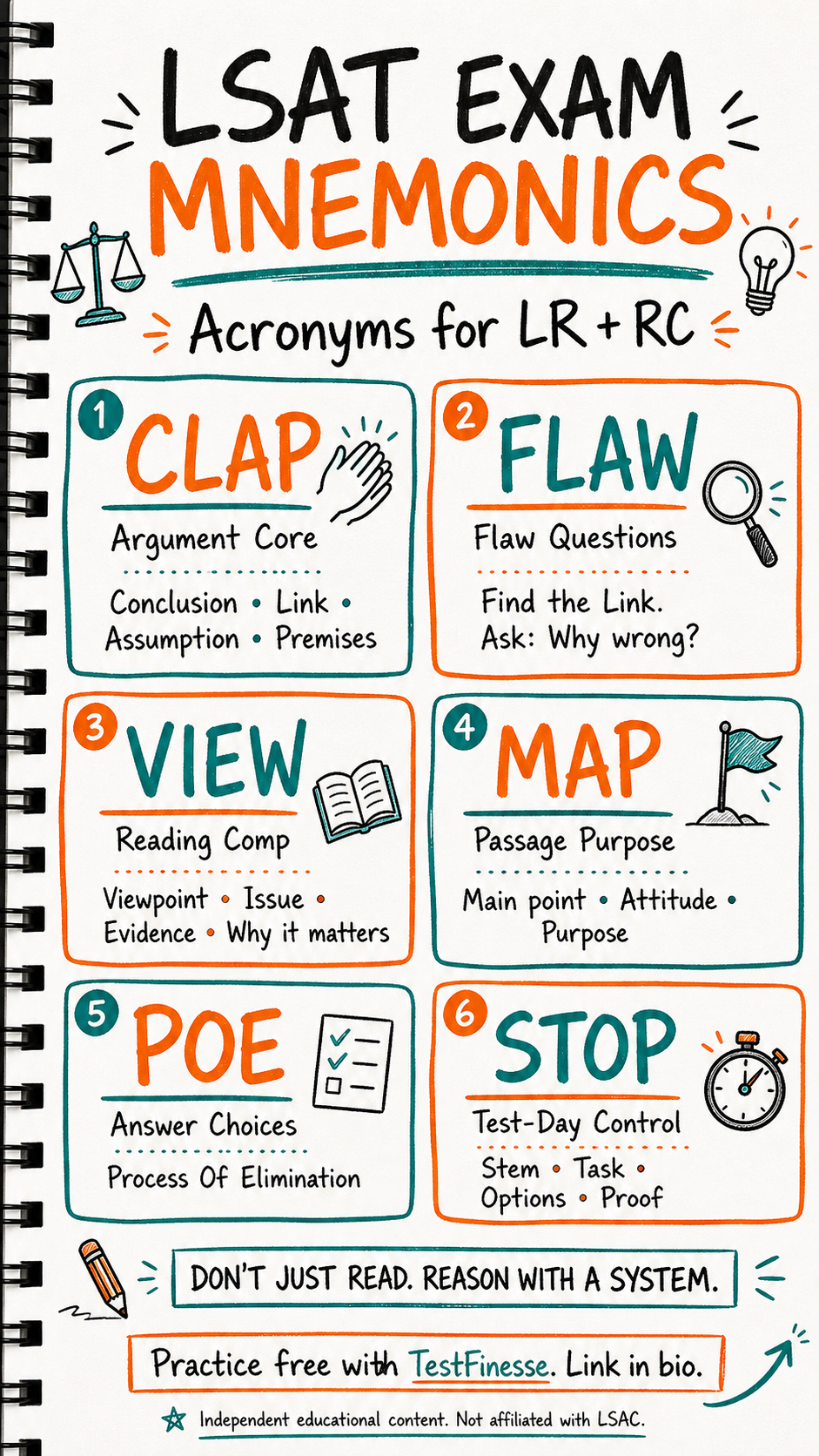
The current LSAT is a reasoning test.
Since the August 2024 format change, the multiple-choice LSAT includes two scored Logical Reasoning sections, one scored Reading Comprehension section, and one unscored variable section that can be either LR or RC.
That means your prep should focus heavily on two skills:
Reasoning through short arguments
Reading complex passages with structure and proof
Mnemonics can help because they give your brain a quick checklist under pressure.
The goal is not to memorize cute acronyms.
The goal is to create a repeatable process so you do not panic, reread randomly, or choose answers based on vibes.
Do not just read.
Reason with a system.
Why LSAT Mnemonics Help
The LSAT rewards controlled thinking.
Logical Reasoning questions ask you to understand and evaluate arguments. Reading Comprehension questions ask you to read complex texts carefully, identify structure, track viewpoints, and choose answers supported by what is stated or implied.
That is a lot to hold in working memory.
A good mnemonic gives you a small mental checklist.
It helps you ask:
What is the conclusion?
What support is given?
What assumption connects them?
What is the author’s purpose?
Which answer is actually proven?
What does the question task require?
Here are six LSAT acronyms that can make LR and RC more manageable.
1. CLAP: Argument Core
Use CLAP for Logical Reasoning argument core.
CLAP = Conclusion, Link, Assumption, Premises
When you read an LR stimulus, do not treat every sentence equally.
Find the argument core.
Conclusion: What is the author trying to prove?
Link: How are the ideas connected?
Assumption: What must be true for the reasoning to work?
Premises: What evidence or reasons are given?
For example, an argument might say:
“The tutoring program improved scores, so the school should expand it.”
The conclusion is that the school should expand the program. The premise is that scores improved. The assumption may be that the tutoring program caused the improvement and that expansion would produce similar benefits.
CLAP helps you avoid a common LR trap: confusing evidence with conclusion.
Before looking at answer choices, ask:
“What is the argument trying to prove, and how is it trying to prove it?”
2. FLAW: Flaw Questions
Use FLAW for flaw questions.
FLAW = Find the Link. Ask: Why wrong?
Flaw questions are not asking whether the topic is interesting or whether the conclusion sounds reasonable.
They are asking what is wrong with the reasoning.
Start by finding the link between the premise and conclusion.
Then ask:
Why does this support not fully prove the conclusion?
What assumption is being made?
Could the evidence be true while the conclusion is still false?
Did the author confuse correlation with causation?
Did the author compare unlike groups?
Did the author overgeneralize?
Did the author ignore an alternative explanation?
A flaw is usually a broken bridge between evidence and conclusion.
The answer choice should describe that broken bridge.
Do not choose an answer just because it sounds negative. Choose the answer that matches the actual reasoning problem.
3. VIEW: Reading Comprehension
Use VIEW for Reading Comprehension.
VIEW = Viewpoint, Issue, Evidence, Why it matters
Reading Comprehension passages often include multiple voices. The author may discuss researchers, critics, historians, scientists, judges, artists, or theorists.
VIEW helps you track the structure.
Viewpoint: Who believes what?
Issue: What question, debate, or problem is the passage about?
Evidence: What support is offered?
Why it matters: Why did the author include this discussion?
This is especially useful when passages are dense or unfamiliar.
You do not need to memorize every detail. You need to know who is saying what and why the passage is organized that way.
Ask:
“What is the author doing with these viewpoints?”
That question is often more useful than trying to remember every line.
4. MAP: Passage Purpose
Use MAP for passage purpose.
MAP = Main point, Attitude, Purpose
After reading an RC passage, make a quick MAP.
Main point: What is the central claim or takeaway?
Attitude: How does the author feel about the subject?
Purpose: Why was the passage written?
This helps with main point, primary purpose, author attitude, organization, and function questions.
For example:
Main point: New evidence challenges an old theory.
Attitude: Cautiously supportive.
Purpose: To explain a revised interpretation.
MAP keeps you from getting lost in details.
If your summary is just the topic, it is too vague.
Weak:
“This passage is about environmental law.”
Stronger:
“The author argues the old environmental standard is too narrow.”
That version captures the move.
5. POE: Answer Choices
Use POE for answer choices.
POE = Process of Elimination
On the LSAT, wrong answers are often close.
That means you should not only hunt for the right answer. You should also eliminate answers for specific reasons.
Common elimination reasons include:
Too strong
Too broad
Too narrow
Wrong viewpoint
Wrong conclusion
Unsupported by the passage
Opposite of the argument
True but irrelevant
Outside information
Answers a different question
POE is not random crossing out.
It is evidence-based elimination.
For LR, ask:
“Does this answer do the job required by the question stem?”
For RC, ask:
“Can I prove this from the passage?”
If not, eliminate it.
6. STOP: Test-Day Control
Use STOP for test-day control.
STOP = Stem, Task, Options, Proof
When pressure rises, use STOP to slow the decision down.
Stem: Read the question stem carefully.
Task: Identify what the question is asking you to do.
Options: Evaluate answer choices by job, not vibes.
Proof: Choose the answer supported by the argument or passage.
This is especially helpful when two answers seem tempting.
Before choosing, ask:
What is the task?
Does this answer match the task?
Where is the proof?
Why is the other tempting answer wrong?
Many LSAT misses happen because students answer a question the test did not ask.
STOP brings you back to the task.
How To Use These Mnemonics In Practice
Do not try to use all six acronyms on every question.
Use the right tool for the job.
For Logical Reasoning:
Use CLAP to find the argument core.
Use FLAW when the question asks what is wrong with the reasoning.
Use POE to eliminate attractive wrong answers.
Use STOP when you feel rushed or uncertain.
For Reading Comprehension:
Use VIEW to track perspectives.
Use MAP to identify passage purpose.
Use POE to eliminate unsupported answers.
Use STOP to stay aligned with the question task.
The goal is automaticity.
You want these checks to become quick, not heavy.
Practice Loop For LSAT Mnemonics
Use this review loop:
Answer
Explain
Reveal
Fix the gap
Before revealing the answer, explain which mnemonic you used.
For example:
“I used CLAP and found the conclusion.”
“I used FLAW and noticed the argument assumes causation.”
“I used MAP and identified the author’s cautious attitude.”
“I used STOP and realized the stem asked for weaken, not strengthen.”
After revealing the answer, ask:
Did I misread the task?
Did I miss the conclusion?
Did I confuse viewpoints?
Did I choose an unsupported answer?
Did I eliminate for a clear reason?
Then write one rule for next time.
That turns mnemonics into real score improvement.
Final Takeaway
The LSAT is not about reading faster or memorizing more terms.
It is about reasoning clearly under pressure.
Use these six acronyms:
CLAP: Conclusion, Link, Assumption, Premises
FLAW: Find the Link. Ask why the reasoning is wrong.
VIEW: Viewpoint, Issue, Evidence, Why it matters
MAP: Main point, Attitude, Purpose
POE: Process of Elimination
STOP: Stem, Task, Options, Proof
Do not just read.
Reason with a system.
Accuracy sources checked: LSAC Types of LSAT Questions, LSAC Logical Reasoning, LSAC Reading Comprehension, and LSAC August 2024 Format Update.
Keep studying
Practice Exam Skills
Turn this into a better score
Reading about a skill only gets you so far. TestFinesse's AI coach walks you through exam questions, explains exactly where your reasoning breaks down, and adapts to what you actually need to practice next.
Explore All Exams