PTCE Medication Math: 7 Setup Errors to Catch Before You Calculate
Last updated September 13, 2026
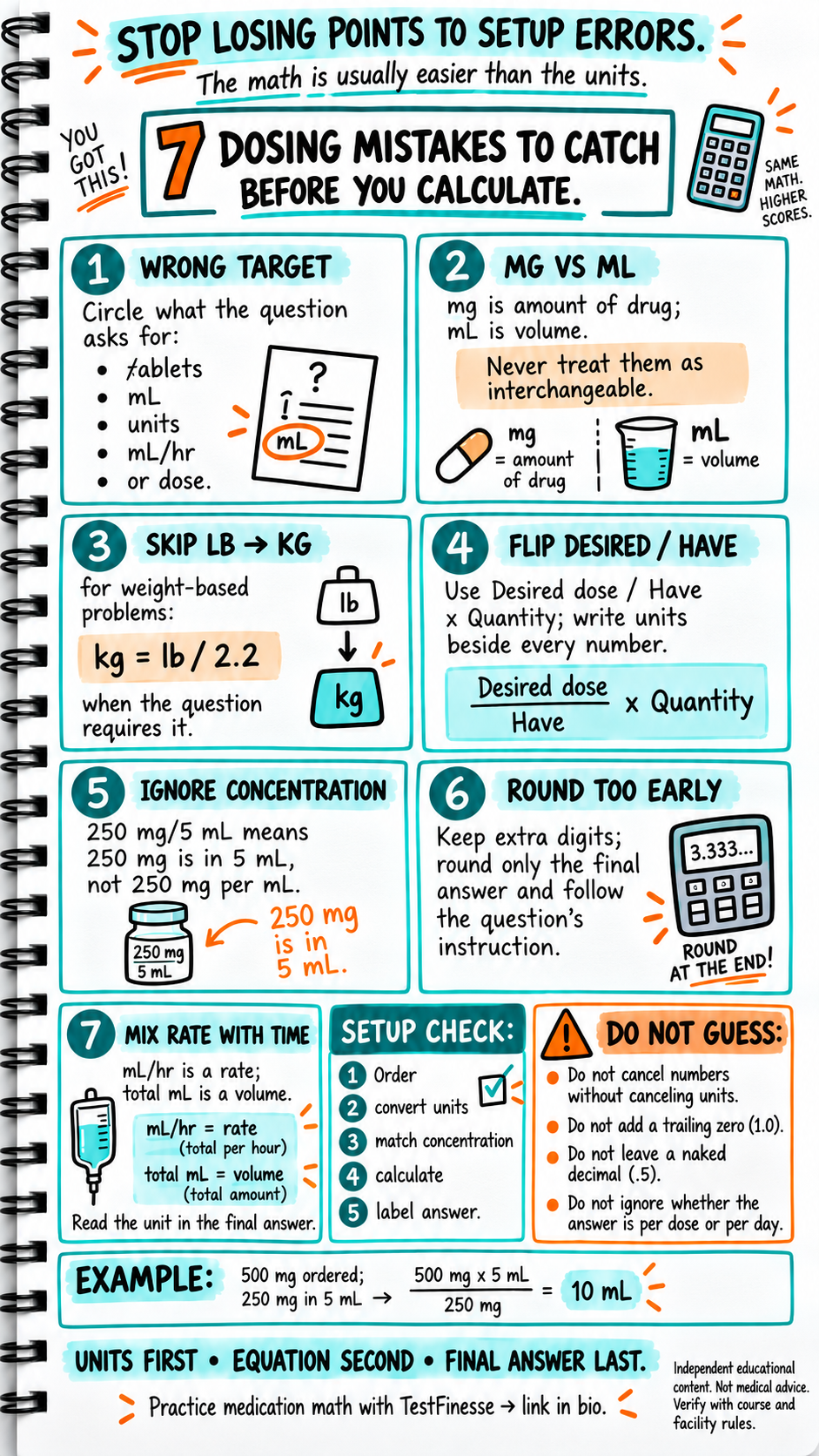
Many medication-math questions do not become difficult because of the arithmetic. They become difficult because the setup is wrong before the calculator is ever used.
You may know the formula, press the correct buttons, and still select the wrong answer because you solved for the wrong unit, confused mass with volume, ignored the concentration, or rounded too early.
The most reliable habit is simple:
Units first. Equation second. Final answer last.
This approach is especially useful for PTCE preparation because the official PTCE content outline includes dosage strengths, doses, concentrations, formulas, ratios, proportions, conversions, and quantity calculations. PTCB’s current PTCE content outline identifies these as calculation-based knowledge areas.
1. Identify the Exact Target
Before writing a formula, circle what the question actually asks for.
Possible targets include:
Tablets
Milliliters
Units
Milliliters per hour
Doses
Days’ supply
Total quantity
A question may provide several related numbers, but only one quantity is the requested answer.
For example, if the question asks how many milliliters to administer, calculating milligrams alone is incomplete. If it asks for an infusion rate, reporting the total volume is not enough.
Target rule: Write the requested quantity and unit on the answer line before calculating.
This prevents a common setup gap: obtaining a mathematically valid number that answers a different question.
2. Keep Milligrams and Milliliters Separate
One of the most common medication-math mistakes is treating mg and mL as interchangeable.
They are not.
mg measures the amount or mass of medication.
mL measures the volume of liquid.
A liquid medication might be labeled 250 mg in 5 mL. That does not mean 250 mg equals 250 mL. It means the stated amount of medication is contained within the stated volume.
The units must be connected through the concentration:
\[ \frac{250\text{ mg}}{5\text{ mL}} \]
When setting up a dosage problem, leave the units visible. They show whether the calculation is moving toward the requested answer or away from it.
Trap: If the final unit is wrong, the calculation is wrong even when the arithmetic is clean.
3. Convert Weight Units Before Using the Formula
Weight-based questions may provide a patient’s weight in pounds while the dose is ordered per kilogram.
When the problem requires kilograms, convert first:
\[ \text{kg}=\frac{\text{lb}}{2.2} \]
Do not place pounds directly into a dose-per-kilogram formula.
For example, if a patient weighs 154 lb:
\[ 154\text{ lb}\div2.2=70\text{ kg} \]
Then use the kilogram value in the dose calculation.
The important phrase is when the question requires it. Do not perform an unnecessary conversion just because a conversion is available. First identify the dose’s unit and the weight unit provided.
Conversion check: Ask, “What unit does the next relationship require?”
4. Use Desired Dose ÷ Have × Quantity
For many dosage problems, the core relationship is:
\[ \text{Quantity to give} = \frac{\text{Desired dose}}{\text{Dose on hand}} \times \text{Quantity on hand} \]
Keep the units beside every number.
Example:
Desired dose: 500 mg
Available: 250 mg in 5 mL
\[ \frac{500\text{ mg}}{250\text{ mg}}\times5\text{ mL} = 10\text{ mL} \]
The milligrams cancel, leaving milliliters.
That cancellation is not cosmetic. It is a built-in error check. If the problem asks for mL and your units do not reduce to mL, stop and repair the setup before calculating.
5. Read Concentrations as Relationships
A label such as 250 mg/5 mL describes a relationship between medication amount and liquid volume.
It means:
250 mg is contained in 5 mL.
It does not automatically mean:
250 mg per 1 mL
250 mL
5 mg
250 mg divided by an unrelated volume
The denominator matters. If the available medication is 250 mg in 5 mL, the quantity attached to that strength is 5 mL.
When solving, preserve the original relationship unless you deliberately convert it to an equivalent concentration.
Concentration rule: Read both sides of the label before substituting numbers.
This matters because medication errors can involve incorrect strength, incorrect quantity, or misinterpretation of drug concentration. Those error categories are also recognized in PTCB medication-related content. PTCB medication-history content
6. Round Only at the Appropriate Point
Early rounding can change the final dose.
Keep extra digits during intermediate steps and round only at the final step, following the instructions provided by the question, course, facility, or exam.
Do not invent a rounding rule when none has been provided.
There is also an important medication-safety distinction between calculation formatting and safe notation:
Use a leading zero for values less than one, such as 0.5 mg.
Do not use a trailing zero after a decimal, such as 1.0 mg.
The Institute for Safe Medication Practices identifies trailing zeros and missing leading zeros as medication-safety risks. ISMP medication-safety guidance
Rounding rule: Preserve precision until the final answer, then apply the stated instruction.
7. Separate Rate From Total Volume
A rate and a total amount are different targets.
mL/hr is a rate: volume delivered per hour.
mL is a total volume: the full amount delivered.
For example, an order may ask for an infusion rate in mL/hr, while another question asks how many total milliliters will be administered over a period of time.
Before calculating, ask:
“Am I finding how fast, how much per dose, or how much in total?”
A correct number with the wrong unit is still the wrong answer.
The Five-Step Setup Check
Before touching the calculator, run this sequence:
Order: What is prescribed?
Convert: Do the units need to match?
Concentration: What amount is contained in what volume?
Calculate: Which relationship connects the known values to the target?
Label: Does the final unit answer the question?
This takes only a few seconds, but it exposes many errors before they become calculator errors.
Use the TestFinesse Practice Loop
Medication-math practice becomes more useful when every miss is diagnosed.
Answer: Solve the problem without immediately checking the explanation.
Explain: State what the target was and why you chose the setup.
Reveal: Compare your setup and units with the rationale.
Fix the gap: Label the miss as a target error, conversion error, concentration error, equation error, rounding error, or unit-labeling error.
Then write one trigger rule:
When I see a weight-based dose, I check the weight unit before calculating.
Or:
When the answer should be mL, I verify that mg cancels before pressing equals.
That turns one missed question into a reusable decision rule.
Final Takeaway
Do not let a familiar formula rush you into calculation.
Name the target. Write the units. Match the concentration. Convert only when required. Calculate carefully. Label the final answer.
Medication-math accuracy often improves when the setup becomes visible. Practice medication math with TestFinesse, then use every miss to strengthen the next setup.
Educational exam-prep content only. Not medical advice. Always follow your program, supervisor, facility policy, current exam rules, and scope of practice.
Accuracy sources checked: PTCB PTCE Content Outline, PTCB Medication History Content, Institute for Safe Medication Practices
Keep studying
Practice Exam Skills
Turn this into a better score
Reading about a skill only gets you so far. TestFinesse's AI coach walks you through exam questions, explains exactly where your reasoning breaks down, and adapts to what you actually need to practice next.