PTCE Conversion Cheat Sheet: Convert Before You Calculate
Last updated August 23, 2026
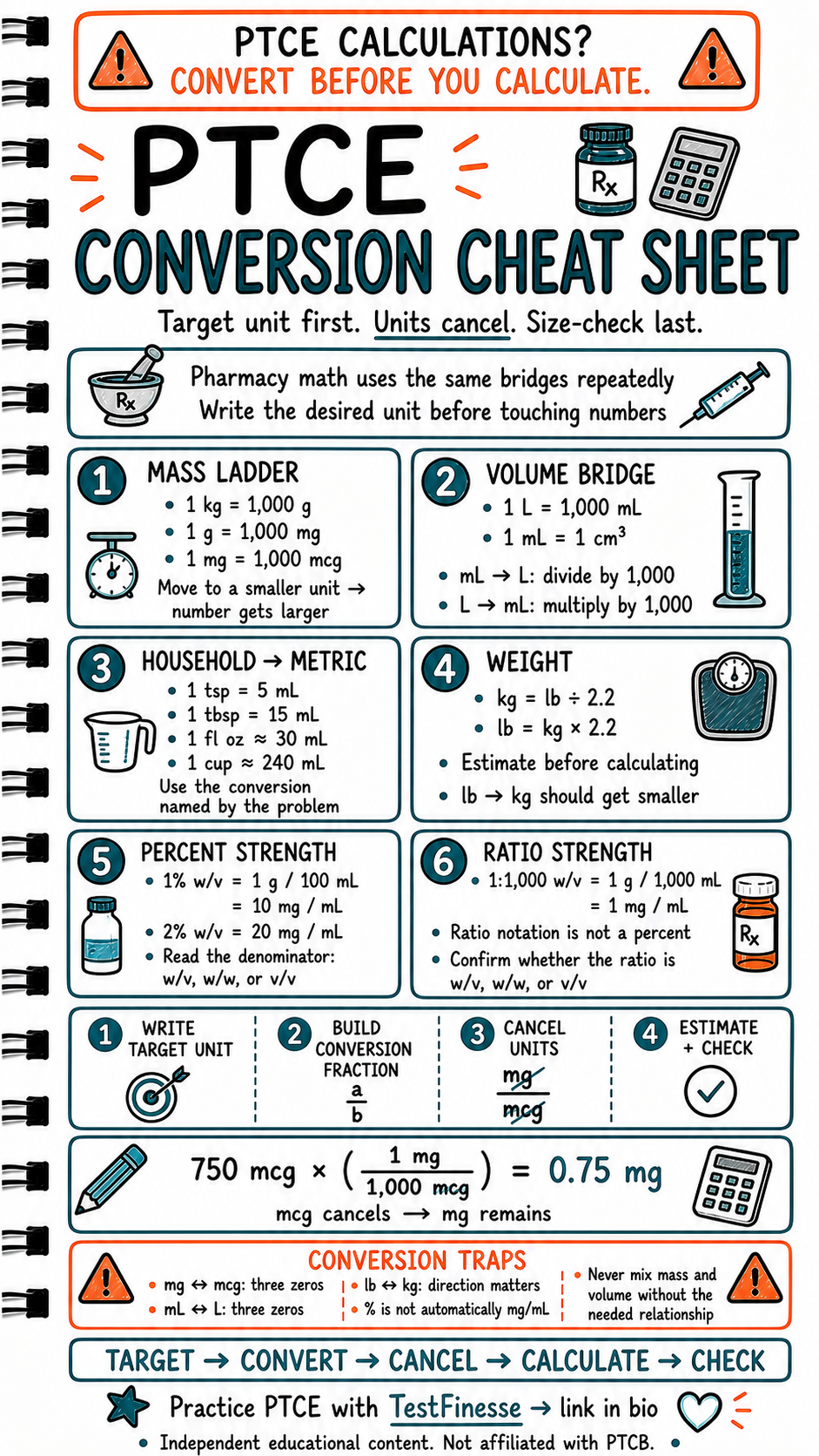
Many PTCE calculation questions are not difficult because the arithmetic is advanced. They are difficult because the units are quietly asking you to make a decision first.
A problem may give you:
Micrograms but ask for milligrams
Liters but provide milliliters
Pounds when the formula requires kilograms
A percentage when the answer needs mg/mL
A ratio strength that looks similar to a percent
A household measurement that must be converted before use
If you begin calculating before identifying the target unit, a wrong answer can still look perfectly reasonable.
The core PTCE calculation workflow is:
Target → Convert → Cancel → Calculate → Check
This is dimensional analysis in action. You are not merely moving numbers around. You are building a conversion path that makes the unwanted units disappear and leaves the requested unit behind.
The PTCB’s current PTCE content outline includes formulas, calculations, ratios, proportions, conversions, dose, concentration, dilutions, and related pharmacy-math concepts under Order Entry and Processing. The outline is effective January 6, 2026, so students should use the current version when planning preparation. PTCB PTCE Content Outline
1. Start With the Mass Ladder
The metric mass relationships are:
1 kilogram = 1,000 grams
1 gram = 1,000 milligrams
1 milligram = 1,000 micrograms
Moving toward a smaller unit makes the numerical value larger. Moving toward a larger unit makes the numerical value smaller.
For example:
Kilograms to grams: multiply by 1,000
Grams to milligrams: multiply by 1,000
Milligrams to micrograms: multiply by 1,000
Micrograms to milligrams: divide by 1,000
Example
Convert 750 mcg to milligrams:
750 mcg x (1 mg / 1,000 mcg) = 0.75 mgThe microgram units cancel, leaving milligrams.
Key rule: Do not rely on the direction of the arrow alone. Write the conversion fraction so the original unit appears in both the numerator and denominator and cancels.
2. Use the Volume Bridge Carefully
The basic metric volume relationship is:
1 liter = 1,000 milliliters
1 milliliter = 1 cubic centimeter
Therefore:
mL to L: divide by 1,000
L to mL: multiply by 1,000
mL and cm³ are numerically equivalent volume units
A common error is to move the decimal in the wrong direction because the number “looks like it should get smaller.” The target unit should control the conversion.
Example
Convert 2,500 mL to liters:
2,500 mL x (1 L / 1,000 mL) = 2.5 LThe mL units cancel, leaving liters.
Key rule: Write the desired volume unit before touching the numbers.
3. Treat Household Conversions as Problem-Specific
Common approximate relationships include:
1 teaspoon ≈ 5 mL
1 tablespoon ≈ 15 mL
1 fluid ounce ≈ 30 mL
1 cup ≈ 240 mL
These are useful exam approximations, but household measures can vary in real-world use. For PTCE questions, follow the conversion supplied or expected by the problem and your current study materials.
Do not substitute a household conversion automatically if the question gives a different relationship.
Watch the word “approximately”
A conversion such as 1 fluid ounce ≈ 30 mL is an approximation. The correct answer may depend on the precision requested and the conversion table used by the exam.
Key rule: Use the conversion named by the question, not the one you happen to remember first.
4. Convert Weight Before Using Weight-Based Formulas
The common relationship is:
1 kg ≈ 2.2 lb
kg = lb ÷ 2.2
lb = kg × 2.2
A pound-to-kilogram conversion should produce a smaller numerical value. For example, 154 lb is approximately 70 kg.
Example
154 lb ÷ 2.2 = 70 kgIf your result moves in the wrong direction, pause before continuing.
This matters because a weight-based dose can be numerically wrong even when the multiplication is flawless. If the formula requires mg/kg and you insert pounds instead, the setup is incorrect before the calculator is involved.
Key rule: Convert the patient weight into the unit required by the formula before calculating the dose.
5. Understand Percent Strength
Percent strength depends on the denominator. You must determine whether the expression is:
% w/v: grams per 100 mL
% w/w: grams per 100 g
% v/v: milliliters per 100 mL
For example:
1% w/v = 1 g per 100 mL
Since 1 g = 1,000 mg, this equals 10 mg/mL
2% w/v = 2 g per 100 mL = 20 mg/mL
The unit type is essential. A percentage is not automatically equivalent to mg/mL.
Example
1% w/v
= 1 g / 100 mL
= 1,000 mg / 100 mL
= 10 mg/mL
Key rule: Read the denominator before converting the percentage.
6. Do Not Confuse Ratio Strength With Percent Strength
Ratio strength uses a different notation and must be interpreted according to its units.
For example:
1:1,000 w/v
= 1 g / 1,000 mL
= 1,000 mg / 1,000 mL
= 1 mg/mL
That is not the same as saying “1%.” A ratio and a percentage communicate concentration differently.
Before calculating, ask:
Is this ratio w/v?
Is it w/w?
Is it v/v?
What units belong in the numerator?
What units belong in the denominator?
Key rule: Ratio notation is not automatically a percent conversion.
The Four-Step Calculation Setup
Before entering numbers into a calculator, use this sequence:
1. Write the target unit
What unit must the final answer have?
Examples:
mg
mL
mg/mL
mL/hr
tablets
doses
2. Build the conversion fraction
Place the units so the unwanted unit cancels.
3. Cancel units visibly
If the units do not cancel cleanly, the setup is not ready.
4. Estimate before calculating
Ask whether the answer should be:
Larger or smaller?
A fraction or a whole number?
Within a realistic range?
Consistent with the requested unit?
The calculator should verify the setup, not choose the setup for you.
Common PTCE Conversion Traps
Watch for these mistakes:
Confusing mg and mcg
Reversing mL and L
Converting pounds in the wrong direction
Treating a percentage as automatically equal to mg/mL
Ignoring the denominator in ratio strength
Mixing mass and volume without a concentration relationship
Rounding too early
Forgetting to check the final unit
Using an approximate household conversion when the question provides another one
A wrong-unit answer may look reasonable. That is why unit cancellation is more reliable than visual estimation alone.
Use the TestFinesse Practice Loop
For every missed PTCE calculation, use the TestFinesse method:
Answer: Set up the problem before reviewing the solution.
Explain: Identify the target unit, conversion path, and formula.
Reveal: Compare your setup with the correct dimensional analysis.
Fix the gap: Write one rule and solve a fresh near-twin problem.
Example fix rule:
“When the target is mg and the given amount is mcg, divide by 1,000 after writing the conversion fraction.”
Track whether each miss came from:
Conversion direction
Unit cancellation
Formula selection
Percent or ratio interpretation
Arithmetic
Rounding
Reading the question
This turns calculation practice into targeted repair rather than random repetition.
Final Takeaway
PTCE math becomes more manageable when you stop treating every question as a calculator problem.
Write the target unit. Build the bridge. Cancel the units. Calculate. Check the size.
That workflow protects you from the most dangerous kind of error: an answer that looks reasonable but belongs to the wrong unit or concentration category.
Target → Convert → Cancel → Calculate → Check
Independent educational content. Not affiliated with PTCB. This article is for exam preparation only and is not a substitute for pharmacist direction, approved institutional procedures, or patient-specific medication guidance.
Accuracy sources checked: PTCB PTCE Content Outline Effective January 2026, PTCB Candidate Guidebook, PTCB Certified Pharmacy Technician Resources
Keep studying
Practice Exam Skills
Turn this into a better score
Reading about a skill only gets you so far. TestFinesse's AI coach walks you through exam questions, explains exactly where your reasoning breaks down, and adapts to what you actually need to practice next.