10 PTCE Score Moves That Save Points on Pharmacy Technician Questions
Last updated August 14, 2026
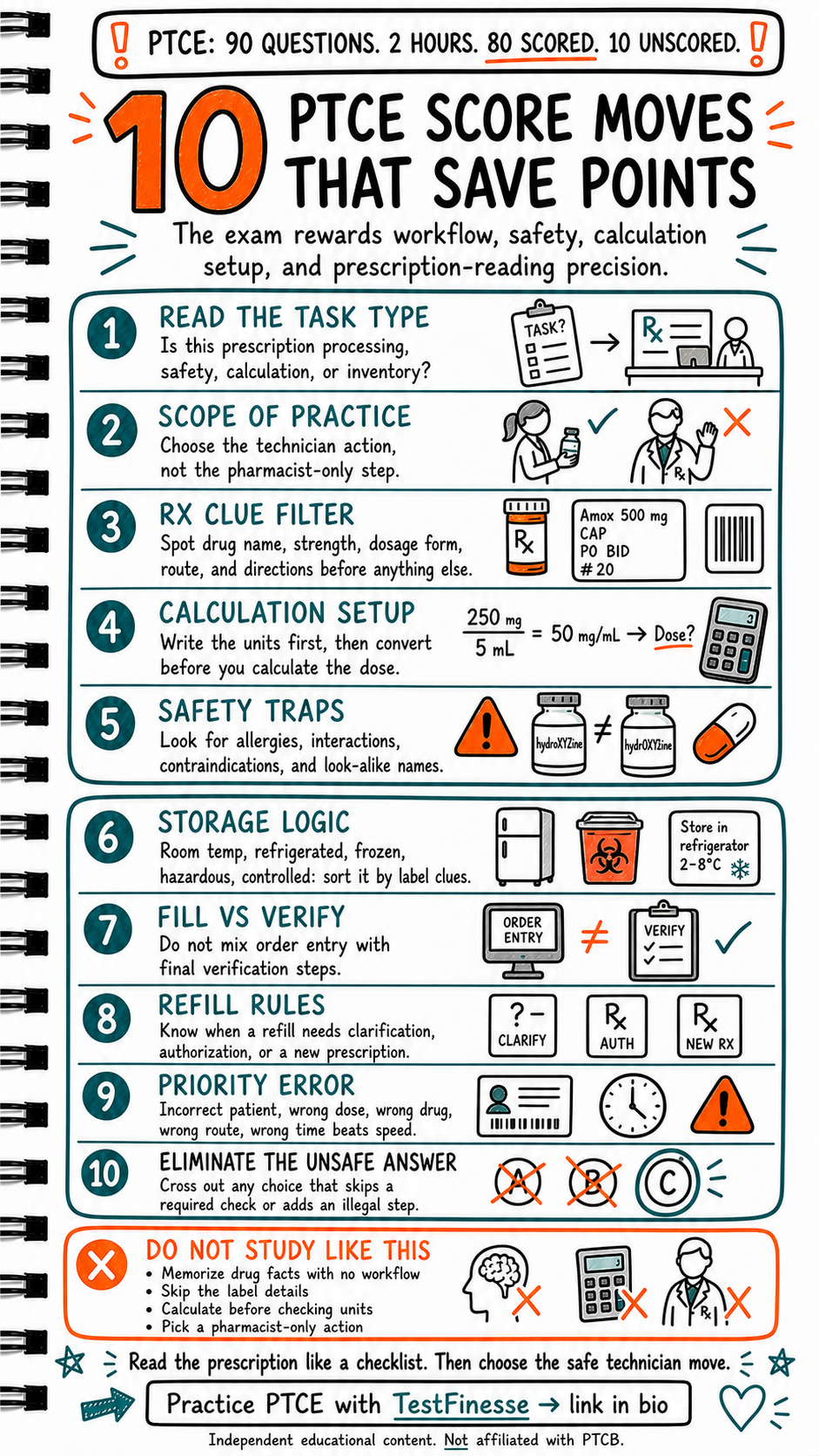
PTCE prep gets messy when students study random pharmacy facts with no workflow.
That is the fastest way to waste time. The PTCE is not only about memorizing drug names or calculation formulas. It is about recognizing what kind of task you are looking at, staying inside technician scope, and choosing the safest answer under time pressure.
PTCB states that the PTCE is a computer-based exam with 90 multiple-choice questions, including 80 scored questions and 10 unscored questions, and candidates should be prepared to commit 2 hours total for the tutorial, exam, and post-exam survey. PTCB also states that the exam uses a built-in calculator and that a personal calculator may not be used.
That means your study plan should not be random fact collection.
It should be:
Read the task → find the clue → set up cleanly → eliminate unsafe answers
Why PTCE Questions Repeat
PTCE questions often look different on the surface:
prescription reading
medications
calculations
storage
refill logic
verification
inventory
safety
workflow
But many of them are testing the same decision:
Can you read the task correctly and choose the safe technician move?
That is why the best prep is pattern-based. When you train the repeated moves, the score becomes more predictable.
1. Read The Task Type
Before anything else, ask:
Is this prescription processing, safety, calculation, or inventory?
That first classification matters because the wrong task type sends you down the wrong route.
Examples:
Prescription processing means you need to read the order carefully.
Safety means you need to think about harm, allergies, interactions, or contraindications.
Calculation means you need units, dose setup, and conversion.
Inventory means you need storage, quantity, labeling, or stock logic.
TestFinesse rule: Do not solve before you know what kind of task the item is asking you to do.
2. Scope Of Practice
Choose the technician action, not the pharmacist-only step.
This is one of the biggest PTCE traps.
A safe technician answer is usually something that fits workflow and role boundaries, such as:
preparing
processing
verifying within technician task limits
stocking
labeling
routing
clarifying when required
escalating when the task is outside scope
PTCB notes that PTCE candidates should know the knowledge areas required for pharmacy technician work, and PTCB also states that a CPhT’s legal scope is defined by individual state boards of pharmacy.
Score move: If the answer sounds like it belongs to a pharmacist-only decision, it is probably wrong.
3. Rx Clue Filter
Spot the prescription clues before anything else.
The important details are usually:
drug name
strength
dosage form
route
directions
quantity
special handling
Do not read the whole label like a novel. Read it like a checklist.
A technician needs to see whether the order is:
complete
legible
internally consistent
safe to process
compatible with the request
Rx rule: The label tells you what kind of task it is before the calculator ever matters.
4. Calculation Setup
Write the units first, then convert before you calculate the dose.
PTCE calculation questions reward setup, not speed-rushing.
Ask:
What unit is the final answer?
What is the available concentration?
What unit has to cancel?
Does the problem ask for tablets, mL, mg, or days supply?
Are there any conversion steps before the dose?
The built-in calculator helps with arithmetic. It does not choose the correct setup for you.
Calculation rule: If the units are not clean, do not calculate yet.
5. Safety Traps
Look for allergies, interactions, contraindications, and look-alike names.
Pharmacy questions love near misses.
Common safety traps include:
drug names that look alike
strengths that do not match
routes that do not match
duplicates or interactions
contraindications
allergy conflicts
special handling issues
This is where many students move too fast because the answer looks familiar.
Do not ask, “Have I seen this drug before?” Ask, “Is this safe for this patient and this order right now?”
6. Storage Logic
Storage questions are often clue questions in disguise.
Watch for labels that tell you whether something is:
room temperature
refrigerated
frozen
hazardous
controlled
light-sensitive
time-sensitive
The exam often wants you to sort by label clues rather than by memory alone.
Storage rule: The label and handling instructions usually tell you the answer faster than recall does.
7. Fill Vs Verify
Do not mix order entry with final verification steps.
This is a common process trap.
The task may ask you to:
enter
process
prepare
verify
dispense
confirm
route for check
Those are not all the same thing.
If the question is about final verification, do not pick a step that belongs to early order entry. If the question is about order entry, do not skip required checks.
Workflow rule: Know where you are in the process before you choose the action.
8. Refill Rules
Know when a refill needs clarification, authorization, or a new prescription.
A refill question is not just “Can I give more?”
It is a workflow and compliance question.
Ask:
Is this refill allowed?
Does it need prescriber authorization?
Is the request missing information?
Is it too early?
Does it require escalation?
Is a new prescription needed?
Refill rule: If the order path is not clear, do not invent one.
9. Priority Error
Incorrect patient, wrong dose, wrong drug, wrong route, wrong time.
Those are the big safety errors.
If the question shows one of those, speed does not matter. The priority is preventing the error.
A wrong answer may sound efficient, but if it misses one of the major safety checks, it fails the task.
Priority rule: One safety error beats three fast shortcuts.
10. Eliminate The Unsafe Answer
Cross out any choice that skips a required check or adds an illegal step.
This is the cleanest final filter.
Ask:
Does this answer skip a required check?
Does it break scope?
Does it ignore an allergy, interaction, or dose issue?
Does it add a step the technician should not take?
Does it solve the wrong problem?
If yes, eliminate it.
The correct answer is usually the safe technician move that still completes the task.
Do Not Study Like This
The wrong way to study PTCE is:
memorize drug facts with no workflow
skip label details
calculate before checking units
choose pharmacist-only actions
ignore scope boundaries
guess on safety issues
That approach creates recognition without judgment. The PTCE rewards judgment.
Use The TestFinesse Practice Loop
The TestFinesse method is:
Answer
Explain
Reveal
Fix the gap
For PTCE review, use this format:
What task type was this?
What clue in the Rx or prompt mattered most?
What was the technician-safe move?
What unit or setup was required?
What safety trap or scope trap was present?
Then tag the miss:
workflow miss
scope miss
Rx reading miss
calculation setup miss
safety trap
storage logic miss
refill rule miss
That turns every mistake into a repeatable fix.
Final Takeaway
PTCE questions are not random pharmacy trivia.
They are workflow questions, safety questions, and setup questions.
Use this order:
Read the task type → find the Rx clue → set up the calculation → eliminate unsafe answers
If you can read the prescription like a checklist and choose the safe technician move, you will save points where other people lose them.
Educational exam prep only. Not affiliated with PTCB. Always follow your program, supervisor, facility policy, and state board rules.
Accuracy sources checked: PTCB Certified Pharmacy Technician, PTCB Candidate Guidebook: PTCE Content Outline, PTCB Candidate Guidebook: Exam Day.
Keep studying
Practice Exam Skills
Turn this into a better score
Reading about a skill only gets you so far. TestFinesse's AI coach walks you through exam questions, explains exactly where your reasoning breaks down, and adapts to what you actually need to practice next.
Explore All Exams