PTCE Math for Beginners: Start With the Unit Before You Calculate
Last updated August 26, 2026
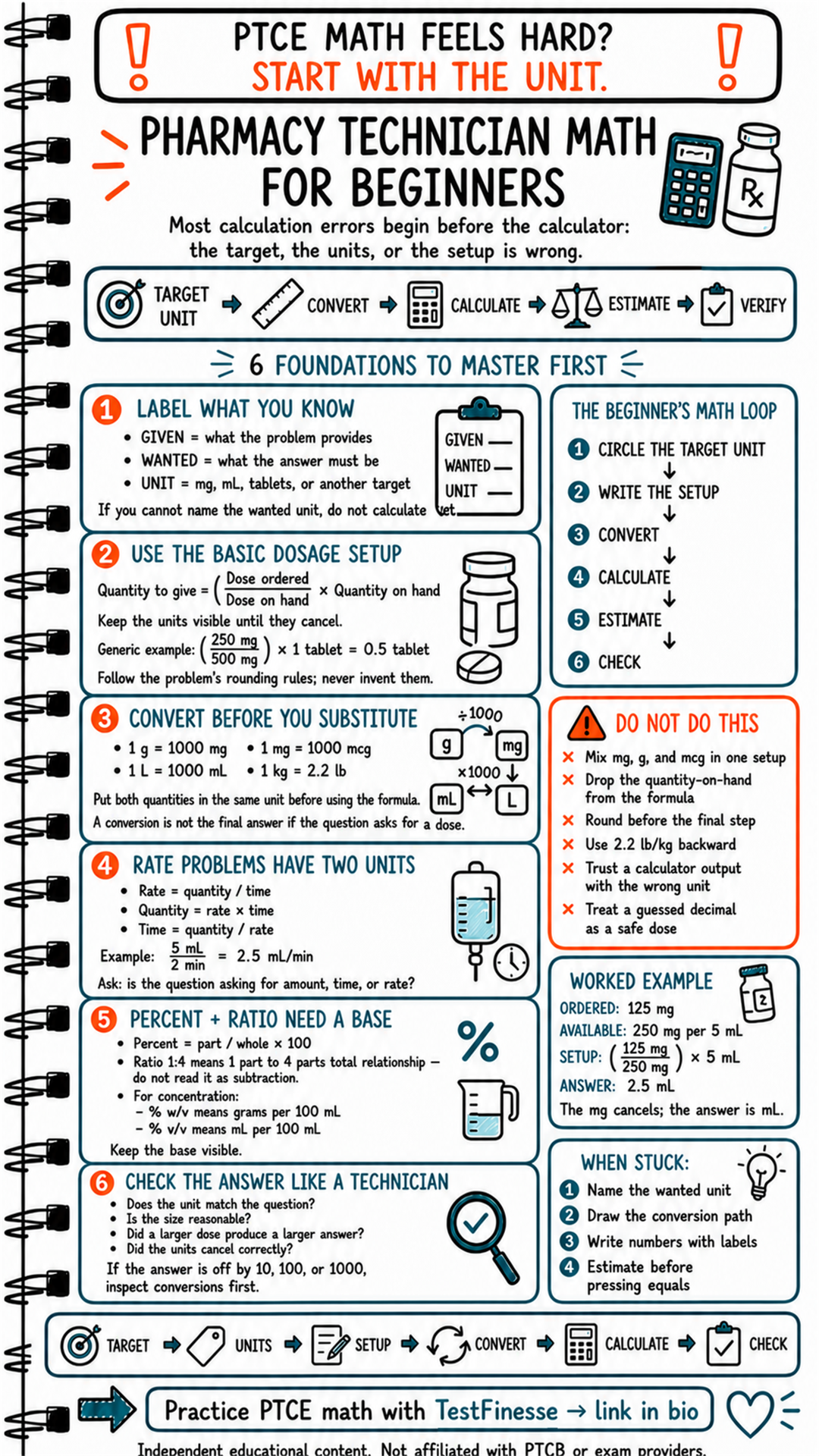
PTCE math can feel difficult when every problem seems to require a different formula. In reality, many pharmacy technician calculation questions use the same small group of relationships repeatedly.
The hardest part is often not pressing buttons on a calculator. It is identifying what the question is asking for, which units belong in the setup, and which relationship connects the information provided.
That is the central idea behind this study note:
Target unit → Convert → Calculate → Estimate → Verify
The current PTCB content outline includes calculation skills such as formulas, ratios, proportions, conversions, dose calculations, concentrations, and dilutions. These skills are tested as part of pharmacy technician knowledge, so building a reliable setup process is more useful than memorizing isolated equations. PTCB’s current PTCE Content Outline
1. Label What You Know
Before calculating, identify three things:
Given: What information does the problem provide?
Wanted: What quantity does the question ask you to find?
Unit: Should the answer be in milligrams, milliliters, tablets, capsules, units, or another measurement?
This simple labeling step prevents a common mistake: solving for a related number instead of the requested answer.
For example, a problem may give you:
A medication dose in milligrams
A concentration in milligrams per milliliter
A bottle quantity in milliliters
But the question may ask how many milliliters to administer.
The correct answer is not merely a converted milligram value. The answer must match the requested unit: mL.
A useful habit is to write the target unit at the top of your work before writing any numbers. This gives your calculation a destination.
Key takeaway: The requested unit should guide the setup.
2. Use the Basic Dosage Setup
For many introductory dosage problems, the core relationship is:
Quantity to give = (Dose ordered ÷ Dose on hand) × Quantity on hand
The units should remain visible until they cancel.
Consider this generic educational example:
Ordered: 125 mg
Available: 250 mg per 5 mL
The setup is:
(125 mg ÷ 250 mg) × 5 mL = 2.5 mL
The milligram units cancel, leaving milliliters as the answer.
This setup works because it connects the ordered dose to the available dose and then applies the matching quantity. The calculator only performs the arithmetic. It does not know whether the problem is asking for milliliters, tablets, or another quantity.
When practicing, avoid entering unexplained numbers into a calculator. First write the relationship, then substitute the values, and only then calculate.
Key takeaway: A calculator can evaluate a setup, but it cannot create the correct setup.
3. Convert Before You Substitute
A calculation can look mathematically correct and still be wrong because the units do not match.
Common metric relationships include:
1 g = 1,000 mg
1 mg = 1,000 mcg
1 L = 1,000 mL
1 kg ≈ 2.2 lb
The kilogram-to-pound relationship is an approximation, so follow the conversion required by the question, institution, or testing context.
Do not combine milligrams and grams in the same formula without converting one of them first. The same applies to micrograms and milligrams, liters and milliliters, or pounds and kilograms.
Dimensional analysis helps make the conversion visible. For example:
750 mcg × (1 mg ÷ 1,000 mcg) = 0.75 mg
The microgram units cancel, leaving milligrams.
A conversion is also not always the final answer. If a question asks for a dose in milliliters, converting milligrams to grams does not solve the problem. You still need to use the available concentration and complete the dosage setup.
Key takeaway: Convert into compatible units before applying the formula.
4. Recognize Rate Problems
Rate problems usually involve two related units, such as volume and time.
The three basic relationships are:
Rate = quantity ÷ time
Quantity = rate × time
Time = quantity ÷ rate
If a problem describes 5 mL delivered over 2 minutes, the rate is:
5 mL ÷ 2 min = 2.5 mL/min
Before calculating, ask which part is unknown:
Is the question asking for the amount?
Is it asking for the rate?
Is it asking how long the process will take?
The wording often reveals the relationship. Words such as “per minute,” “per hour,” “over,” “in,” and “how long” can help identify the structure.
Do not automatically multiply because two numbers appear next to each other. First determine whether the unknown belongs in the numerator or denominator.
Key takeaway: Rate problems are easier when you identify the two units and the missing piece.
5. Understand That Percent and Ratio Need a Base
Percent and ratio problems are not just about symbols. They depend on the base or relationship being described.
The basic percent relationship is:
Percent = part ÷ whole × 100
For percent change, the original amount is the base:
Percent change = change ÷ original × 100
That “original” denominator matters. Using the new amount instead can produce a different and incorrect result.
Ratio notation also requires careful reading. A ratio such as 1:4 expresses a relationship between parts. It is not subtraction, and it should not automatically be treated as a percentage without knowing the stated basis.
For concentration problems, pay attention to the notation:
% w/v: grams per 100 mL
% w/w: grams per 100 g
% v/v: milliliters per 100 mL
For example, 1% w/v means 1 gram per 100 mL. Since 1 gram equals 1,000 milligrams, that is equivalent to 10 mg/mL.
The denominator tells you what the strength means. A percentage by weight is not interpreted the same way as a percentage by volume.
Key takeaway: Never interpret a percent or ratio without identifying its base and units.
6. Check the Answer Like a Technician
After calculating, do not stop at the displayed decimal. Verify the result using several checks:
Does the final unit match the question?
Did the units cancel correctly?
Is the answer’s size reasonable?
Would a larger ordered dose produce a larger answer?
Is the decimal in a plausible range?
Did you accidentally reverse a conversion?
Did you round too early?
If an answer is off by a factor of 10, 100, or 1,000, inspect the conversions first. Large errors often come from confusing grams with milligrams, milligrams with micrograms, or liters with milliliters.
Rounding should follow the rules stated in the problem or the applicable educational, institutional, or prescription context. Do not invent a rounding rule, and do not assume that a calculator’s decimal is automatically an appropriate dose.
This is especially important in practice questions that ask for a specific measurement format. The final unit and required precision should match the blank being completed.
Common PTCE Math Mistakes to Avoid
Avoid these habits:
Mixing mg, g, and mcg in one setup
Dropping the quantity-on-hand from the dosage formula
Using the pounds-to-kilograms conversion backward
Rounding before the final calculation
Treating a conversion as the final answer
Using a percentage without identifying its denominator
Trusting a calculator result with the wrong unit
Guessing that a decimal is safe without checking the problem’s instructions
When You Are Stuck
Use the beginner’s math loop:
Circle the target unit.
Write the setup using labeled values.
Convert incompatible units.
Calculate only after the units are compatible.
Estimate the expected size.
Check the final unit and reasonableness.
This sequence turns a vague word problem into a series of smaller decisions.
Study PTCE Math With the TestFinesse Practice Loop
Practice questions become much more valuable when you study the reasoning behind each answer.
Use the TestFinesse loop:
Answer: Complete the problem before checking the explanation.
Explain: State why you chose the formula and what the target unit is.
Reveal: Compare your setup, conversion path, and arithmetic with the solution.
Fix the gap: Label the problem as a unit error, setup error, conversion error, formula error, or execution error.
If you repeatedly miss unit conversions, practice conversions instead of doing another random set of unrelated questions. If your setup is correct but your arithmetic is inconsistent, focus on estimation and final checks.
The goal is not simply to complete more calculations. It is to make the correct workflow automatic:
Target → Units → Setup → Convert → Calculate → Check
PTCE math becomes more manageable when you stop treating each question as a brand-new puzzle. Identify the requested unit, connect the given information with the correct relationship, keep units visible, and verify the final result.
Educational disclaimer: This article is for pharmacy technician exam preparation only. It is not patient-specific medical or dosing advice. Always follow the instructions provided by your pharmacist, training program, employer, facility, prescription, or applicable professional guidance. TestFinesse is independent educational content and is not affiliated with PTCB or any exam provider.
Accuracy sources checked: PTCB PTCE Content Outline, PTCB Certified Pharmacy Technician information, and PTCB CPhT Knowledge Reference.
Keep studying
Practice Exam Skills
Turn this into a better score
Reading about a skill only gets you so far. TestFinesse's AI coach walks you through exam questions, explains exactly where your reasoning breaks down, and adapts to what you actually need to practice next.
Explore All Exams