PTCE Cheat Sheet: Conversions and Key Pharmacy Math Formulas
Last updated August 10, 2026
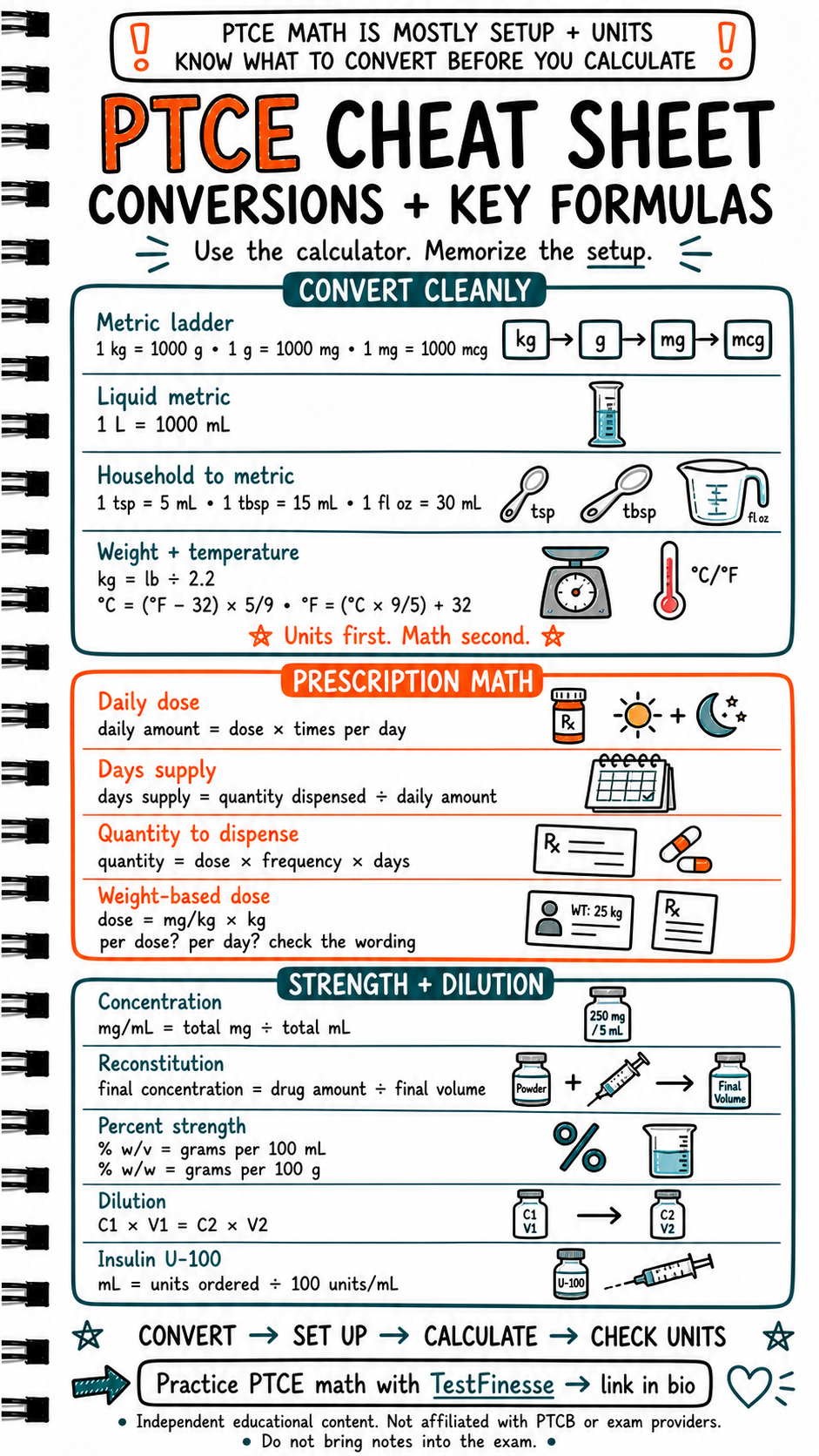
PTCE math is mostly setup and units.
Yes, you need to calculate. But on the Pharmacy Technician Certification Exam, many math mistakes happen before the calculator ever matters.
Students often miss questions because they:
Converted too late
Used the wrong unit
Mixed mg and mcg
Confused daily dose with total quantity
Used the wrong final volume
Forgot that U-100 insulin means 100 units per mL
The calculator can handle arithmetic.
Your job is to know what to convert, how to set up the problem, and how to check whether the answer makes sense.
Use this as a study cheat sheet before the PTCE. Do not bring notes into the exam. PTCB provides a built-in calculator, and personal calculators are not allowed except under specific test-center conditions described by PTCB.
Convert Cleanly
Before you calculate, make the units match.
A good PTCE math order is:
Convert
Set up
Calculate
Check units
That order prevents most avoidable pharmacy math errors.
Metric Ladder
Know the common metric ladder:
1 kg = 1,000 g
1 g = 1,000 mg
1 mg = 1,000 mcg
This matters because medication strengths often move between grams, milligrams, and micrograms.
For example:
0.5 g = 500 mg
250 mcg = 0.25 mg
The trap is assuming the number is the hard part. Usually, the unit is the hard part.
Liquid Metric
Know:
1 L = 1,000 mL
This conversion shows up in liquid medications, IV volumes, compounding, and concentration problems.
Example:
0.25 L = 250 mL
If the final answer asks for mL, convert liters before calculating.
Household To Metric
Common pharmacy study conversions include:
1 tsp = 5 mL
1 tbsp = 15 mL
1 fl oz = about 30 mL
Technically, 1 U.S. fluid ounce is about 29.57 mL, but pharmacy math problems commonly use 30 mL unless a question gives a more specific conversion.
Also remember:
1 tbsp = 3 tsp
So:
1 tbsp = 15 mL
and
3 tsp = 15 mL
Weight And Temperature
For weight:
kg = lb ÷ 2.2
Example:
154 lb ÷ 2.2 = 70 kg
For temperature:
°C = (°F - 32) × 5/9
°F = (°C × 9/5) + 32
Weight matters for weight-based dosing. Temperature matters for storage, conversions, and certain medication handling questions.
Prescription Math
Prescription math is where setup matters most.
Do not rush to multiply numbers until you know what the question is asking.
Daily Dose
Formula:
Daily amount = dose × times per day
Example:
A patient takes 1 tablet twice daily.
1 tablet × 2 times daily = 2 tablets per day
If the prescription says 2 capsules three times daily:
2 capsules × 3 = 6 capsules per day
Always translate the sig before calculating.
Days Supply
Formula:
Days supply = quantity dispensed ÷ daily amount
Example:
Quantity dispensed: 60 tablets
Directions: 1 tablet twice daily
Daily amount:
1 × 2 = 2 tablets per day
Days supply:
60 ÷ 2 = 30 days
The key is to calculate the daily amount first.
Quantity To Dispense
Formula:
Quantity = dose × frequency × days
Example:
Directions: 1 tablet twice daily for 10 days
1 × 2 × 10 = 20 tablets
Be careful: this shortcut works cleanly when the dose is already expressed in the final dosage unit, such as tablets or capsules.
For liquids, you may need to calculate mL per dose first using the medication concentration.
Weight-Based Dose
Formula:
Dose = mg/kg × kg
Example:
Order: 10 mg/kg
Patient weight: 25 kg
10 × 25 = 250 mg
Then check the wording:
Is that per dose?
Is that per day?
How many doses per day?
Does the final answer need mg, mL, tablets, or total quantity?
Weight-based questions often have more than one step.
Strength And Dilution
These formulas help with concentration, reconstitution, percent strength, dilution, and insulin calculations.
Concentration
Formula:
mg/mL = total mg ÷ total mL
Example:
A bottle contains 250 mg in 5 mL.
250 ÷ 5 = 50 mg/mL
Once you know the concentration, you can calculate how many mL are needed for a dose.
Reconstitution
Formula:
Final concentration = drug amount ÷ final volume
The important phrase is final volume.
If a powder is mixed with diluent, the final volume may not always equal the diluent volume. Use the final volume given in the question or on the label.
Example:
A reconstituted medication contains 500 mg in a final volume of 10 mL.
500 ÷ 10 = 50 mg/mL
Percent Strength
Percent strength depends on the type of product.
For weight/volume:
% w/v = grams per 100 mL
For weight/weight:
% w/w = grams per 100 g
Example:
A 5% w/v solution contains:
5 g per 100 mL
This is a common pharmacy math concept, especially for solutions and compounding-style questions.
Dilution
Formula:
C1 × V1 = C2 × V2
Use this when the amount of drug stays the same but concentration and volume change.
Where:
C1 = starting concentration
V1 = starting volume
C2 = final concentration
V2 = final volume
The most common mistake is solving for the wrong variable.
Before calculating, write what each part represents.
Insulin U-100
U-100 insulin means:
100 units per mL
Formula:
mL = units ordered ÷ 100 units/mL
Example:
Order: 25 units
25 ÷ 100 = 0.25 mL
Insulin questions are safety-sensitive. Always check the unit, concentration, and syringe wording carefully.
How To Avoid PTCE Math Mistakes
Use this checklist:
Convert units before calculating
Match the final answer unit
Translate the sig carefully
Calculate daily amount before days supply
Use final volume for reconstitution
Check whether weight-based dosing is per dose or per day
Know that U-100 means 100 units/mL
Use the calculator for arithmetic, not setup
Check whether the answer size makes sense
A strange answer usually means the setup needs another look.
Final Takeaway
PTCE math is not about memorizing every possible problem.
It is about recognizing the setup.
Know these core tools:
Metric conversions
Household-to-metric conversions
Pounds to kilograms
Temperature formulas
Daily dose
Days supply
Quantity to dispense
Weight-based dose
Concentration
Reconstitution
Percent strength
Dilution
U-100 insulin
The calculator helps with numbers.
But the score comes from the setup.
Convert first. Set up carefully. Calculate second. Check units last.
Educational note: This is independent PTCE study content, not pharmacy practice guidance. Always follow your training program, pharmacist supervision, workplace policies, state law, and PTCB rules.
Accuracy sources checked: PTCB PTCE Content Outline, PTCB CPhT Exam At-a-Glance, PTCB Calculator Policy, OpenStax Dosage Calculations, NCBI StatPearls Pharmacy Calculations, and Merck Manual Conversion Table.
Keep studying
Practice Exam Skills
Turn this into a better score
Reading about a skill only gets you so far. TestFinesse's AI coach walks you through exam questions, explains exactly where your reasoning breaks down, and adapts to what you actually need to practice next.
Explore All Exams