Protect the Hours That Actually Count: Build a Study Plan Around Real Time, Not Equal Time
Last updated August 18, 2026
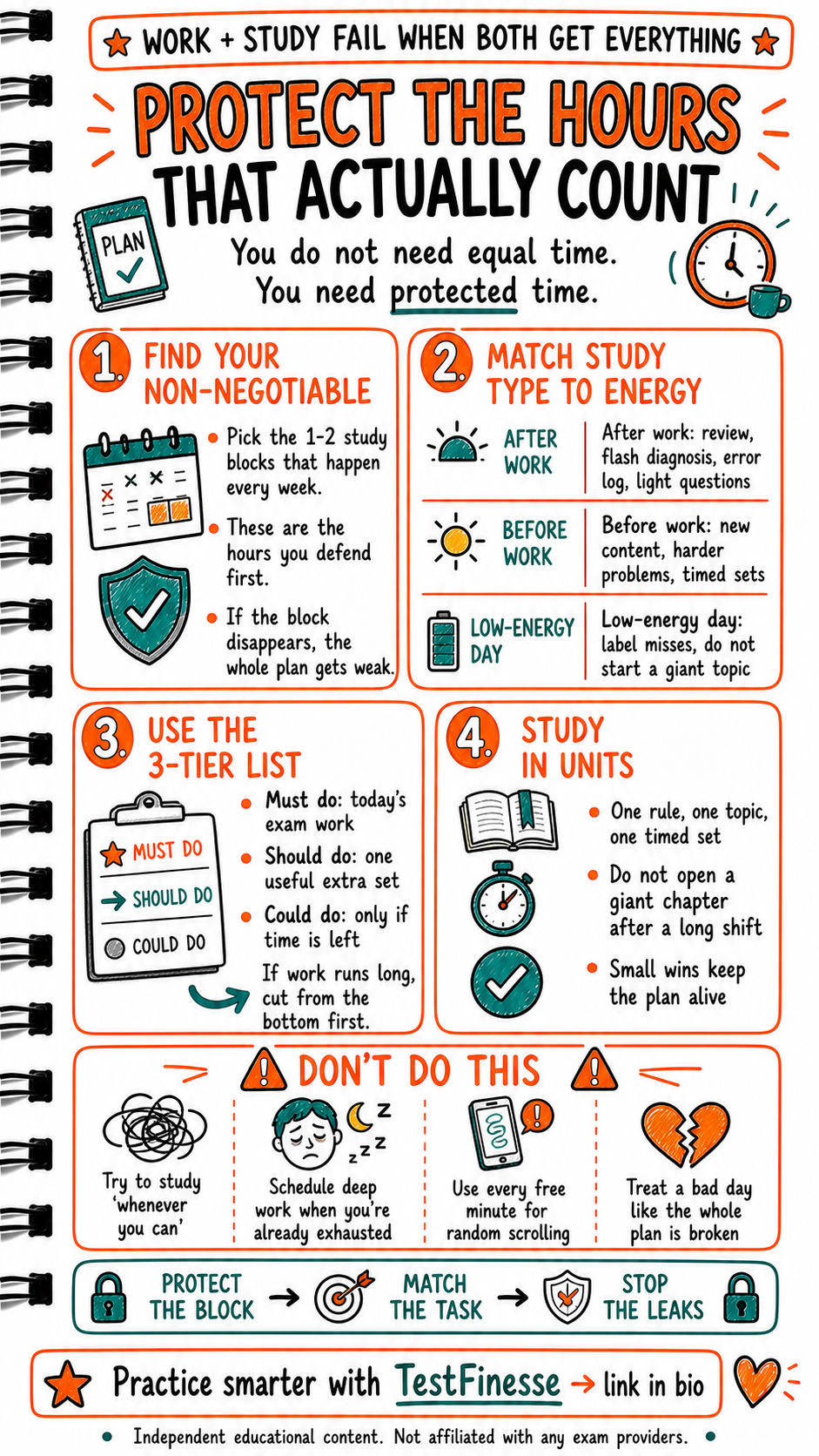
Work and study fail when both get everything.
That is the real problem. Students often build schedules as if every hour has the same value and every task deserves the same energy. But real life is not that even. Some hours are protected. Some are thin. Some are high-energy. Some are recovery hours. If you treat them all the same, the plan gets squeezed until it breaks.
The better move is not equal time.
It is protected time.
That means choosing the hours that matter most, then matching the kind of work to the kind of energy you actually have. That is how you keep the plan alive long enough to produce results.
Why Equal Time Fails
A lot of people try to make work and study coexist by giving everything a little bit of attention.
That sounds fair, but it usually creates three problems:
the best hours get consumed by low-value tasks
the hardest tasks get scheduled when energy is already gone
the whole week starts to feel crowded and fragile
A better system has boundaries. It makes a few blocks non-negotiable, keeps the study tasks realistic, and trims from the bottom when life gets full.
1. Find Your Non-Negotiable Blocks
Pick the 1 to 2 study blocks that happen every week.
These are the hours you defend first.
Not the ideal hours. Not the “if everything goes perfectly” hours. The real blocks that reliably exist.
Ask:
When do I actually have repeatable time?
Which blocks can I protect every week?
Which hours are most likely to disappear if I do not defend them?
These blocks are the backbone of the plan. If they disappear, the whole schedule gets weak.
TestFinesse rule: Protect the blocks before you protect the extras.
2. Match Study Type To Energy
Not every study task belongs in every time slot.
You need to match the work to the energy you have.
After Work
After work energy is usually better for:
review
flash diagnosis
error logs
light questions
cleanup
short, controlled practice
After work is usually not the best time for a giant new topic or a brutal new skill set. Your brain may be tired enough that the session turns into friction instead of progress.
Before Work
Before work energy is usually better for:
new content
harder problems
timed sets
fresh learning
deep focus
Before work can be a strong study window because the mind is often less cluttered and less drained.
Low-Energy Day
On a low-energy day, do not start a giant topic.
Use the day to:
label misses
review one rule
do a small targeted set
keep momentum alive
protect the schedule from collapse
Energy rule: Match the size of the task to the size of the energy.
3. Use The 3-Tier List
Not all tasks belong in the same bucket.
Use three levels:
Must do: today’s exam work
Should do: one useful extra set
Could do: only if time is left
That hierarchy protects the plan from overreach.
When the day runs long, cut from the bottom first.
Do not cut the core block. Do not cut the work that keeps the plan moving. Cut the optional layer first.
That is how you stop a busy day from becoming a lost day.
TestFinesse rule: Protect must-do first. Trim from the bottom.
4. Study In Units
One rule, one topic, one timed set.
That is the right unit size for a sustainable plan.
A lot of students open a giant chapter after a long work shift and then wonder why the session feels impossible. The problem is not that they are lazy. The problem is that the unit is too large for the available energy.
Smaller study units keep the plan alive.
Good units look like:
one formula family
one passage type
one review log
one missed concept
one timed set
one short drill
Small wins are not small in impact. They are what keep the system from breaking.
Unit rule: Make the unit small enough to finish cleanly.
What Not To Do
The warning section in the image is exactly right.
Do not:
study whenever you can with no real plan
schedule deep work when you are already exhausted
use every free minute for random scrolling
treat a bad day like the whole plan is broken
Those habits create a plan that looks busy but feels unstable.
A strong schedule is not a perfect schedule. It is a protected one.
Why This Works
This strategy works because it respects reality.
You are not an unlimited-energy machine. Work days differ. Study days differ. Sleep differs. Stress differs. If your plan assumes equal energy every day, it will eventually fail under normal life.
But if you build around:
protected blocks
matched energy
a 3-tier list
smaller study units
you create a schedule that can survive real life.
That is the difference between a plan that sounds good and a plan that actually gets used.
Use The TestFinesse Practice Loop
The TestFinesse method is:
Answer
Explain
Reveal
Fix the gap
For a time-and-energy plan, use it like this:
Answer: What is the most important block today?
Explain: What energy do I actually have right now?
Reveal: Is this the right task size for this window?
Fix the gap: What should I protect, shrink, or move?
That turns scheduling into a decision system instead of a guilt system.
Final Takeaway
You do not need equal time.
You need protected time.
Use your best blocks for the work that matters, match the task to the energy you actually have, and cut from the bottom when the day gets long.
Protect the block. Match the task. Stop the leaks.
Educational content only. Not affiliated with any exam providers.
Keep studying
Practice Exam Skills
Turn this into a better score
Reading about a skill only gets you so far. TestFinesse's AI coach walks you through exam questions, explains exactly where your reasoning breaks down, and adapts to what you actually need to practice next.
Explore All Exams