Practice Score Plateau Audit: Find the Leak Before Taking Another Test
Last updated August 11, 2026
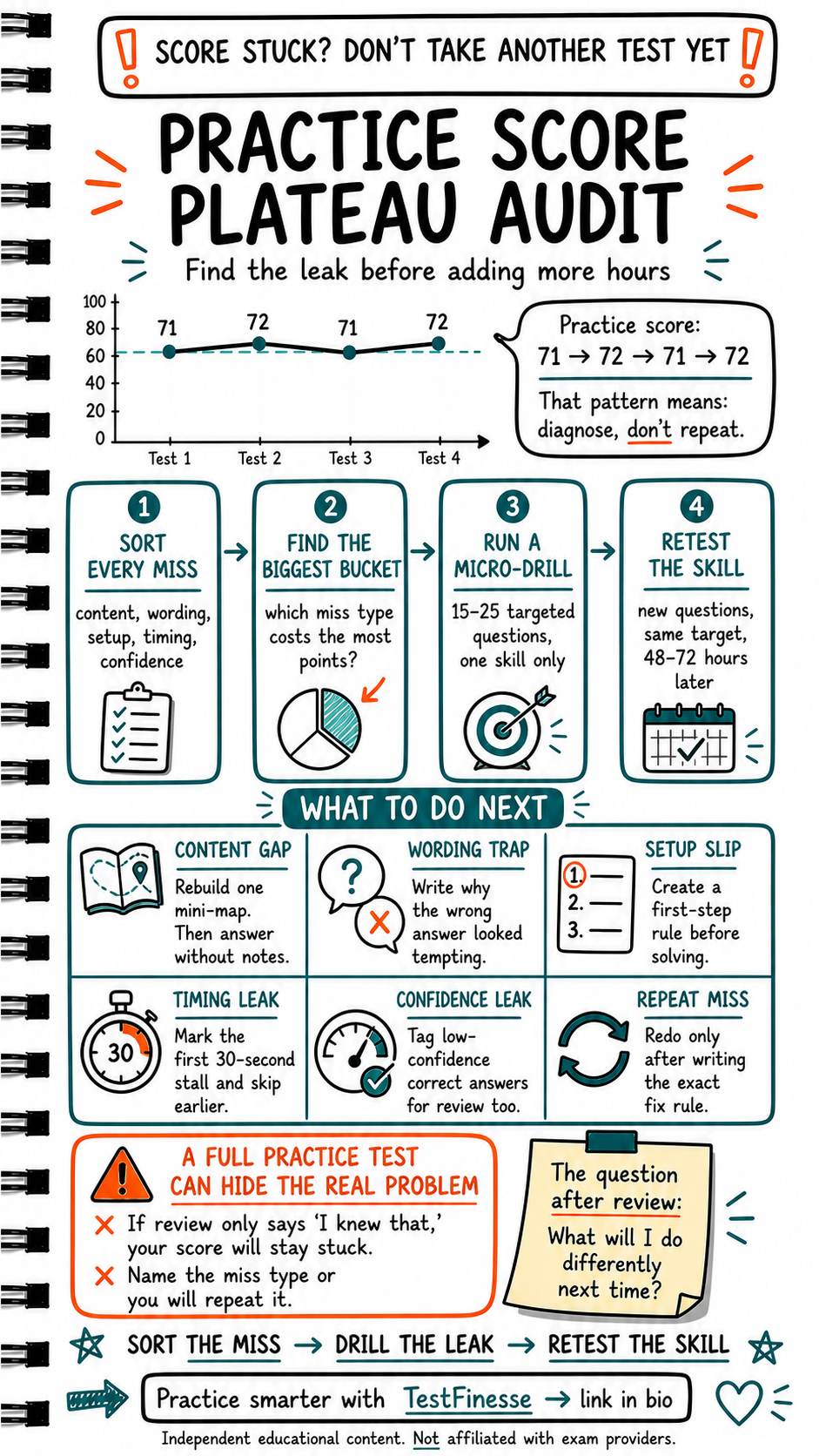
A practice score plateau can feel like proof that you are not improving. You take one practice test, score around the same number, take another test, and end up right back where you started.
But a flat score does not always mean your studying is failing.
It often means your review process is too vague.
If your practice scores look like:
71 → 72 → 71 → 72
that pattern is not telling you to take another full test immediately. It is telling you to stop, diagnose, and find the leak.
The TestFinesse rule is simple:
Find the leak before adding more hours.
More practice is only useful when it targets the real problem. If every review ends with “I knew that,” “I just made a silly mistake,” or “I’ll do better next time,” the score will usually stay stuck. A plateau breaks when every miss becomes a category, every category becomes a drill, and every drill gets retested.
Why Full Practice Tests Can Hide The Real Problem
Full practice tests are useful, but they are not always the best next move.
A full test gives you a big score number. It may show whether you are generally improving, but it does not automatically show why you missed points.
A student might miss questions because of:
Content gaps
Wording traps
Setup slips
Timing leaks
Low-confidence correct answers
Repeat misses
Those are different problems. They need different fixes.
If you treat every miss the same way, your review becomes passive. You read explanations, nod along, and move on. That feels productive, but it does not change your next decision under pressure.
A plateau audit makes the work visible.
1. Sort Every Miss
Start by sorting every missed question into a clear bucket.
Use categories like:
Content: You did not know the rule, formula, process, term, or concept.
Wording: You knew the topic, but the question’s phrasing pulled you toward the wrong answer.
Setup: You understood the concept, but your first step was wrong.
Timing: You spent too long, rushed, guessed late, or ran out of time.
Confidence: You got it right but were unsure, lucky, or unable to explain why.
This step matters because “wrong” is not a diagnosis.
A missed question should never end as just a red X. It should become a sentence:
“I missed this because I skipped the unit conversion.”
“I missed this because I answered the opposite of what the stem asked.”
“I missed this because I knew the concept but started with the answer choices too soon.”
“I missed this because I spent three minutes on a low-value item.”
That level of labeling turns practice into data.
2. Find The Biggest Bucket
After sorting, look for the bucket that costs you the most points.
Do not automatically study the topic that feels most annoying. Study the leak that shows up most often.
Ask:
Which miss type appears again and again?
Which miss type costs the most easy points?
Which miss type shows up across multiple sections?
Which miss type still happens after review?
Your biggest bucket is your next study priority.
For example, if most misses are content gaps, you need targeted review. If most misses are wording traps, another chapter of content may not help. If most misses are timing leaks, untimed practice may be hiding the real issue.
The goal is not to study more. The goal is to study the score leak.
3. Run A Micro-Drill
Once you know the biggest bucket, run a small, targeted drill.
A micro-drill is not another full practice test. It is a focused set of questions designed to train one skill.
A strong micro-drill might be:
15-25 targeted questions
One skill only
Same question type
Same trap pattern
Immediate review after the set
This works because it gives your brain repeated exposure to the same decision. You are not just hoping to improve; you are training the exact move that broke down.
If your leak is word problems, drill setup.
If your leak is inference questions, drill proof.
If your leak is dosage math, drill unit cancellation.
If your leak is timing, drill the first 30 seconds of decision-making.
Micro-drills are how you convert a vague weakness into a trainable behavior.
4. Retest The Skill
After the micro-drill, do not immediately declare the problem fixed.
Retest it.
Use:
New questions
The same skill target
A short delay, ideally 48-72 hours later
The same rules you will use on test day
This delayed retest matters because immediate redo work can create false confidence. You may remember the answer, the explanation, or the exact trap. That does not prove you can solve a fresh version later.
A true retest asks:
Can I recognize the same skill in a new question after time has passed?
That is what breaks the plateau.
What To Do Next By Miss Type
Different leaks need different fixes. Use the audit to choose the next move.
Content Gap
If the issue is content, rebuild one small mini-map.
Do not reread an entire chapter automatically. Instead, make a compact map of:
The rule
The formula or process
The common clue words
One example
One trap
Then answer without notes.
Fix rule: Rebuild the concept until you can use it, not just recognize it.
Wording Trap
If the issue is wording, write why the wrong answer looked tempting.
This is where many students skip the most valuable part of review. They only ask, “Why is the right answer right?” But the plateau often lives in the tempting wrong answer.
Ask:
What word pulled me in?
Did I answer a different question?
Did I miss “except,” “least,” “most likely,” or “best”?
Did the wrong answer sound familiar but fail the task?
Fix rule: Study the trap, not just the correct answer.
Setup Slip
If the issue is setup, create a first-step rule.
Examples:
“Before solving, label the units.”
“Before reading answer choices, identify the task.”
“Before using a formula, write what is given and what is asked.”
“Before algebra, translate the sentence into variables.”
Setup slips usually happen before the hard work begins. That means the fix has to happen before solving too.
Fix rule: Train the first move.
Timing Leak
If the issue is timing, mark the first 30-second stall.
Do not only record that you “ran out of time.” Find the moment when the time leak started.
Ask:
When did I stop making progress?
Did I keep rereading?
Did I refuse to guess and move?
Did I spend too long trying to rescue one question?
A timing leak needs a skip rule.
Fix rule: Notice the stall earlier and protect the rest of the section.
Confidence Leak
If the issue is confidence, tag low-confidence correct answers for review too.
Correct answers can hide weak reasoning. If you guessed correctly, eliminated poorly, or could not explain the answer, that item still belongs in the audit.
Track:
Correct but unsure
Correct by elimination only
Correct with no clear rule
Correct but too slow
Fix rule: Review shaky correct answers before they become future misses.
Repeat Miss
If the same miss happens again, do not redo it instantly.
First, write the exact fix rule.
Then redo later with a new version of the skill.
A repeat miss usually means the explanation made sense, but the behavior did not change.
Fix rule: No redo without a next-time rule.
The Question After Review
After every practice set, ask one question:
What will I do differently next time?
Not “Do I understand now?”
Not “Did I read the explanation?”
Not “Was that a silly mistake?”
A useful review ends with a behavior change.
Examples:
“I will underline the task before reading answer choices.”
“I will convert units before calculating.”
“I will flag after 60 seconds with no setup.”
“I will write the rule before checking the explanation.”
“I will review low-confidence correct answers.”
That is how practice becomes progress.
Use The TestFinesse Practice Loop
The TestFinesse method is:
Answer
Explain
Reveal
Fix the gap
For a score plateau, add one extra layer:
Sort the miss → drill the leak → retest the skill
This turns review from passive explanation-reading into a repeatable improvement system.
Final Takeaway
If your score is stuck, do not rush into another full test just to collect the same number again.
Pause and audit.
Sort every miss. Find the biggest bucket. Run a micro-drill. Retest the skill later.
A plateau is not a verdict. It is a signal that your study plan needs a sharper target.
Sort the miss → drill the leak → retest the skill.